
At 9:00 a.m., a clinic receptionist may already be answering phone calls, checking in patients, confirming appointments, responding to scheduling requests, and helping people at the front desk.
Then another call comes in.
For many healthcare practices, this is the real operational challenge. The issue is not that human receptionists are ineffective. It is that patient communication can outpace the time available to handle it.
This is why more practices are evaluating the best AI receptionist in the USA and asking whether AI can manage routine patient communication more efficiently than a traditional front desk.
The answer is not simply AI versus humans.
AI can provide continuous availability, manage repetitive requests, and support high volumes of routine interactions. Human receptionists bring empathy, judgment, flexibility, and the ability to respond to situations that do not fit a defined workflow.
This guide compares both approaches and examines how healthcare AI solutions in the USA can support a more efficient front desk without removing human support where it matters most.
What Does an AI Receptionist Do in a Healthcare Practice?
The best AI receptionist in the USA should do more than answer incoming calls.
A healthcare-focused AI receptionist can identify why a patient is contacting the practice and guide the interaction toward an appropriate administrative workflow.
Depending on the platform and configuration, this may include:
- Answering incoming patient calls
- Supporting routine administrative questions
- Booking appointments
- Managing rescheduling and cancellations
- Confirming appointments
- Sending reminders
- Capturing relevant information
- Routing calls to the appropriate team
- Supporting after-hours communication
- Escalating complex or unusual requests to staff
MantraAssist, for example, describes its AI Receptionist as supporting 24/7 call handling, appointment booking, multilingual communication, and warm transfers when human assistance is needed.
Unlike a traditional phone tree, conversational AI can allow patients to explain their needs in their own words.
A patient may simply say, “I need to change my appointment,” rather than navigating multiple menu options. The system can then identify the request and move toward the relevant workflow.
This is one reason practices searching for the best AI receptionist in the USA are increasingly looking beyond traditional IVR systems.
AI Receptionist vs Human Receptionist: The Core Difference
The primary difference is not simply technology versus people.
It is the type of work each approach handles most effectively.
AI generally performs best when interactions are repetitive, rule-based, and connected to clearly defined workflows. Human receptionists are particularly valuable when conversations require empathy, judgment, flexibility, or complex problem-solving.
| Area | AI Receptionist | Human Receptionist |
|---|---|---|
| Availability | Can support configured patient communication beyond standard office hours | Limited by scheduled working hours |
| Routine Calls | Can manage high volumes of repetitive requests | May become overloaded during busy periods |
| Appointment Scheduling | Can support configured booking and scheduling workflows | Can handle complex scheduling situations and exceptions |
| Consistency | Follows configured workflows consistently | Performance may vary depending on workload and circumstances |
| Complex Requests | Requires escalation when outside defined workflows | Can use judgment and adapt to unusual situations |
| Patient Empathy | Can communicate conversationally but does not replace human empathy | Better suited for emotionally sensitive conversations |
| Multitasking | Can support multiple eligible interactions simultaneously | Must divide attention between calls and in-person patients |
| Workflow Changes | Requires configuration and updates | Can adapt using experience and judgment |
The most useful question for a practice is therefore not:
Which is better?
It is:
Which patient interactions require human judgment, and which are repetitive enough to automate?
Where AI Receptionists Have an Advantage
AI receptionists are particularly effective at managing high-volume, repetitive, and clearly defined patient communication workflows.
24/7 Availability
A traditional receptionist works according to scheduled office hours.
An AI receptionist can support configured patient communication outside standard business hours.
This can be valuable for practices that receive appointment requests in the evening, early morning, or on weekends.
Patients do not always contact their healthcare provider when the front desk is open. An automated workflow may allow eligible appointment requests to be handled immediately rather than waiting until the next business day.
MantraAssist states that its AI Receptionist can answer calls day or night and support scheduling and human handoffs when needed.
Managing High Call Volumes
One of the strongest use cases for the best AI receptionist in the USA is handling high volumes of routine patient communication.
Front-desk teams may spend a significant part of the day answering questions about appointments, cancellations, provider availability, reminders, locations, and other administrative matters.
When several calls arrive at the same time, a human receptionist has limited capacity to manage them simultaneously.
AI can help handle eligible routine interactions and route more complex requests to staff.
This can be especially useful for growing practices where patient communication volume increases without a corresponding expansion of the front-desk team.
For organizations dealing with larger call volumes, a broader healthcare call center automation solution can also support routine call handling, intelligent routing, and escalation workflows. MantraAssist describes these workflows as automating routine administrative calls while routing complex or clinical interactions to appropriate human teams.
Consistent Workflow Execution
Healthcare front desks often operate according to scheduling rules, provider preferences, communication procedures, and escalation requirements.
AI follows the workflow and rules configured for it.
This can help create more consistent handling of routine requests, particularly for larger practices with multiple providers, departments, or locations.
Consistency can become increasingly important as organizations grow and need to standardize how common patient requests are handled.
Where Human Receptionists Have an Advantage
AI does not eliminate the value of human receptionists.
In healthcare, people remain essential for many interactions.
Empathy and Emotional Understanding
Healthcare conversations can be stressful.
A patient may be anxious, frustrated, confused, or dealing with a sensitive situation.
Human receptionists can respond with emotional awareness and adjust their communication based on context and tone.
AI can support conversational communication, but it should not be viewed as a replacement for genuine human empathy.
Complex Problem-Solving
Not every patient request follows a predictable workflow.
A scheduling issue may involve multiple providers. A patient may have an unusual administrative problem. A family member may call on behalf of someone else.
Human staff can assess these situations and adapt.
This is why the best AI receptionist in the USA should have clearly defined escalation capabilities rather than attempting to resolve every conversation independently.
Handling Unusual Situations
Healthcare practices regularly encounter situations that are difficult to anticipate.
Patients may explain problems in unexpected ways, request exceptions, or require coordination across multiple departments.
Human receptionists can use context and judgment to determine the next step.
AI works best when it knows when to hand the interaction over.
MantraAssist specifically describes escalation as part of its healthcare AI approach, with unusual or complex interactions routed to the appropriate person rather than handled through guesswork.
The Patient Experience: AI vs Human Interaction
Patient experience is one of the biggest concerns when healthcare practices consider automation.
Some organizations worry that AI will make communication feel impersonal.
That can happen when automation is poorly designed.
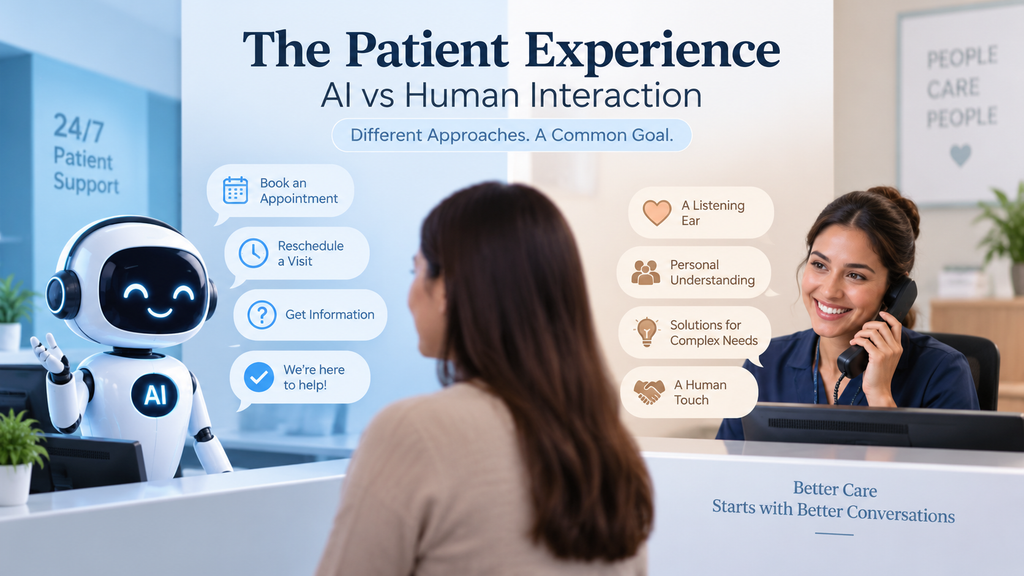
A frustrating automated experience often occurs when the system:
- Does not understand the patient’s request
- Repeats irrelevant responses
- Cannot transfer the patient to a person
- Forces patients through unnecessary menus
- Attempts to manage situations outside its capabilities
The strongest healthcare AI solutions in the USA should therefore focus on making routine interactions easier rather than forcing every patient through automation.
For a simple appointment request, immediate assistance may be more convenient than waiting on hold.
For a sensitive or complicated issue, human support may be the better option.
The patient experience improves when technology is used selectively.
AI Receptionists and Appointment Scheduling
Appointment scheduling is one of the clearest areas where AI can support healthcare practices.
Receptionists frequently receive questions such as:
- “Do you have an appointment this week?”
- “Can I reschedule?”
- “What times are available?”
- “Can I see a different provider?”
- “I need to cancel my appointment.”
Many of these requests follow repeatable workflows.
An AI receptionist connected to the appropriate scheduling system can support booking, rescheduling, cancellations, confirmations, reminders, and waitlist workflows based on configured practice rules.
Human staff can then focus on scheduling situations involving exceptions or additional coordination.
MantraAssist’s AI appointment scheduling software describes capabilities including automated booking, rescheduling, cancellations, reminders, calendar synchronization, and waitlist management across multiple communication channels.
Practices evaluating the best AI receptionist in the USA should therefore look beyond whether the system can answer a scheduling question.
The more important consideration is whether it can support the actual scheduling workflow.
Cost and Staffing Considerations
Hiring additional front-desk staff involves more than salary.
Healthcare practices may also need to consider recruitment, onboarding, training, benefits, staff turnover, and coverage during absences.
AI can change the staffing equation by automating some repetitive, high-volume administrative work.
However, automation should not be viewed only as a cost-reduction strategy.
Its greater value may come from allowing existing staff to spend more time on work that genuinely requires people.
For example, if routine appointment requests are handled through automation, front-desk staff may have more capacity to:
- Assist patients in person
- Resolve complicated scheduling problems
- Coordinate with other departments
- Respond to unusual requests
- Manage patient concerns requiring personal attention
This is why a hybrid approach can be more practical than attempting to automate every interaction.
The Best Model for Most Healthcare Practices: AI + Human Staff
For many U.S. healthcare practices, the strongest option is not an AI-only or human-only front desk.
It is a hybrid model.
AI handles appropriate routine interactions, while human staff remains responsible for conversations requiring judgment, empathy, or deeper problem-solving.
AI Can Handle
- Routine appointment requests
- Rescheduling and cancellations
- Basic administrative questions
- Appointment confirmations
- Automated reminders
- After-hours requests
- Initial call routing
Human Staff Can Handle
- Complex scheduling issues
- Sensitive conversations
- Patient complaints
- Unusual requests
- Administrative exceptions
- Situations requiring professional judgment
- Interactions requiring clinical escalation
This model allows practices to use automation without removing human support where it matters most.
The best AI receptionist in the USA should complement the front desk rather than simply attempt to replace it.
How to Choose the Right AI Receptionist
Healthcare practices should begin with their operational challenges rather than a technology feature list.
What Percentage of Calls Are Routine?
Analyze why patients contact the practice.
If a significant percentage of calls involve scheduling, cancellations, reminders, or routine information, these workflows may be strong candidates for automation.
Can the System Work With Existing Technology?
An AI receptionist should reduce administrative work rather than create duplicate data entry.
Practices should evaluate how the platform connects with relevant scheduling systems, communication tools, calendars, EHRs, and other technology.
MantraAssist states that its platform is designed to work alongside existing healthcare technology stacks and lists integrations with several commonly used healthcare systems.
What Happens When AI Cannot Resolve a Request?
This is one of the most important questions to ask.
The platform should have clear escalation rules and provide a path to the appropriate staff member when a request is complex, unusual, or outside the configured workflow.
Does It Fit the Practice’s Patient Population?
Practices should consider factors such as:
- Language requirements
- Communication preferences
- Call volume
- Appointment complexity
- Number of providers
- Number of locations
- Specialty-specific workflows
Can It Scale With the Practice?
The best AI receptionist in the USA should support current requirements while allowing the organization to expand workflows as patient volume, providers, or locations increase.
How Healthcare AI Fits Into Broader Practice Automation
An AI receptionist does not need to operate as an isolated tool.
It can become part of a broader patient communication and administrative automation strategy.
For example:
- A patient contacts the practice.
- AI identifies the purpose of the interaction.
- The appropriate workflow begins.
- The appointment is scheduled or updated.
- A confirmation is sent.
- Automated reminders follow.
- The patient can reschedule when appropriate.
- Complex requests are escalated to staff.
This connected approach is one reason practices are increasingly evaluating healthcare AI solutions in the USA as part of broader operational automation.
MantraAssist offers healthcare-focused AI workflows across patient communication, appointment scheduling, reminders, follow-ups, call handling, and other administrative processes. Its AI team is positioned around combining automated workflows with human oversight and escalation where needed.
Explore MantraAssist healthcare automation
AI Receptionist vs Human Receptionist: Which Is Better?
There is no universal winner.
A human receptionist is better suited to situations requiring empathy, judgment, flexibility, and complex problem-solving.
AI is better suited to high-volume, repetitive, and clearly defined workflows.
The strongest healthcare operations can combine both.
The best AI receptionist in the USA should help manage routine work that consumes significant front-desk time while allowing human staff to focus on patients and situations where personal attention matters most.
For many practices, the question is no longer whether AI will completely replace a receptionist.
The better question is:
How can AI help receptionists spend less time on repetitive administrative work and more time on patients who need them?
That is where healthcare AI solutions in the USA can provide meaningful operational value.
Frequently Asked Questions
AI can automate many routine administrative interactions, but human receptionists remain important for complex, sensitive, and unusual situations. A hybrid AI and human model is often more practical for healthcare practices.
Depending on the platform and configuration, an AI receptionist can support routine calls, appointment scheduling, rescheduling, cancellations, reminders, basic administrative questions, and call routing.
Practices should evaluate conversational capabilities, scheduling workflows, integrations, escalation paths, security requirements, scalability, and how well the system fits existing patient communication processes.

