
Hospitals and clinics across the United States are under pressure to do more with increasingly complex operations. Staff must manage patient calls, appointment scheduling, referrals, documentation, billing workflows, follow-ups, data exchange, and coordination across multiple departments—often while working across disconnected systems.
The result is familiar: administrative teams spend significant time moving information between platforms, patients wait for responses, and routine workflows depend heavily on manual intervention.
A modern healthcare automation platform in the USA can help address these challenges by connecting workflows and automating repetitive tasks. However, hospitals and clinics do not all need the same type of technology.
A large health system may need enterprise process orchestration across clinical, financial, and operational departments. A growing outpatient organization may need to automate patient communication and scheduling first.
This guide compares the types of platforms healthcare organizations should consider, including options for large hospitals, clinics, and organizations looking for AI-powered patient communication. It also examines what to look for when evaluating the best healthcare process automation platforms for large hospitals and the best AI chatbot platforms for automating appointment scheduling in healthcare.
Why Healthcare Organizations Are Investing in Automation
Healthcare automation is no longer limited to isolated tasks.
Organizations are increasingly looking for ways to connect workflows across patient access, administration, clinical operations, and financial processes. The objective is not simply to automate individual activities. It is to reduce the number of manual steps required to complete an end-to-end process.
For example, a patient scheduling workflow may involve:
- Answering the initial call or message
- Understanding the patient’s request
- Checking provider availability
- Confirming eligibility for the appointment type
- Booking the appointment
- Updating the relevant calendar or system
- Sending a confirmation
- Triggering reminders
- Handling cancellations or rescheduling
When these activities happen across disconnected systems, staff may have to manually move information between each step.
The right healthcare automation platform in the USA can help organizations design more connected workflows around their specific operational needs.
Automation is especially relevant for repetitive processes where rules, data, and escalation paths can be clearly defined. Human staff can then focus more of their time on exceptions, complex requests, and interactions that require professional judgment.
For a deeper look at where automation can improve daily operations, see our guide on how healthcare automation improves clinic operations.
What Should a Healthcare Automation Platform Support?
The best platform depends on the size and complexity of the organization. However, healthcare providers should generally evaluate whether a solution can support automation across the workflows that create the greatest administrative burden.
| Automation Area | Potential Capabilities | Operational Value |
|---|---|---|
| Patient Communication | AI call handling, chat, messaging, and automated responses | Helps manage routine patient interactions at scale |
| Appointment Scheduling | Booking, rescheduling, cancellations, reminders, and waitlists | Reduces repetitive front-desk scheduling work |
| Clinical Workflows | Documentation support, task coordination, and workflow automation | Helps reduce manual administrative activity |
| Revenue Cycle Operations | Coding support, claims workflows, and financial processes | Supports more efficient administrative processes |
| Process Orchestration | Multi-step workflows across systems and departments | Reduces fragmented processes |
| Data Integration | Connections between EHRs, scheduling systems, and other platforms | Helps limit duplicate data entry |
| Human Escalation | Routing exceptions and complex requests to appropriate staff | Keeps people involved when judgment is required |
A healthcare automation platform in the USA should not be selected based solely on the number of available features. Organizations should begin by identifying the workflows that currently consume the most staff time or create the greatest operational friction.
Top Healthcare Automation Platforms to Consider
There is no single platform that is universally best for every hospital or clinic.
The platforms below represent different approaches to healthcare automation, from healthcare-specific patient engagement to enterprise workflow orchestration and large-scale clinical systems.
1. MantraAssist — Healthcare AI for Patient Communication and Administrative Workflows
MantraAssist is designed specifically around healthcare workflows and patient-facing administrative automation.
Its platform focuses on areas such as AI call handling, appointment scheduling, reminders, follow-ups, patient communication, and administrative workflows. The platform also describes AI roles including reception, call center support, billing, reminders, and patient engagement workflows.
For clinics and healthcare organizations, this type of healthcare-specific automation can be particularly useful when patient access is the primary operational challenge.
For example, an AI receptionist workflow may help manage routine calls, identify the purpose of an interaction, support appointment requests, and escalate conversations when human assistance is required. Similarly, AI-powered scheduling workflows can support booking, rescheduling, cancellations, reminders, and waitlist management.
This makes MantraAssist particularly relevant for organizations evaluating the best AI chatbot platforms for automating appointment scheduling in healthcare, especially when appointment scheduling needs to work alongside voice-based patient communication and follow-up workflows.
You can also explore MantraAssist’s dedicated AI appointment scheduling software for healthcare practices for a closer look at scheduling automation.
Best suited for: Clinics, specialty practices, outpatient organizations, and healthcare providers looking to automate patient communication and administrative workflows.
2. UiPath — Enterprise Process Automation and Orchestration
UiPath takes a broader enterprise automation approach.
Its healthcare automation capabilities focus on process orchestration and automation across regulated healthcare workflows. UiPath states that its healthcare platform supports connections with systems such as Epic, Cerner, Meditech, and payer systems while incorporating governance and human-in-the-loop processes.
This type of platform may be particularly relevant for organizations that already have multiple major enterprise systems and need to automate processes across them.
Potential use cases can include workflows involving:
- Administrative processes
- Revenue cycle activities
- Data movement between systems
- Document-heavy processes
- Employee and operational workflows
- Cross-department process orchestration
For organizations comparing the best healthcare process automation platforms for large hospitals, enterprise orchestration can be an important capability because hospital workflows often cross multiple systems rather than remaining within a single application.
Best suited for: Large hospitals and health systems with complex, cross-system automation requirements.
3. Oracle Health — Enterprise Clinical, Operational, and Financial Workflows
Oracle Health offers a broad healthcare technology ecosystem spanning clinical applications, operational workflows, data exchange, and AI-enabled capabilities.
This healthcare automation platform describes its platform as supporting providers, payers, and public health organizations with cloud-based solutions designed to streamline operations, connect workflows, and support data-driven decision-making. Its healthcare portfolio includes clinical applications, clinical and financial operations, interoperability capabilities, and patient-facing technologies.
Oracle Health’s clinical and operational offerings are particularly relevant to large organizations that need to coordinate workflows across multiple departments and care settings.
Its clinical operations capabilities include areas such as patient flow, transfers, capacity management, and coordination across health system operations.
Oracle also offers AI-enabled workflow capabilities designed to support documentation, coding, scheduling, care coordination, and financial operations.
Best suited for: Large hospitals and integrated health systems seeking enterprise-scale clinical and operational technology.
4. Microsoft for Healthcare — Connected Data, AI, and Low-Code Automation
Microsoft for Healthcare brings together capabilities from Microsoft Azure, Dynamics 365, Power Platform, and Microsoft 365 to support healthcare organizations.
The platform describes its healthcare capabilities as supporting patient engagement, health team collaboration, clinical and operational insights, and healthcare data management. Its ecosystem also includes low-code tools through Power Platform, allowing organizations to develop and automate workflows based on their requirements.
This approach can be particularly valuable for healthcare organizations that already use Microsoft technologies and want to build automation around their existing technology environment.
Potential areas include:
- Patient access workflows
- Care management
- Data integration
- Operational analytics
- Healthcare-specific applications
- Custom workflow development
- AI-enabled productivity
Microsoft’s healthcare capabilities are designed to connect data and processes across its broader ecosystem rather than functioning as a single-purpose automation product.
Best suited for: Healthcare organizations seeking a flexible technology ecosystem for data, AI, low-code development, and workflow automation.
How the Platforms Compare
| Platform | Primary Focus | Best For |
|---|---|---|
| MantraAssist | Patient communication and healthcare administrative automation | Clinics and outpatient healthcare organizations |
| UiPath | Enterprise process automation and orchestration | Large hospitals with complex cross-system workflows |
| Oracle Health | Enterprise clinical, operational, and healthcare workflows | Large health systems and integrated organizations |
| Microsoft for Healthcare | Connected healthcare data, AI, and low-code automation | Organizations building customized healthcare workflows |
The right choice depends on where the organization experiences the greatest operational challenge.
A hospital trying to automate processes across multiple enterprise systems may require a different platform from a clinic primarily struggling with patient calls and appointment scheduling.
What Large Hospitals Should Look For
The best healthcare process automation platforms for large hospitals should support more than simple task automation.
Large organizations often operate across multiple facilities, departments, EHR environments, administrative systems, and patient populations.
Before selecting a platform, hospital leaders should evaluate several areas.
Cross-System Integration
Hospitals rarely operate with a single technology platform.
Automation may need to interact with EHRs, financial systems, scheduling tools, laboratory platforms, communication systems, and other applications.
The ability to connect workflows across these environments can be more important than automating one isolated task.
Process Orchestration
Large healthcare workflows often involve multiple steps and stakeholders.
For example, a process may require information from one system, review by another department, escalation when an exception occurs, and documentation of the outcome.
The best healthcare process automation platforms for large hospitals should provide the ability to coordinate these processes rather than simply automating individual actions.
Governance and Human Oversight
Healthcare automation should include clearly defined boundaries.
Organizations should understand which tasks can be automated, which require review, and how exceptions are handled.
Human oversight becomes particularly important when workflows affect clinical decisions or sensitive patient interactions.
Scalability
A workflow that works effectively in one department should be capable of being adapted and expanded when appropriate.
Large health systems should therefore evaluate whether automation can scale across locations while maintaining governance and consistency.
What Clinics Should Look For
Clinics may not require enterprise-wide process orchestration from the beginning.
Their largest administrative challenges are often more concentrated around patient access and front-office workflows.
Common examples include:
- High volumes of incoming calls
- Appointment scheduling
- Rescheduling and cancellations
- Patient reminders
- Follow-up communication
- Repetitive administrative questions
- Missed calls outside business hours
For these organizations, a healthcare-specific automation platform in the USA may provide a faster path to operational improvement than a large enterprise automation deployment.
The key is to identify where staff spends the most repetitive time.
If the front desk is overwhelmed by calls, patient communication may be the best starting point. If missed appointments are a persistent challenge, automated scheduling and reminders may offer greater value.
Our guide on AI use cases in healthcare for clinics explores additional areas where automation can support administrative and patient-facing operations.
AI Chatbots and Appointment Scheduling
Appointment scheduling is one of the most practical areas for healthcare AI automation.
Patients increasingly expect to interact with healthcare providers outside traditional office hours. However, expanding manual front-desk coverage can increase staffing requirements.
The best AI chatbot platforms for automating appointment scheduling in healthcare should do more than display an appointment calendar.
A useful system should be capable of supporting a complete scheduling conversation.
Depending on the workflow, this may include:
- Understanding why the patient is requesting an appointment
- Identifying the appropriate provider or appointment type
- Checking available appointment slots
- Confirming relevant information
- Booking or updating the appointment
- Sending confirmation messages
- Supporting reminders
- Handling rescheduling or cancellations
- Escalating situations that require staff involvement
AI-powered scheduling can also be combined with other patient communication channels.
For example, a patient may begin an interaction through a phone call and receive confirmation or reminders through another approved communication channel.
This connected approach is one reason healthcare organizations evaluating the best AI chatbot platforms for automating appointment scheduling in healthcare should examine the entire patient workflow rather than only the chatbot interface.
For more information, visit our guide on AI-powered appointment scheduling automation.
Choosing Between Enterprise Automation and Healthcare-Specific AI
One of the most important decisions is whether the organization needs a broad enterprise automation platform or a healthcare-specific AI solution.
The answer depends on the workflow.
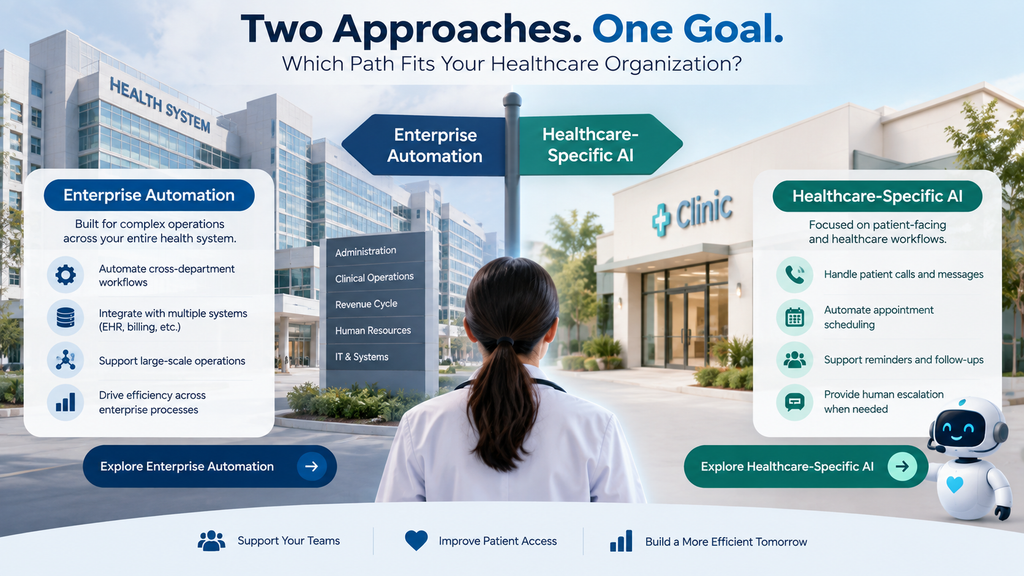
Choose Enterprise Automation When:
- Processes involve multiple enterprise applications
- Workflows span departments
- Large volumes of back-office processes need automation
- Complex process orchestration is required
- The organization has dedicated automation or IT teams
Choose Healthcare-Specific AI When:
- Patient communication is a major challenge
- Appointment scheduling consumes significant staff time
- The front desk handles high volumes of routine requests
- Automated reminders and follow-ups are priorities
- The organization wants healthcare-specific workflows that can be implemented around patient operations
Some large organizations may ultimately use both approaches.
For example, enterprise automation can orchestrate complex internal workflows, while healthcare-focused conversational AI manages high-volume patient communication.
The goal should be to create connected workflows rather than accumulate disconnected automation tools.
Questions to Ask Before Selecting a Platform
Before choosing a healthcare automation platform in the USA, healthcare leaders should ask:
Which Workflow Are We Trying to Improve?
Start with a specific operational problem.
Avoid purchasing AI or automation simply because the technology is available.
Can the Platform Integrate With Existing Systems?
Automation should reduce duplicate work rather than create additional data entry.
How Are Exceptions Handled?
Every automated process should have clear rules for when human intervention is required.
Can the Platform Scale?
Consider whether the solution can support additional providers, departments, locations, or workflows as organizational needs change.
How Is Governance Managed?
Healthcare organizations should evaluate security, access controls, audit capabilities, and other requirements relevant to their implementation.
What Does Implementation Require?
Technology capabilities matter, but implementation is equally important.
Organizations should understand integration requirements, workflow configuration, staff training, and the resources needed to maintain the system.
The Best Approach Is to Start With a High-Impact Workflow
Healthcare automation does not need to begin with a complete transformation of every system.
In many cases, the most effective approach is to identify a high-volume, repetitive process and begin there.
For clinics, this might be appointment scheduling.
If it concerns a hospital, it might be a cross-departmental administrative workflow.
For large health systems, it could involve connecting multiple existing systems around a specific operational process.
The best healthcare process automation platforms for large hospitals are therefore not necessarily those with the longest feature lists. The right platform is the one that can address a clearly defined workflow while integrating with the organization’s existing technology environment.
Similarly, the best AI chatbot platforms for automating appointment scheduling in healthcare should be evaluated based on their ability to support real patient interactions, not simply their ability to respond to predefined questions.
Key Takeaway
The right healthcare automation platform in the USA depends on the size of the organization, existing technology infrastructure, and the specific processes that need improvement.
Healthcare-specific AI platforms can be particularly effective for patient communication, appointment scheduling, reminders, and other front-office workflows. Enterprise platforms may be better suited to large hospitals that need process orchestration across multiple departments and systems.
The most successful automation strategy begins with a clear operational problem.
Identify the workflow creating the greatest burden, evaluate how information currently moves through that process, determine where automation can safely reduce manual work, and ensure that human teams remain involved where judgment or escalation is required.
For clinics and healthcare organizations looking to begin with patient communication and scheduling, healthcare automation solutions provide one healthcare-focused option to explore alongside its AI appointment scheduling capabilities.
A connected, workflow-first approach can help healthcare organizations move beyond isolated automation and build systems that support staff, improve patient access, and scale with operational needs.
Frequently Asked Questions
The best healthcare automation platform in the USA depends on the organization’s size, existing technology systems, and automation goals. Clinics may prioritize patient communication and scheduling automation, while large hospitals may require enterprise process orchestration across multiple departments and systems.
Large hospitals should evaluate integration capabilities, cross-system workflow orchestration, scalability, governance, human oversight, and the ability to manage processes across multiple departments. The best healthcare process automation platforms for large hospitals should support connected workflows rather than isolated task automation.
Many healthcare automation platforms are designed to connect with existing systems, although integration capabilities vary by provider and implementation. Hospitals and clinics should evaluate compatibility with their EHR, scheduling, practice management, financial, and communication systems before selecting a platform.

