
Administrative work has become a significant source of pressure across healthcare. Clinicians balance patient care with documentation, messages, follow-ups, and administrative requirements, while front-desk and operational teams manage calls, appointments, cancellations, reminders, and routine patient communication. Over time, these responsibilities can create constant interruptions and contribute to Healthcare Administrative Burnout.
Understanding how AI reduces administrative burnout is not simply about introducing another technology platform. AI can create meaningful value when it removes repetitive work, reduces manual coordination, and supports staff with high-volume administrative tasks. When implemented effectively, it can help healthcare teams spend more time on patients and responsibilities that genuinely require human judgment.
The Growing Challenge of Healthcare Administrative Burnout
Healthcare Administrative Burnout rarely develops because of one responsibility. More often, it results from the combined pressure of documentation requirements, repetitive communication, fragmented workflows, and constant task switching.
A clinician may move from a patient consultation to documentation, then respond to messages before preparing for the next appointment. Similarly, a front-desk employee may be updating an appointment when another patient calls to cancel, reschedule, or ask a routine question. These repeated interruptions can increase cognitive workload and make it difficult for employees to focus.
Physicians increasingly see administrative automation as one of AI’s most valuable opportunities. In an AMA survey, 57% of physicians identified addressing administrative burden through automation as the biggest opportunity for AI.
This is why how AI reduces administrative burnout has become an important question for healthcare organizations. The objective should not be to add more digital tools to an already complex workplace. Instead, AI should help remove unnecessary manual work from existing processes.
How AI Reduces Administrative Burnout
AI can support healthcare teams across documentation, patient communication, appointment management, follow-ups, and administrative coordination. However, technology only reduces workload when it genuinely removes steps from a process.
If staff members must constantly switch between platforms, manually transfer information, or spend significant time correcting automated outputs, AI may simply shift the burden rather than reduce it. The strongest opportunities are therefore often repetitive, high-volume, and structured tasks.
How AI Can Reduce Administrative Pressure Across Healthcare Workflows
| Administrative Challenge | How AI Can Help | Potential Benefit for Staff |
|---|---|---|
| Clinical documentation | Generates draft notes for clinician review | Reduces documentation effort and after-hours work |
| Appointment scheduling | Handles routine booking and scheduling requests | Reduces repetitive front-desk tasks |
| Appointment reminders | Automates confirmations and reminders | Reduces manual follow-up |
| Routine patient questions | Supports structured responses to common requests | Reduces communication overload |
| Patient follow-ups | Automates reminders and tracks routine actions | Reduces manual coordination |
| Inbox and message management | Helps identify and prioritize relevant information | Reduces cognitive workload |
| Administrative workflows | Connects repetitive steps across a process | Reduces duplicate work and task switching |
The value of automation is not simply that tasks can be completed faster. Effective AI can also reduce the number of interruptions, handoffs, and repetitive decisions staff must make throughout the day.
Reducing Documentation Burden
Documentation is one of the clearest examples of how AI reduces administrative burnout.
Healthcare professionals can spend substantial time creating and reviewing clinical notes. When documentation continues after scheduled working hours, it can affect personal time and contribute to the feeling that the workday extends well beyond patient appointments.
Ambient AI scribes are designed to support this process by capturing information from patient encounters and generating draft documentation for clinician review. The clinician remains responsible for reviewing and approving the final note, but AI can reduce the effort required to create the initial documentation.
A multicenter quality improvement study published in JAMA Network Open evaluated 263 ambulatory clinicians across six healthcare systems. After 30 days of using an ambient AI scribe, the proportion of participants reporting burnout decreased from 51.9% to 38.8%. The study also found improvements in cognitive task load, time spent documenting after hours, focused attention on patients, and urgent access to care.
This provides important evidence for AI for healthcare staff burnout. The potential benefit is not limited to completing notes more efficiently. Reducing documentation pressure may also give clinicians greater capacity to focus on patients during appointments and reduce the amount of administrative work extending into personal time.
Automating Repetitive Administrative Tasks
Healthcare organizations manage a large number of predictable requests every day. Patients may contact a clinic to schedule an appointment, confirm a visit, cancel, reschedule, or ask about availability.
When every routine interaction requires direct staff involvement, administrative teams can spend a significant part of their day managing repetitive communication.
AI can support these structured interactions by handling predictable requests through automated workflows. A straightforward appointment confirmation, for example, may not require the same level of staff involvement as a patient with complex scheduling requirements.
This can play an important role in reducing admin workload in clinics. Instead of requiring employees to personally manage every routine request, automation can handle predictable parts of the workflow while staff focus on situations requiring flexibility or personalized support.
Practices looking to streamline booking, reminders, cancellations, and rescheduling can explore Appointment Automation as part of a broader strategy for reducing repetitive administrative work.
Reducing Interruptions and Communication Overload
Administrative workload is not determined only by the number of tasks employees complete. The frequency of interruptions can also contribute to pressure.
A front-desk employee may begin processing an administrative request before receiving a patient call. Another appointment change may arrive before that conversation is complete. Throughout the day, employees may repeatedly move between calls, messages, scheduling updates, and patient requests.
This fragmented way of working can increase cognitive pressure and make it more difficult to complete important tasks efficiently.
AI can help by managing routine communication before human intervention is required. Predictable questions and requests can move through structured workflows, while complicated or sensitive situations can be escalated to staff.
For organizations managing substantial patient communication volumes, Healthcare Call Center Automation can support routine interactions while helping ensure that more complex conversations reach the appropriate team member.
Reducing unnecessary interruptions is another important aspect of how AI reduces administrative burnout. The benefit is not simply completing more tasks but helping employees spend more focused time on responsibilities that genuinely require their attention.
AI for Healthcare Staff Burnout Beyond Documentation
Although documentation is an important focus, administrative pressure in healthcare extends far beyond clinical notes.
Prior authorization, patient communication, inbox management, scheduling, follow-ups, and administrative coordination can all consume significant staff time. According to an AMA survey reported in 2024, physicians completed an average of 39 prior authorization requests per physician each week, while physicians and staff spent an average of 13 hours per week on those requests. Eighty-nine percent said prior authorization somewhat or significantly increases physician burnout.
These figures demonstrate why AI for healthcare staff burnout should not be discussed only in relation to documentation.
AI and automation may support administrative workflows by organizing information, identifying missing details, prioritizing communication, preparing structured processes, and tracking workflow status. However, healthcare organizations should avoid assuming that every AI system automatically reduces workload.
The technology must fit into the workflow and eliminate meaningful manual steps. If staff still need to complete the same process across multiple disconnected systems, the administrative burden may remain unchanged.
Reducing Admin Workload in Clinics
The first step toward reducing admin workload in clinics is understanding where staff time is actually being spent.
Healthcare organizations should identify repetitive tasks, high-volume communication, frequent interruptions, duplicate data entry, and processes requiring employees to manually monitor multiple stages.
Common areas where AI can help include:
- Appointment scheduling and changes: AI can support routine booking, cancellations, confirmations, and rescheduling, reducing the number of repetitive requests handled directly by front-desk teams.
- Patient reminders: Automated reminders can support appointment confirmations, follow-ups, forms, and other routine actions without requiring staff to manually contact every patient.
- Routine patient communication: Structured patient questions can be addressed through automated workflows, while complex or sensitive conversations can be escalated to a staff member.
- Information collection: Automation can help gather relevant information before staff reviews it, reducing repetitive administrative coordination.
- Follow-up coordination: AI-supported workflows can manage routine reminders and help identify situations requiring direct human intervention.
- Administrative task tracking: Connected workflows can reduce the need for employees to manually monitor every stage of a repetitive process.
By identifying these high-volume responsibilities, healthcare organizations can focus automation efforts where repetitive work creates the greatest pressure.
Appointment Scheduling and Management
Appointment management creates continuous administrative activity in many healthcare practices. Patients may need to book, confirm, cancel, or reschedule appointments, often requiring staff to check availability and update relevant systems.
AI-supported scheduling can help manage predictable appointment requests while maintaining human support for more complicated situations. This can be particularly valuable for practices dealing with high patient volumes.
For clinics exploring more advanced scheduling workflows, AI Appointment Scheduling Software can support appointment availability, booking requests, and routine scheduling processes.
The purpose of this technology is not to eliminate human support. Instead, it can reduce the number of repetitive interactions staff members need to handle manually.
This contributes directly to reducing admin workload in clinics while allowing employees to focus on patients with more complex scheduling or communication needs.
Routine Patient Communication
Healthcare teams often answer similar patient questions repeatedly throughout the day. These may involve office hours, appointment preparation, scheduling changes, or other routine requests.
A Healthcare Virtual Assistant can support structured patient communication and guide patients through routine processes. More complicated, sensitive, or unusual requests can then be transferred to an appropriate staff member.
This approach can reduce repetitive communication volume without removing access to human assistance.
The strongest automation strategy is therefore not one where every interaction is handled by AI. Instead, technology should manage predictable requests efficiently while people handle situations requiring empathy, context, and judgment.
AI Automation for Medical Offices
When considering AI automation for medical offices, healthcare organizations do not need to automate every workflow simultaneously.
A practical approach is to begin with repetitive, high-volume, and structured processes. Scheduling, reminders, routine patient communication, follow-ups, and information collection can often provide suitable starting points.
A relatively simple task performed hundreds of times may create more administrative pressure than a complicated task completed only occasionally. Identifying these high-frequency processes can help organizations focus their automation efforts where they are most likely to reduce meaningful workload.
Another important consideration in AI automation for medical offices is workflow integration. Technology should fit naturally into existing processes rather than creating another disconnected system.
If employees must manually copy information between platforms or repeatedly correct automated outputs, the expected efficiency benefits may disappear. The best automation reduces the number of steps required to complete a process rather than simply changing where employees complete those steps.
Healthcare Workflow Automation and Connected Processes
Healthcare workflow automation becomes more valuable when it connects multiple stages of a process rather than automating one isolated task.
Consider a routine patient follow-up. Without connected automation, an employee may need to identify the patient, determine the required action, send a message, track the response, send another reminder, update the relevant system, and close the task.
Each step may appear manageable individually. However, when the same process is repeated across hundreds of patients, the total coordination burden can become substantial.
Effective healthcare workflow automation can connect these stages and reduce the amount of manual monitoring required. Automation can manage routine progression while staff focus on exceptions and situations requiring direct intervention.
Healthcare organizations exploring connected administrative workflows can also examine Healthcare Automation to identify opportunities for reducing unnecessary coordination across the patient journey.
This broader approach is central to how AI reduces administrative burnout. The greatest benefits may come from improving an entire workflow rather than automating only one small responsibility.
Why Human Support Still Matters
AI can reduce repetitive administrative work, but it cannot independently manage every healthcare interaction.
Some situations require empathy, professional judgment, context, and complex problem-solving. A straightforward scheduling request may be appropriate for automation, while a sensitive concern or complicated patient situation may require direct human assistance.
The most effective approach therefore combines automation with clear human escalation.
AI can manage predictable and structured work, while healthcare professionals focus on situations where their experience and judgment provide the greatest value.
This balance is particularly important for addressing healthcare staff burnout. The objective should not be to remove people from healthcare communication. Instead, automation should reduce repetitive work surrounding the responsibilities that require meaningful human involvement.
How Healthcare Organizations Should Implement AI
Healthcare organizations should approach AI implementation as a workflow improvement strategy rather than simply introducing a new technology platform.
A practical implementation process should focus on the following:
- Identify the biggest administrative pain points: Review where clinicians and staff spend the most time and which tasks create the greatest number of interruptions.
- Prioritize repetitive and high-volume tasks: Start with processes that follow predictable patterns and consume significant administrative effort.
- Involve frontline employees: Clinicians, front-desk teams, and administrative staff can identify workflow problems that may not be visible at a management level.
- Ensure integration with existing systems: AI should reduce duplicate work rather than forcing employees to manually transfer information between platforms.
- Create clear human escalation processes: Patients and staff should know when a situation requires direct human involvement.
- Measure results after implementation: Documentation time, after-hours work, call volume, missed calls, appointment wait times, and staff feedback can help determine whether the technology is genuinely improving workflows.
The most important question remains simple: Has the technology actually removed work from healthcare staff?
This is especially important because physicians have identified seamless workflow integration, data privacy assurances, and appropriate oversight as important requirements for greater AI adoption.
A Realistic Approach to AI and Healthcare Burnout
AI can help reduce administrative workload, but it cannot independently solve every cause of burnout.
Healthcare professionals may also experience pressure because of staffing shortages, organizational culture, leadership challenges, workload expectations, and limited workplace support.
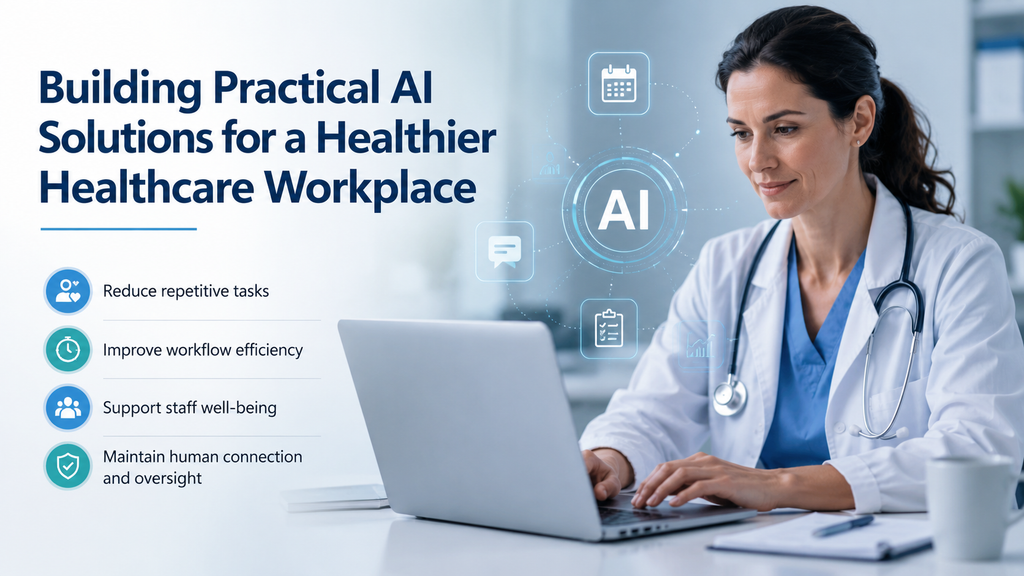
Technology also requires appropriate oversight. AI-generated outputs should be reviewed according to the requirements of the workflow, particularly when clinical documentation or patient information is involved.
Research into ambient AI scribes is encouraging, but the findings should not automatically be assumed for every AI system or healthcare setting. The JAMA study was a quality improvement study based on preintervention and postintervention surveys, and its findings show an association rather than proving that the technology alone caused every improvement.
Therefore, how AI reduces administrative burnout should be understood realistically. AI can remove repetitive work, but sustainable improvements depend on thoughtful implementation and broader workplace support.
The objective should be better and more sustainable workflows, not simply increasing the amount of work employees are expected to complete.
Conclusion
How AI reduces administrative burnout ultimately depends on whether technology genuinely removes administrative work from healthcare professionals’ daily responsibilities.
The strongest opportunities are often found in repetitive and structured workflows, including documentation, appointment scheduling, routine patient communication, follow-ups, inbox management, and administrative coordination. Research on ambient AI scribes provides encouraging evidence that reducing documentation-related workload may also support clinician well-being, while physician surveys continue to highlight strong interest in automation that addresses administrative burden.
However, AI is not a complete solution to burnout. Technology must integrate effectively, reduce rather than shift administrative burden, and maintain appropriate human oversight.
The opportunity is not simply to make healthcare employees work faster. It is to reduce unnecessary administrative pressure and give clinicians and staff more capacity to focus on patients and responsibilities that genuinely require human attention.
Sources
- American Medical Association — Physician Views on AI and Administrative Burden – Read the AMA physician survey
- JAMA Network Open — Ambient AI Scribes and Professional Burnout – Read the JAMA Network Open study
- American Medical Association — Prior Authorization and Physician Burnout – Read the AMA prior authorization report
Frequently Asked Questions
AI can reduce administrative burnout by supporting repetitive tasks such as documentation, appointment scheduling, routine patient communication, follow-ups, and administrative coordination. It is most effective when it removes existing work instead of creating additional systems or duplicate responsibilities.
Yes. Ambient AI scribes can generate draft documentation for clinician review. A multicenter study of 263 ambulatory clinicians found that the proportion reporting burnout decreased from 51.9% to 38.8% after 30 days of use, alongside improvements in cognitive task load, after-hours documentation, and focused attention on patients.
AI and automation may support parts of prior authorization workflows by organizing information, identifying missing documentation, and tracking administrative processes. Prior authorization remains a significant source of administrative burden; AMA survey reporting found that physicians complete roughly 39 prior authorization requests per week and that 89% say the process somewhat or significantly increases burnout.
High-volume, repetitive, and structured tasks are often suitable candidates. These may include appointment scheduling, reminders, routine patient communication, follow-ups, information collection, and parts of administrative coordination.
No. AI can help reduce administrative pressure, but burnout is also influenced by staffing shortages, organizational culture, workload expectations, leadership, and workplace support. AI is most effective when it forms part of a broader strategy for improving healthcare workflows.

