
A busy front desk may seem like a sign of a thriving practice, but constant phone calls, missed callbacks, long hold times, and overwhelmed employees can point to a growing communication problem. When staff are expected to manage patients in person while answering calls, updating appointments, and responding to routine requests, the existing workflow can quickly reach its limits.
A Virtual Medical Receptionist can help healthcare practices manage routine patient communication, appointment requests, and administrative interactions while allowing in-house staff to focus on responsibilities that require direct human attention. The key is recognizing when the current system is no longer meeting the needs of your patients or team.
Here are five important signs you need a virtual medical receptionist and what they could mean for your practice.
Why Patient Communication Matters
Telephone access remains an important part of the patient experience. Patients often rely on phone communication to schedule appointments, ask routine questions, confirm visits, make changes, and contact the appropriate member of the healthcare team.
Research on primary care telephone access found that timely call answers, helpful information, and positive staff interactions were associated with higher patient satisfaction.
The Agency for Healthcare Research and Quality also notes that patients can become frustrated when they have difficulty reaching a practice or when it takes too long to reach a person. Its guidance recommends assessing telephone systems and gathering patient feedback about communication access.
This does not mean every practice needs to automate its front desk. However, when communication gaps become frequent, a Virtual Medical Receptionist can provide additional support and capacity for routine interactions.
Sign 1: Your Practice Is Missing Calls During Busy Periods
Morning rushes, lunch breaks, and the end of the day can create sudden increases in patient calls. At the same time, front-desk employees may be checking patients in, answering questions, updating records, managing appointment changes, and supporting clinicians.
Even experienced employees cannot manage multiple conversations simultaneously.
If calls are consistently missed during the same periods each day, the issue may not be staff performance. The practice may simply have more incoming communication than the available team can manage at one time.
This is one of the clearest signs you need a virtual medical receptionist.
A virtual receptionist can provide additional support for routine incoming requests when staff members are already occupied. Depending on the workflow and system, patients may receive help with appointment scheduling, cancellations, rescheduling, confirmations, office information, and other structured requests.
For practices where appointment-related communication creates a significant workload, Appointment Automation can help support booking, cancellations, rescheduling, reminders, and other routine scheduling workflows.
The important question is not whether your employees are working hard enough. It is whether your current front desk has enough capacity to manage the number of patients trying to contact the practice at the same time.
Sign 2: Your Front-Desk Staff Is Constantly Multitasking
Front-desk employees often manage far more than incoming phone calls.
Throughout the day, they may need to:
- Check patients in and out
- Answer incoming calls
- Schedule and reschedule appointments
- Respond to routine patient questions
- Update patient information
- Coordinate follow-ups
- Handle administrative requests
- Support clinicians and other staff
The challenge is not necessarily that these tasks are difficult individually. The problem is that many of them require attention at the same time.
An employee speaking with a patient at the reception desk cannot always answer another patient’s call immediately. While resolving a complex scheduling issue, other callers may be placed on hold. Constantly moving between conversations and tasks can also make it more difficult for employees to give proper attention to each interaction.
This is another important example of the signs you need a virtual medical receptionist.
A virtual receptionist for medical practice operations can help manage predictable and repetitive communication while allowing in-house employees to focus on patients in front of them and administrative situations requiring judgment.
The American Medical Association has discussed how virtual assistants can support private practices with responsibilities such as answering phones, scheduling, reminder calls, referrals, and other administrative tasks.
The purpose is not necessarily to replace front-desk staff. Instead, a Virtual Medical Receptionist can reduce the volume of repetitive interactions competing for the attention of employees who are already managing multiple responsibilities.
Sign 3: Patients Are Complaining About Hold Times or Delayed Callbacks
Patient feedback can provide one of the clearest indications that communication workflows need attention.
An occasional complaint is unavoidable. However, repeated comments about long hold times, unanswered calls, difficulty reaching the office, or delayed callbacks may indicate that the practice’s communication capacity is under pressure.
Research examining telephone access in primary care found that timely call answers, staff responsiveness, and receiving needed information were associated with greater patient satisfaction.
A virtual receptionist for medical practice workflows can help by separating routine requests from conversations that require direct staff involvement.
For example, predictable questions involving office information, appointment availability, confirmations, or routine scheduling changes may follow structured workflows. More complicated conversations can then be directed to the appropriate employee.
Practices experiencing high call volumes can also explore Healthcare Call Center Automation to support routine patient requests and route more complex conversations to the appropriate team member.
Improving communication access does not mean every patient interaction should be automated. It means routine conversations should not unnecessarily consume the same staff capacity needed for more complicated or sensitive situations.
Sign 4: After-Hours Calls Go Unanswered
Traditional front-desk coverage generally ends when the workday ends. Patients, however, may need to contact the practice outside normal office hours.
Someone may want to confirm an appointment after work. Another patient may need to cancel or reschedule before the following day. Others may need basic information about office processes or the appropriate next step.
If after-hours and weekend calls consistently go unanswered, this may be another of the important signs you need a virtual medical receptionist.
A healthcare virtual receptionist can provide additional support for defined routine workflows outside normal front-desk hours. Depending on the system and the practice’s configuration, patients may receive assistance with appropriate administrative requests instead of being directed immediately to voicemail.
AHRQ recommends that practices assess how easily patients can reach them, including evaluating telephone access and patient feedback about the communication experience.
However, clear boundaries remain essential.
A healthcare virtual receptionist should not attempt to independently manage urgent, clinically sensitive, or complex situations. Practices need clear escalation pathways so callers can be directed appropriately when an issue requires human or clinical intervention.
The most effective approach is therefore one that combines routine automation with clear human support.
Sign 5: Hiring and Turnover Are Creating Ongoing Front-Desk Gaps
Front-desk turnover can create an ongoing operational challenge.
When an employee leaves, the practice may need to recruit, interview, hire, and train a replacement. During this period, remaining employees often take on additional phone and administrative responsibilities.
This can create more pressure on the existing team while increasing the risk of missed calls and inconsistent patient communication.
If your practice is constantly struggling to maintain sufficient front-desk coverage, technology may provide an additional layer of support.
A Virtual Medical Receptionist can help manage routine communication without making every incoming interaction dependent on the availability of a particular employee.
Human staff remains important for many responsibilities, including in-person reception, sensitive conversations, unusual administrative situations, and interactions requiring empathy or professional judgment.
However, one of the key AI medical receptionist benefits is the ability to support routine communication while allowing staff to focus on higher-value responsibilities. The AMA notes that practices can use virtual assistants to help reduce administrative burden and support efficiency in areas such as phone answering and scheduling.
Quick Reference: Do These Signs Sound Familiar?
| Sign Your Practice Is Experiencing | What It May Indicate | How a Virtual Receptionist Can Help |
|---|---|---|
| Calls are regularly missed | Call volume exceeds available staff capacity | Supports routine incoming calls |
| Staff constantly multitask | Too many responsibilities compete for attention | Reduces repetitive phone interactions |
| Patients complain about hold times | Communication access is affecting patient experience | Helps manage routine requests efficiently |
| After-hours calls go unanswered | Patient access is limited to office hours | Provides support for defined after-hours workflows |
| Hiring and turnover create gaps | Communication depends heavily on individual employees | Provides additional administrative capacity |
If several of these challenges occur regularly, the problem may not be the performance of individual employees. Your practice may simply have outgrown the communication capacity of its existing workflow.
Understanding the AI Medical Receptionist Benefits
The AI medical receptionist benefits extend beyond answering more incoming calls.
One important advantage is consistency. A properly configured system can follow defined workflows for routine requests regardless of how busy the practice becomes.
Another benefit is scalability. A sudden increase in patient calls can immediately create pressure on a traditional front desk. A virtual system can provide additional capacity for predictable interactions without expecting employees to manage multiple conversations at once.
Another important benefit is helping staff focus on responsibilities that require greater human involvement. The AMA has reported examples of private practices using virtual assistants to support administrative tasks and reduce the burden placed on in-person staff.
This does not mean technology should remove human interaction from healthcare communication.
The strongest approach usually combines automation with human support. Routine and structured interactions can be managed efficiently, while sensitive, unusual, or complex situations are escalated to the appropriate staff member.
Medical Answering Service vs. Virtual Medical Receptionist
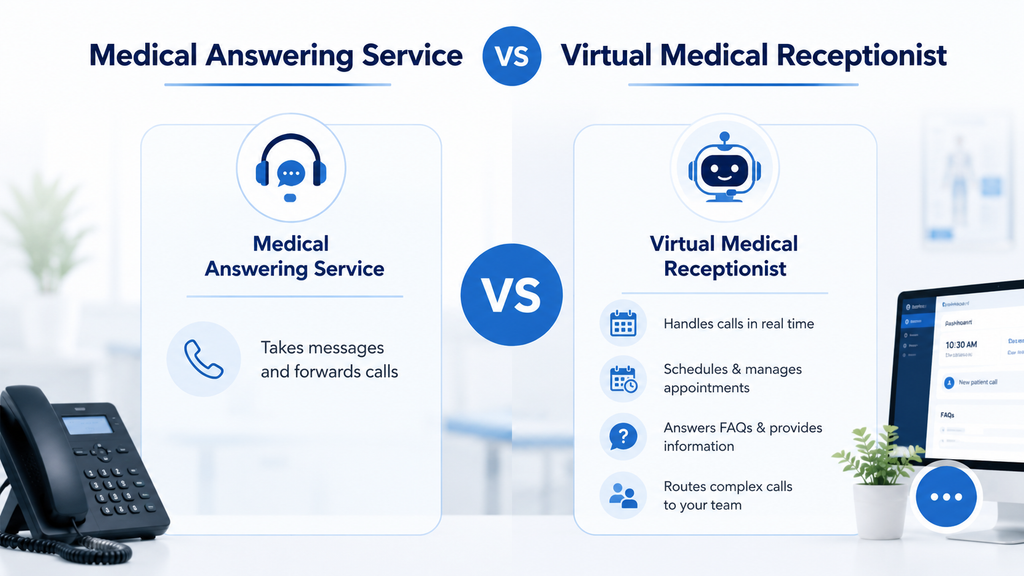
A medical answering service and a virtual receptionist may sound similar, but they can serve different purposes.
A traditional medical answering service generally focuses on receiving calls and taking or forwarding messages. This can ensure that calls are acknowledged, but the patient may still need to wait for a staff member to respond.
A Virtual Medical Receptionist, depending on its capabilities and configuration, can support a broader range of routine administrative interactions in real time. This may include answering common questions, helping patients navigate scheduling, managing appointment-related requests, and directing callers through predefined workflows.
The distinction matters because a practice should first identify the problem it wants to solve.
If the primary requirement is simply ensuring that someone receives and forwards messages, a medical answering service may be sufficient.
If the practice needs help completing routine administrative tasks in real time, a virtual receptionist may provide more comprehensive support.
For practices where appointment-related calls create a significant administrative burden, AI Appointment Scheduling Software can support automated booking, rescheduling, cancellations, reminders, and other appointment-management workflows.
How to Choose the Right Virtual Receptionist for Your Practice
Not every virtual receptionist offers the same features or workflow capabilities. Before choosing a solution, healthcare organizations should consider how effectively it fits into their existing operations.
Data Privacy and Compliance
Healthcare practices should understand exactly what information a system receives, maintains, or transmits.
The U.S. Department of Health and Human Services guidance on Business Associates explains that when an organization qualifies as a business associate and performs functions involving protected health information on behalf of a covered entity, HIPAA Rules and appropriate written arrangements may apply.
Practices should therefore review the vendor’s privacy, security, and contractual processes carefully rather than assuming every solution provides the same protections.
Integration With Existing Systems
A virtual receptionist should reduce administrative work rather than create additional steps.
If employees must manually transfer appointment information between platforms or repeatedly correct disconnected workflows, the technology may create more work instead of reducing it.
Integration capabilities should be evaluated based on the practice’s existing scheduling, communication, phone, and healthcare technology systems.
A Healthcare Virtual Assistant can also provide broader support for practices looking to streamline routine patient communication and administrative workflows beyond incoming phone calls.
The right solution should fit naturally into the practice’s existing processes.
Human Escalation
No automated system should attempt to manage every healthcare conversation independently.
Before choosing a provider, practices should understand:
- Which requests can be handled automatically
- When calls are transferred to staff
- How urgent situations are routed
- Whether escalation rules can be customized
- What information is transferred when a human takes over
Automation is most effective when it can recognize when human involvement is necessary.
Specialty and Workflow Fit
Different practices receive different types of calls.
A primary care clinic, specialty practice, dental office, behavioral health provider, or multi-location organization may all have different communication requirements and scheduling rules.
The best solution is therefore not necessarily the platform with the longest list of features. It is the one that fits the way your practice actually communicates with patients.
A Virtual Receptionist Should Support Your Team
The decision does not need to be framed as technology versus people.
A Virtual Medical Receptionist can manage predictable, repetitive, and high-volume interactions while human employees focus on patients at the front desk, sensitive conversations, unusual administrative problems, and responsibilities requiring judgment.
This approach can reduce unnecessary interruptions without removing the human element from healthcare communication.
Practices looking to streamline repetitive work across multiple administrative processes can also explore Healthcare Automation as part of a broader strategy for improving workflow efficiency and reducing manual coordination.
The purpose of technology should be to make staff capacity more effective, not simply to expect fewer employees to manage more work.
Conclusion
Missed calls, overwhelmed staff, patient complaints about hold times, unanswered after-hours calls, and ongoing front-desk staffing challenges are five important signs you need a virtual medical receptionist.
A Virtual Medical Receptionist can provide additional capacity for routine patient communication while allowing in-house staff to focus on interactions and responsibilities that genuinely require human attention.
The right solution will depend on your practice’s size, patient volume, specialty, staffing model, and existing technology.
Before making a decision, review your missed-call patterns, patient feedback, after-hours communication, staff workload, and hiring challenges.
If the same issues continue appearing, the issue may not be that your staff is not working hard enough. Your practice may simply have outgrown the communication capacity of its current workflow.
Sources
- Agency for Healthcare Research and Quality — Be Easy to Reach – Read the AHRQ guidance
- PubMed — Optimizing Primary Care Telephone Access and Patient Satisfaction – Read the PubMed study
- American Medical Association — Virtual Assistants Can Boost Efficiency for Private Practices – Read the AMA article
- HHS — Business Associates and HIPAA – Read the HHS guidance
Frequently Asked Questions
A Virtual Medical Receptionist is a technology-supported or remote solution that helps healthcare practices manage routine patient communication. Depending on the system, it may support incoming calls, appointment scheduling, common patient questions, and routing to the appropriate staff member.
Common signs include frequent missed calls, overwhelmed front-desk employees, patient complaints about hold times, unanswered after-hours calls, and ongoing difficulties maintaining consistent front-desk coverage.
A medical answering service generally focuses on receiving calls and taking or forwarding messages. A virtual receptionist for medical practice workflows may support broader real-time tasks, including routine scheduling, common patient questions, and predefined administrative workflows.
AI medical receptionist benefits can include more consistent communication coverage, reduced repetitive work for staff, additional support during busy periods, and greater capacity for employees to focus on complex or in-person responsibilities.
Yes. In many practices, the most effective approach is a combination of technology and human support. A healthcare virtual receptionist can manage routine and predictable requests while staff handles sensitive, complex, and unusual situations that require judgment or direct patient interaction.

