
A clinic receptionist may answer dozens of calls in a single day. Patients want to book appointments, reschedule visits, ask about doctor availability, confirm timings, receive directions, or follow up on a previous request.
The challenge is that these calls do not stop when the front desk becomes busy.
When staff are assisting patients in person, answering another call may not always be possible. During peak hours, calls can queue or go unanswered. After working hours, patients may have to wait until the next day for a response.
This is why more providers are exploring the best AI receptionist for clinics in India to use to automate routine patient communication without removing human support from important interactions.
A healthcare AI receptionist can answer appropriate calls, understand what a patient needs, support appointment scheduling, manage routine requests, and transfer more complex situations to staff. For clinics, the goal is not simply to add another technology tool. It is to make the front desk more responsive without proportionally increasing administrative workload.
This guide explains what to look for when choosing the best AI receptionist for clinics in India, how AI receptionists support patient communication, what to consider about healthcare AI India pricing, and how to evaluate the right platform for your practice.
What Is an AI Receptionist for a Clinic?
An AI receptionist is a conversational system that can handle patient interactions through channels such as phone calls and, depending on the platform, messaging or other digital communication channels.
Unlike traditional IVR systems that require patients to navigate menu options, conversational AI can understand the purpose of a patient’s request and guide the interaction toward an appropriate next step.
For example, an AI receptionist may support eligible requests such as:
- Booking an appointment
- Rescheduling or cancelling a visit
- Confirming clinic or doctor availability
- Answering routine administrative questions
- Sending appointment confirmations or reminders
- Routing calls to the appropriate department
- Capturing relevant patient information
- Escalating complex requests to staff
The most important distinction is between automation and replacement.
The best AI receptionist for clinics in India should not attempt to handle every situation independently. It should manage appropriate routine workflows while ensuring patients can reach a human team member when necessary.
This is particularly important in healthcare, where an apparently routine conversation may sometimes require staff attention or clinical escalation.
Why Indian Clinics Are Turning to AI Receptionists
Front-desk work becomes increasingly difficult as patient volumes grow.
A small clinic may initially manage calls with one receptionist. As the practice adds doctors, services, or locations, the number of incoming interactions can increase significantly.
Staff may spend a large part of the day answering questions that follow predictable patterns. At the same time, they must check in patients, coordinate schedules, update records, and manage in-person requests.
An AI receptionist can help distribute this workload.
Instead of expecting staff to answer every routine call manually, the system can handle eligible interactions and route exceptions appropriately. This can allow front-office teams to spend more time on patients and situations that genuinely require human involvement.
For clinics comparing the best AI receptionist for clinics in India can adopt, the operational question should therefore be:
Which repetitive front-desk workflows are currently consuming the most staff time?
The answer may be appointment booking for one clinic and missed-call recovery for another.
For a broader look at how voice automation can support healthcare communication, explore our guide on healthcare call center AI and automation.
How AI Receptionists Automate Patient Calls
The primary purpose of an AI receptionist is to understand why a patient is contacting the clinic and guide the interaction accordingly.
A patient should not have to navigate multiple menu options simply to ask whether an appointment is available.
Conversational AI can allow patients to communicate their request naturally. The system can then identify the intent and initiate an appropriate workflow.
For example, a patient may say:
“I need to book an appointment with the doctor this week.”
The system may check relevant availability and guide the patient through the scheduling process.
Another patient may say:
“I already have an appointment but need to change the time.”
The interaction can move toward a rescheduling workflow.
However, not every call should be resolved automatically.
If the request is unusual, sensitive, or outside the system’s defined workflow, it should be escalated to staff. A well-designed AI receptionist should make this transition easy rather than forcing patients through repeated automated responses.
This balance is one of the most important factors when evaluating the best AI receptionist for clinics in India to deploy.
Automating Appointment Scheduling and Rescheduling
Scheduling is often one of the largest sources of administrative work in a clinic.
Patients may call throughout the day to book appointments, confirm availability, reschedule visits, or cancel existing bookings. Staff must then check calendars, confirm provider availability, and update schedules.
An AI receptionist can support eligible scheduling workflows by connecting with the clinic’s scheduling system.
Depending on the configured workflow, it may help:
- Check available appointment slots
- Book eligible appointment types
- Confirm patient details
- Reschedule appointments
- Process cancellations
- Send confirmations
- Trigger reminders
The system should follow the clinic’s rules rather than making assumptions about scheduling.
For example, appointment types, provider availability, visit durations, and booking restrictions may vary across specialties.
Clinics looking to improve scheduling efficiency can also explore AI-powered appointment automation and how connected workflows can support booking, rescheduling, cancellations, reminders, and follow-ups.
For many practices, appointment management is a major reason they begin searching for the best AI receptionist for clinics in India.
Supporting Patients Beyond Appointment Booking
An AI receptionist can support more than scheduling.
Patients often contact clinics with routine administrative questions, including clinic hours, location details, appointment preparation instructions, doctor availability, and other non-clinical information.
Handling these requests automatically can reduce repetitive work for staff.
However, healthcare providers should clearly define what information the AI receptionist is allowed to provide.
Routine administrative information is different from medical advice.
The system should not independently provide clinical guidance outside its approved workflows. When a patient raises a clinical concern or a request requiring professional judgment, the interaction should follow an appropriate escalation process.
This is where healthcare-specific workflow design becomes more important than simply choosing a generic AI voice agent.
The best AI receptionist for clinics in India should understand the boundaries between routine patient administration and interactions requiring human or clinical involvement.
Multilingual and Natural Patient Communication
India’s healthcare environment is linguistically diverse.
Patients may prefer English, Hindi, Hinglish, or other regional languages depending on the location and patient population.
When evaluating an AI receptionist, clinics should consider whether the platform supports the languages and communication patterns relevant to their patients.
Natural communication also matters.
Patients should be able to explain their needs without memorizing specific commands or navigating complicated phone menus.
At the same time, clinics should test how accurately the system understands real patient interactions. Actual patient conversations may include interruptions, incomplete information, different accents, mixed-language speech, and unexpected questions.
Before selecting a platform, healthcare providers should test it using realistic scenarios from their own clinic.
Human Escalation Is a Core Requirement
One of the biggest mistakes clinics can make is evaluating automation only by asking how many calls AI can handle.
A more important question is:
What happens when AI should not handle the call?
Patients should have a clear path to human support.
The system should also have defined escalation rules for situations such as:
- Clinical concerns
- Emergencies
- Distressed or dissatisfied patients
- Requests outside configured workflows
- Complex administrative issues
- Situations where the AI does not have sufficient information
A useful AI receptionist does not simply try to continue every conversation.
It should recognize when the next step requires a person and provide the receiving staff member with relevant context.
This principle is also relevant when replacing outdated phone trees. You can explore how conversational AI can replace traditional IVR systems in healthcare by supporting more natural interactions and intelligent routing.
Integration With Clinic Systems Matters
An AI receptionist can create additional work if it operates separately from the clinic’s existing systems.
For example, if the AI collects appointment information but staff must manually enter it into another scheduling platform, automation may simply move the administrative burden from one step to another.
The value increases when relevant workflows can connect with existing systems.
Depending on the clinic, these may include:
- Appointment scheduling platforms
- EMRs or EHRs
- Practice management systems
- CRM platforms
- Laboratory systems
- Communication tools
Integration requirements vary significantly.
A single-doctor clinic may require a simple scheduling connection, while a multi-specialty organization may need department routing, multiple calendars, and more complex workflow coordination.
When comparing the best AI receptionist for clinics in India, providers should therefore evaluate integration requirements before focusing only on feature lists.
Healthcare AI India Pricing: What Clinics Should Consider
Healthcare AI India pricing can vary depending on the platform, deployment model, call volume, integrations, communication channels, and workflow complexity.
For this reason, comparing only the monthly subscription price can be misleading.
A lower-priced platform may have limited integrations or usage allowances. Another solution may cost more but support a broader set of automated workflows.
When evaluating healthcare AI India pricing, clinics should consider the following factors:
| Pricing Factor | What Clinics Should Evaluate |
|---|---|
| Call Volume | Whether pricing is based on calls, minutes, interactions, credits, or another usage model. |
| Number of Locations | Whether additional clinics or locations affect the overall platform cost. |
| Number of Providers | Whether pricing changes based on doctors, departments, or users supported. |
| Scheduling Integrations | Whether connecting existing appointment or practice systems requires additional implementation costs. |
| Workflow Complexity | Whether advanced routing, scheduling rules, follow-ups, or custom workflows affect pricing. |
| Communication Channels | Whether phone, messaging, WhatsApp, or other supported channels are included separately. |
| Implementation and Support | Whether onboarding, configuration, training, and ongoing support are included in the quoted price. |
The right approach to healthcare AI India pricing is to evaluate the total operational value rather than selecting a platform based only on the lowest advertised price.
A useful question is:
How much repetitive administrative work can this system realistically reduce for our specific clinic?
What Should the Best AI Receptionist for Clinics Include?
The best AI receptionist India clinics choose will depend on their workflows, but several capabilities are particularly important.
| Feature | What It Should Support | Why It Matters |
|---|---|---|
| AI Call Handling | Answer routine patient calls and understand the purpose of the interaction. | Reduces pressure on front-desk staff during busy hours. |
| Appointment Management | Booking, confirmations, rescheduling, and cancellations based on configured clinic rules. | Helps reduce repetitive scheduling work. |
| Natural Conversations | Allow patients to explain their needs without navigating complex phone menus. | Creates a more convenient patient experience. |
| Human Escalation | Transfer complex, sensitive, or unresolved interactions to staff. | Ensures automation does not become a barrier to patient support. |
| System Integration | Connect with relevant scheduling, EMR, practice management, or communication systems. | Helps reduce duplicate data entry and disconnected workflows. |
| Multilingual Communication | Support languages relevant to the clinic’s patient population. | Makes communication more accessible for diverse patient groups. |
| Workflow Controls | Define which requests AI can handle and when human intervention is required. | Helps clinics maintain appropriate control over automated interactions. |
These capabilities are generally more valuable than simply comparing the number of AI features listed on a vendor’s website.
The best AI receptionist for clinics in India should ultimately fit the practice’s existing workflows rather than forcing the clinic to redesign every process around the technology.
AI Receptionists for Single Clinics vs Multi-Location Practices
The requirements of a single clinic and a multi-location healthcare organization can be very different.
A smaller practice may primarily need help answering calls and managing appointments.
A larger organization may need to route calls between departments, manage provider-specific schedules, standardize communication across locations, and track interactions centrally.
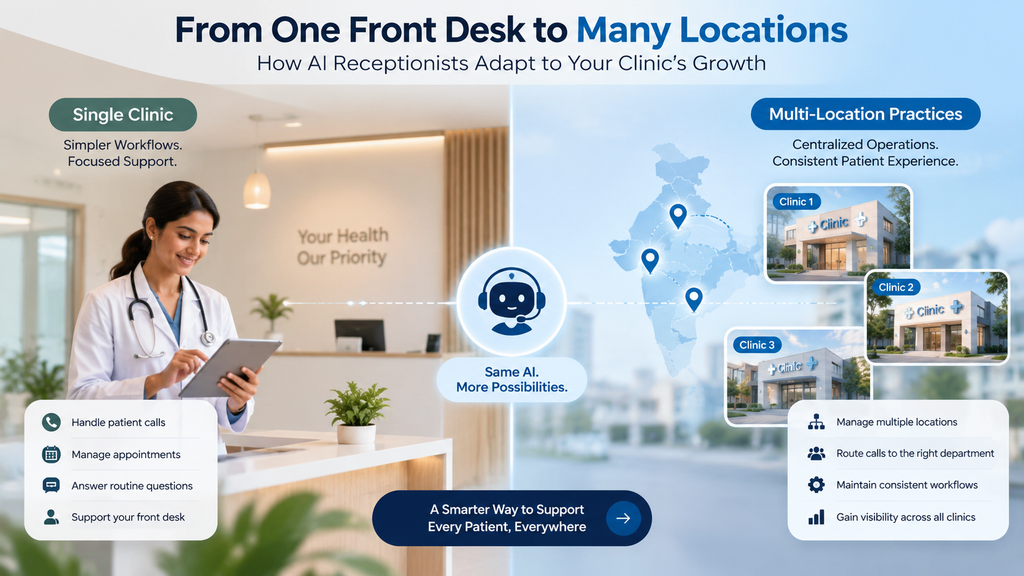
For multi-location practices, consistency becomes particularly important.
Patients should receive a reliable experience regardless of which location they contact.
This is also where AI receptionists can support broader operational standardization. Instead of every location developing different call-handling practices, organizations can configure common workflows while still allowing location-specific rules where necessary.
For larger healthcare groups, our guide on automation software for multi-location healthcare practices explores how connected workflows can support standardized operations as organizations expand.
How to Evaluate an AI Receptionist Before Deployment
Before selecting a platform, clinics should test it against real operational scenarios.
A practical evaluation should include questions such as:
Can the AI Understand the Way Our Patients Actually Speak?
Test different accents, languages, mixed-language conversations, interruptions, and incomplete requests.
Can It Follow Our Scheduling Rules?
Evaluate appointment types, provider availability, restrictions, visit durations, and exceptions.
What Happens When It Does Not Know the Answer?
The system should avoid guessing and provide an appropriate escalation path.
How Does It Connect With Existing Systems?
Understand whether information can move between relevant platforms without unnecessary manual entry.
Can Staff Review Interactions?
Clinics should understand how calls, summaries, and workflow outcomes can be monitored.
How Is Patient Information Handled?
Healthcare providers should evaluate applicable security, access controls, data management practices, and relevant compliance requirements.
The best evaluation is based on the clinic’s real workflows rather than generic demonstration scenarios.
A Healthcare-Focused Option to Consider
For clinics looking for an AI receptionist alongside broader patient communication and administrative automation, MantraAssist offers healthcare-focused workflows that can support call handling, appointment scheduling, reminders, follow-ups, and appropriate human escalation.
The value of a healthcare-focused platform is the ability to evaluate patient communication as part of a connected workflow rather than using separate tools for call answering, scheduling, and follow-up.
This can be particularly useful for organizations looking beyond a standalone voice agent and exploring how automation can support broader clinic operations.
Key Takeaway
The best AI receptionist India clinics can implement is not simply the one with the most advanced voice technology.
It is the one that fits naturally into the clinic’s existing workflows, handles appropriate routine patient interactions, supports scheduling and communication, integrates with relevant systems, and provides clear human escalation when automation is not the right solution.
For clinics comparing options, start with the front-desk problems that consume the most staff time. This may include missed calls, repetitive appointment requests, rescheduling, reminders, or routine patient questions.
From there, evaluate how the platform handles real conversations, integrates with existing systems, and fits within operational requirements and healthcare AI India pricing expectations.
A healthcare-focused solution such as MantraAssist can be worth evaluating when the goal is to connect AI call handling with scheduling, reminders, follow-ups, and broader patient communication workflows rather than using separate tools for each task. A clinic receptionist may answer dozens of calls in a single day. Patients want to book appointments, reschedule visits, ask about doctor availability, confirm timings, receive directions, or follow up on a previous request.
Frequently Asked Questions
The best AI receptionist for clinics in India depends on factors such as patient volume, language requirements, appointment workflows, existing software, integration needs, and the availability of human escalation. Clinics should evaluate platforms using real patient scenarios rather than relying only on feature lists.
Yes. An AI receptionist can support eligible appointment scheduling, confirmations, rescheduling, and cancellations when connected to the appropriate scheduling workflows and configured according to clinic rules.
Healthcare AI India pricing varies depending on call volume, communication channels, integrations, workflow complexity, implementation requirements, and the number of users or locations. Clinics should evaluate the total cost and expected operational value rather than comparing subscription prices alone.

