
A doctor finishes a consultation and immediately turns to the next patient. Meanwhile, the front desk is answering calls, confirming appointments, updating patient details, managing follow-ups, checking records, and responding to routine questions.
None of these activities is unimportant. However, when a growing share of staff time is spent repeating administrative tasks, clinics can struggle to keep operations efficient as patient volumes increase.
This is where healthcare automation can make a meaningful difference. The purpose is not to replace doctors, nurses, or front-office teams. It is to reduce the amount of time people spend on repetitive, rule-based administrative work so they can focus more attention on patients and higher-value responsibilities.
For clinics exploring AI software for Indian Clinics, the opportunity is increasingly about connecting routine communication, patient administration, scheduling, records, and follow-up workflows rather than automating one isolated task.
This guide explains how healthcare automation can reduce administrative work in Indian clinics and diagnostic centres, what processes are suitable for automation, and what providers should consider when selecting an AI-driven healthcare administration platform for clinics and diagnostic centres in India.
Why Administrative Work Is Becoming a Growing Challenge for Indian Clinics
Administrative work often increases alongside patient volume.
A clinic may begin with a manageable number of appointments and a small team. As the practice grows, however, staff must handle more calls, appointment requests, rescheduling, patient registration, reminders, documentation, follow-ups, and information requests.
The challenge is not simply that there is more work. It is that much of this work is repetitive.
A receptionist may answer the same questions throughout the day. Staff may repeatedly contact patients to confirm appointments. Patients may call for information that could potentially be provided through an appropriate automated workflow. Teams may also have to manually transfer information between disconnected systems.
For many growing practices, this creates a familiar problem: increasing patient demand does not always require more clinical staff, but it can quickly increase the administrative workload. As discussed in MantraAssist’s guide on how clinics can scale without hiring more admin staff, repetitive administrative processes can become a major barrier to efficient clinic growth.
For AI software for Indian Clinics, the goal should therefore be to reduce administrative friction rather than simply move the same manual work into another digital interface.
What Healthcare Automation Means for Clinics
Healthcare automation refers to the use of software, workflow technology, and, where appropriate, artificial intelligence to perform or support repeatable administrative processes.
Not every clinic process should be automated.
Clinical decisions, diagnosis, treatment planning, and complex patient conversations require appropriate human expertise. Administrative processes are different. Many follow predictable patterns and can potentially be streamlined using predefined workflows or AI-assisted communication.
For example, automation can potentially support:
- Appointment confirmations and reminders
- Routine scheduling requests
- Eligible rescheduling or cancellation workflows
- Patient registration and information collection
- Routine patient communication
- Call routing and intent identification
- Follow-up reminders
- Administrative notifications
- Information requests and status updates
The value comes from connecting these activities into practical workflows.
For example, an automated reminder is useful on its own. However, a stronger workflow can identify a patient’s response, update the appropriate appointment status, and route exceptions to staff when human assistance is needed.
This is one reason an AI-driven healthcare administration platform for clinics and diagnostic centres in India should be evaluated as a workflow system rather than simply as an AI chatbot or automated messaging tool.
Clinics can also explore broader examples of AI automation use cases in healthcare to understand how scheduling, communication, intake, and other administrative workflows can work together.
Reducing Routine Patient Calls and Administrative Communication
Phone calls remain an important communication channel for healthcare providers, but many incoming calls involve routine administrative questions.
Patients may ask about appointment availability, clinic timings, location, preparation instructions, follow-up requirements, or the status of a request.
When staff must manually answer every routine question, call volume can consume a significant portion of the working day.
Healthcare automation can help by identifying the purpose of an incoming interaction and directing the patient toward an appropriate workflow. Conversational systems can also support more natural interactions than traditional menu-based systems for eligible administrative requests.
The objective is not to prevent patients from reaching staff.
Instead, routine requests can be handled more efficiently, while complex, sensitive, or non-standard situations can be escalated to the appropriate person.
This approach is particularly relevant for clinics with high call volumes. A healthcare-focused system such as call center automation platform is designed around handling routine non-clinical interactions while routing complex or clinical concerns to the appropriate team.
For clinics considering AI software for Indian Clinics, this can help reduce unnecessary manual call handling while preserving human support where it matters most.
Making Appointment Management More Efficient
Appointment scheduling is one of the most common administrative activities in healthcare.
A patient may call to book an appointment, change a time, cancel a visit, or confirm availability. Staff may then need to update schedules manually and communicate changes to the relevant provider or department.
Automation can support parts of this process when the workflow is clearly defined.
For example, eligible appointment requests may be processed according to provider availability, appointment rules, clinic timings, or other predefined criteria. Reminder workflows can also reduce the need for staff to manually contact every patient before an appointment.
The key word is eligible.
Not every scheduling request should be completed automatically. Complex appointments, urgent clinical situations, or requests requiring staff judgment should be routed appropriately.
This creates a practical model in which automation handles routine scheduling activity while staff manage exceptions and situations requiring human intervention.
Improving Patient Registration and Information Collection
Manual patient registration can create avoidable administrative work.
Staff may need to collect demographic information, contact details, visit reasons, insurance information where applicable, and other required data. If the information is collected repeatedly or transferred between disconnected systems, the process can become slower for both patients and staff.
Digital registration workflows can allow relevant information to be collected before the patient’s arrival or through structured processes at the clinic.
Healthcare providers should still determine what information is necessary and how it should be collected, stored, and accessed. Automation should simplify the process without collecting unnecessary information.
India’s digital health ecosystem is also creating a broader foundation for digital health records and patient identification. The ABDM framework supports the integration of digital health solutions through common infrastructure while allowing healthcare providers to use different digital systems.
For clinics, this means that AI software for Indian Clinics should increasingly be evaluated alongside broader digital record management and interoperability requirements.
Automating Reminders and Follow-Up Workflows
Administrative follow-up can consume substantial staff time.
Teams may need to remind patients about upcoming appointments, notify them about routine follow-up requirements, communicate preparation instructions, or provide other non-clinical updates.
Automation can help deliver these communications consistently through appropriate channels.
Instead of staff manually preparing and sending every reminder, workflows can trigger communication based on defined events or schedules.
However, healthcare providers should distinguish between routine administrative communication and clinical advice.
Automation can support reminders and administrative notifications, but clinical communication should always be designed with appropriate governance, professional oversight, and escalation pathways.
This is particularly important when clinics adopt AI-driven communication systems. The technology should have clear boundaries around what it can handle independently and when a patient needs to be directed to a qualified healthcare professional.
For growing practices, automating these workflows can also support the broader objective of scaling operations without proportionally increasing administrative headcount. Learn more about scaling a clinic with automation.
Reducing Repetitive Data Entry and Disconnected Workflows
Automation becomes more valuable when it connects systems.
One of the biggest administrative challenges occurs when staff receive information in one system and then manually enter the same information into another.
For example, patient information collected through a digital form may need to be entered into a clinic management system. A scheduling update may require changes across multiple systems. Staff may also need to repeatedly check different platforms to understand the current status of a patient request.
Connected workflows can reduce this duplication where technically and operationally appropriate.
India’s digital health strategy places significant emphasis on interoperability. ABDM does not require all providers to use the same software. Instead, digital solutions can integrate with common infrastructure and APIs to support communication between systems.
For healthcare providers, the practical lesson is clear: automation should not create another disconnected system.
When evaluating an AI-driven healthcare administration platform for clinics and diagnostic centres in India, clinics should understand how the platform connects with their existing systems and where staff may still need to manually move information.
How Automation Can Support Diagnostic Centres
Diagnostic centres have their own administrative challenges.
Patient registration, test scheduling, preparation instructions, appointment reminders, status communication, and report-related workflows can create significant operational workloads.
Automation can potentially support routine communication around these processes.
For example, patients may need information about preparation requirements before an eligible diagnostic appointment. Staff may need to send reminders or manage routine scheduling changes. A connected administrative platform can help standardize these workflows while ensuring that exceptions are routed to the appropriate team.
Diagnostic centres can also participate in India’s digital health ecosystem. ABDM’s official guidance specifically includes laboratories and diagnostic centres among eligible health facilities and recognizes the role of Laboratory Management Information Systems in digital health operations.
The most effective approach is not necessarily to automate every interaction. It is to identify high-volume, repeatable administrative processes and determine where technology can reduce manual effort safely and effectively.
AI Can Improve Routing, Not Just Communication
One of the most useful applications of AI in healthcare administration is understanding the purpose of an interaction.
Traditional systems often depend on predefined options. Patients may have to navigate several menu choices before reaching the correct department.
Conversational AI can potentially identify what the patient is trying to accomplish through natural language and direct the interaction toward an appropriate workflow.
For example, an administrative system may distinguish between an appointment request, a cancellation request, a routine information question, or a request that needs staff assistance.
This can reduce unnecessary transfers and help staff receive requests with more context.
However, routing systems must be designed carefully.
Healthcare organizations should establish clear escalation rules for clinical concerns, emergencies, sensitive issues, and requests that cannot be safely resolved through an automated workflow.
The role of AI should be to improve administrative efficiency and routing—not to independently replace clinical judgment.
Choosing the Right AI Software for Indian Clinics
The growing number of healthcare technology options can make software selection difficult.
The best AI software for Indian Clinics is not necessarily the platform with the largest number of features. It should address the clinic’s actual administrative challenges.
Before selecting a platform, healthcare providers should examine the following areas.
| Evaluation Area | What to Look For | Why It Matters for Indian Clinics |
|---|---|---|
| Administrative Problem Solved | The platform should address a specific challenge, such as routine calls, appointment management, reminders, or patient communication. | Ensures the technology delivers practical value instead of adding unnecessary features. |
| Integration With Existing Systems | Check whether the software can work with appointment systems, EMRs, practice management platforms, laboratory systems, or other relevant tools. | Helps reduce duplicate data entry and supports more connected workflows. |
| Human Escalation | Ensure patients can be transferred or routed to an appropriate staff member when automation cannot resolve their request. | Prevents patients from being trapped in automated workflows and supports a better patient experience. |
| Security and Data Management | Evaluate access controls, data handling practices, security measures, and applicable healthcare compliance requirements. | Healthcare information requires appropriate protection and governance. |
| ABDM and Digital Health Compatibility | Understand which ABDM-related integrations and workflows are currently supported by the platform. | Helps clinics assess whether the technology can support relevant digital health requirements and future interoperability needs. |
| Workflow Usability | Evaluate whether doctors and staff can easily use the platform within their existing daily processes. | Technology should reduce administrative effort rather than introduce additional complexity. |
| Vendor Support and Scalability | Review implementation support, training, updates, and the platform’s ability to adapt as patient volumes and workflow requirements grow. | Helps ensure the software remains useful as the clinic expands and operational needs change. |
Why Workflow Design Matters More Than Automation Volume
A common mistake is assuming that more automation automatically produces better results.
It does not.
Poorly designed automation can create new problems. Patients may receive irrelevant messages. Staff may have difficulty managing exceptions. Information may still need to be entered manually. Automated systems may also route interactions incorrectly if workflows and escalation rules are poorly designed.
The better approach is to begin with workflow analysis.
Healthcare providers should identify:
- Which administrative activities occur most frequently
- Which tasks are repetitive and rule-based
- Where staff spend unnecessary time
- Which workflows require human judgment
- Where information is duplicated
- Which patient interactions should always have an easy escalation path
This approach makes automation more targeted.
Rather than attempting to automate an entire clinic at once, providers can begin with high-volume administrative workflows and expand based on operational needs.
Healthcare Automation and India’s Digital Health Future
Healthcare automation is becoming part of a broader shift toward connected digital health infrastructure in India.
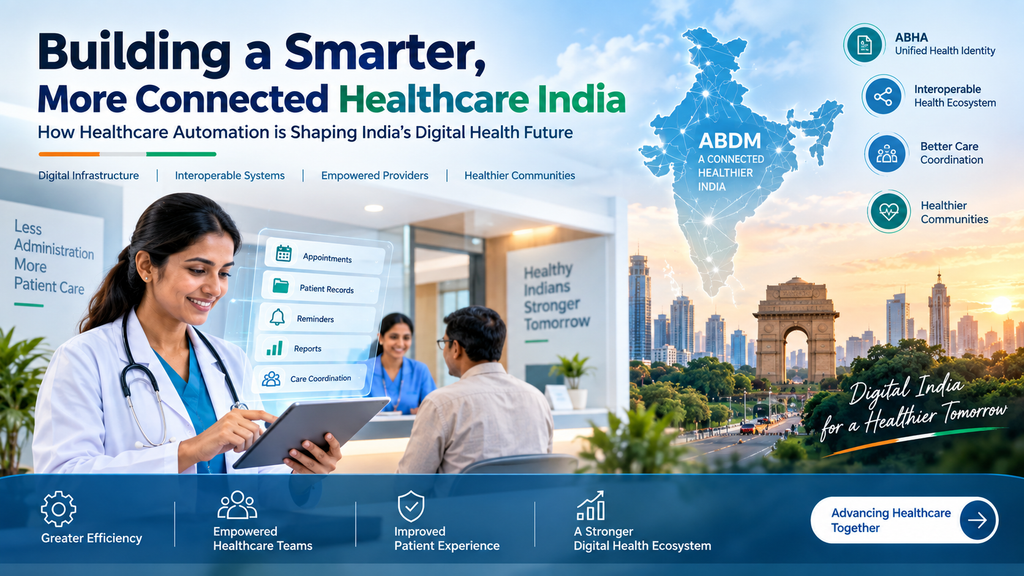
The Government of India continues to expand digital health initiatives, while ABDM provides infrastructure intended to support interoperability between healthcare stakeholders and digital solutions. The National Health Authority’s guidance emphasizes that digital health solutions should support healthcare delivery rather than create barriers to it.
Recent government initiatives also highlight the focus on reducing duplication and administrative burden through connected digital systems. For example, the Swasth Bharat Portal was launched in 2026 with the stated objective of integrating programme systems through APIs, reducing duplicate data entry, and streamlining reporting.
For smaller outpatient practices, the government has also recognized the practical challenge that large hospital management systems can be too complex or costly for small clinics. In June 2026, the Ministry of Health and Family Welfare announced eSushrut@Clinic, describing it as a light ABDM-enabled HMIS intended to address digitization challenges in small clinics.
These developments reinforce an important point: healthcare technology must be appropriate for the size and needs of the organization using it.
A small clinic does not necessarily need the same automation infrastructure as a large hospital. The goal should be to adopt technology that addresses genuine operational bottlenecks.
Key Takeaway
Healthcare automation can help Indian clinics reduce administrative work by simplifying repetitive communication, appointment management, patient registration, reminders, information collection, and routing workflows.
The greatest value does not come from automating every patient interaction. It comes from identifying repetitive administrative tasks and building workflows that handle appropriate requests efficiently while ensuring that staff remain available for exceptions, complex issues, and patient needs that require human attention.
For providers evaluating AI software for Indian Clinics, the best starting point is to identify where administrative teams spend the most time and determine which workflows can be streamlined without compromising patient experience or clinical oversight.
An AI-driven healthcare administration platform for clinics and diagnostic centres in India should support connected workflows, practical system integration, clear escalation paths, and the evolving requirements of India’s digital health ecosystem.
The future of clinic automation is not about removing people from healthcare. It is about reducing unnecessary administrative work so healthcare teams can spend more of their time doing the work that requires them most.
For clinics ready to explore healthcare-focused AI workflows, explore MantraAssist’s AI healthcare automation solutions or request a MantraAssist demo.
Frequently Asked Questions
Healthcare automation can support repetitive administrative tasks such as appointment reminders, routine scheduling requests, patient information collection, follow-up notifications, call routing, and other eligible communication workflows. This can help staff spend less time on repetitive tasks and focus more on patients and exceptions that require human attention.
AI software for Indian Clinics can support administrative communication, patient interaction routing, appointment management, information collection, reminders, and other repeatable workflows. Its role should be to improve operational efficiency while maintaining appropriate human involvement for complex, sensitive, or clinical matters.
No. The purpose of an AI-driven healthcare administration platform for clinics and diagnostic centres in India is generally to reduce repetitive administrative work rather than replace healthcare professionals or staff. Human teams remain essential for clinical decisions, complex patient interactions, exceptions, and situations requiring judgment.