

“My clinic has moved beyond paper records—but is our EMR ready for the future of connected healthcare?”
This is becoming an important question for clinics and healthcare providers across India. Digitizing patient records is only one part of healthcare transformation. As healthcare systems become more connected, providers also need to consider interoperability, patient identification, consent-based health information sharing, and compatibility with India’s evolving digital health ecosystem.
This guide focuses on what Digital Health in India means for clinics, what to look for in an ABDM-compliant medical software for clinics, and how healthcare providers can choose an EMR that supports both everyday clinical workflows and long-term digital readiness.
What Is ABDM and Why Does It Matter for Clinics?
The Ayushman Bharat Digital Mission (ABDM) aims to build an interoperable digital health ecosystem in India. Rather than requiring every healthcare provider to use the same software, ABDM enables different digital health systems to connect with its core infrastructure and supports interoperability across the ecosystem.
The ecosystem includes important components such as the Ayushman Bharat Health Account (ABHA), the Healthcare Professionals Registry (HPR), the Health Facility Registry (HFR), and the Health Information Exchange and Consent Manager (HIE-CM).
For Digital Health in India, this represents a shift from isolated digital systems toward greater interoperability.
ABDM adoption is also continuing to expand. In May 2026, the Government of India announced that more than 100 crore health records had been linked with ABHA accounts, reflecting the continued growth of the country’s digital health ecosystem.
For clinics, this makes the choice of EMR software increasingly important. The system should not only digitize patient records but also support relevant workflows that can help the clinic participate in India’s evolving digital health ecosystem.
What Does ABDM-Compliant EMR Software Mean?
An ABDM-enabled or ABDM-compliant EMR is a digital medical record system designed to support relevant integrations and workflows within the ABDM ecosystem.
However, clinics should not assume that every software product described as ABDM-ready, ABHA-enabled, or ABDM-compliant offers identical functionality.
The more important question is:
Which ABDM services and workflows does the software actually support?
Different digital health solutions can integrate with ABDM’s core modules through APIs. Depending on its integrations, an ABDM-compliant medical software for clinics may support workflows involving ABHA, health record creation and linking, consent-based information exchange, and other applicable ABDM services.
Healthcare providers should therefore ask vendors for specific information about active integrations and supported workflows instead of relying only on broad compliance claims.
Understanding the Key ABDM Components
To understand what makes an EMR ABDM-ready, clinics should first be familiar with the key components that support India’s digital health ecosystem.
ABHA
The Ayushman Bharat Health Account, or ABHA, is a randomly generated 14-digit unique number used to uniquely identify an individual in the digital health ecosystem. It can support the linking of health records across multiple systems and stakeholders with the individual’s consent.
For clinics, support for relevant ABHA workflows can help create more structured patient identification and digital health record processes.
However, having an ABHA does not automatically give a healthcare provider unrestricted access to a patient’s complete medical history. Health records are shared through applicable consent-based processes.
Health Facility Registry and Healthcare Professionals Registry
The Health Facility Registry and Healthcare Professionals Registry are important components of ABDM’s digital infrastructure.
Healthcare facilities, including hospitals, clinics, laboratories, diagnostic centres, and pharmacies, can participate in the ecosystem through relevant registration and integration pathways. Healthcare professionals can also register through the Healthcare Professionals Registry.
These registries support identification, trust, and interoperability within the broader digital health ecosystem.
Clinics evaluating EMR software should understand whether the platform supports the relevant facility and professional workflows applicable to their operations.
Consent-Based Health Information Exchange
Consent is one of the most important principles of ABDM.
ABDM follows a federated architecture and does not centrally store patients’ medical records. Health records continue to be created and stored within the digital systems used by healthcare providers, while ABDM facilitates secure information exchange between intended stakeholders after the patient’s consent.
The consent model can also be granular, allowing individuals to choose which records they wish to share rather than automatically sharing all linked health information.
For this reason, clinics should carefully understand how their EMR handles consent-related workflows, health record linking, sharing requests, and access to information.
Why Basic Digital Record Keeping Is No Longer Enough
Many clinics have already moved away from completely paper-based records. However, simply storing consultation notes electronically does not automatically make an EMR interoperable.
Doctors need efficient access to relevant patient information. Staff need practical registration and documentation workflows. At the same time, clinics increasingly need technology that can adapt to connected healthcare systems.
This is where Digital Health in India is changing how healthcare providers should evaluate software.
Instead of asking only:
“Can this EMR store patient records?”
Clinics should also consider whether the system can support structured health information, relevant ABDM-enabled workflows, consent-based processes, efficient daily operations, and future interoperability requirements.
The right EMR should support both clinical work and operational efficiency rather than simply replacing paper files with digital ones.
Key Features to Look for in an ABDM-Compliant EMR
When evaluating an ABDM-compliant EMR, clinics should focus on features that support both practical daily workflows and relevant digital health requirements.
Relevant ABDM Integrations
The first step is to understand exactly what the software supports.
Healthcare providers should ask vendors which ABDM services are integrated, which workflows are currently available, and how those integrations work in daily practice.
It is important to distinguish between future integration plans and capabilities that are currently available to the clinic.
ABDM also has a certification framework for HMIS, LMIS, and Clinic MIS solutions that have integrated with the ABDM Sandbox. Eligible solutions can undergo assessment, with the framework evaluating software functionality and applicable requirements. The official certification framework also specifies security certification and testing requirements for eligible solutions.
Structured Clinical Documentation
An EMR should make clinical documentation easier without adding unnecessary administrative complexity.
Healthcare providers should evaluate whether the system can capture and manage patient information in a structured and consistent way that supports their clinical requirements and relevant interoperability needs.
The exact functionality required will vary by clinic size, specialty, and workflow. A small outpatient clinic may have different documentation requirements from a multi-specialty practice or larger healthcare organization.
The key is to choose a system that can support structured information without making routine documentation unnecessarily difficult for doctors.
Efficient Patient Registration
Patient registration is one of the most frequently performed processes in a clinic.
A suitable EMR should help staff manage patient information efficiently while reducing duplicate records and unnecessary manual work. Where relevant ABDM-enabled workflows are used, the software should also make those processes practical for busy clinic staff.
Technology should simplify registration rather than creating another administrative burden.
Consent and Health Record Management
Healthcare providers should clearly understand how an ABDM-compliant medical software for clinics handles consent-related workflows.
Useful questions include:
- How is patient consent managed?
- How are consent-related actions recorded?
- Which health record linking workflows are supported?
- How are sharing requests handled?
- How does the system manage access to information?
These questions are particularly important because ABDM supports consent-based and granular sharing of health information.
Usability for Doctors and Staff
Compliance alone does not make software useful.
An EMR may support several integrations but still create operational problems if doctors and staff find routine tasks difficult to complete.
The system should fit naturally into workflows involving patient registration, consultation documentation, prescriptions, follow-ups, and record management.
For Digital Health India to deliver practical value, healthcare technology must work effectively in real clinical environments. Clinics should therefore evaluate whether the software improves everyday efficiency rather than simply adding more features.
How to Evaluate an ABDM-Compliant EMR
Healthcare providers should move beyond broad marketing terms and evaluate the actual capabilities of the software.
Before choosing an EMR, ask the vendor:
Which ABDM services are integrated?
Understand the exact services and workflows supported by the platform.
Are the integrations currently active?
A planned integration is different from a workflow the clinic can use today.
What validation, certification, and security processes apply to the solution?
Ask the vendor to explain the relevant validation, certification, security testing, and compliance processes associated with its ABDM integrations. Where applicable, vendors may also be eligible for ABDM’s certification and assessment framework.
How does the system manage future updates?
Digital health infrastructure continues to evolve, so the software provider should have a clear process for supporting relevant updates and changes.
How does the technology fit into everyday clinic operations?
The EMR should support doctors and staff without creating unnecessary administrative complexity.
This approach helps clinics evaluate real capabilities rather than relying only on labels such as ABDM-ready or ABDM-compliant.
How ABDM-Compliant EMR Software Can Support Clinic Growth
The value of a well-designed EMR extends beyond digital compliance.
As patient volume increases, clinics need more structured ways to manage information and workflows. A suitable EMR can help create a stronger digital foundation for patient records, documentation, and relevant healthcare processes.
Potential benefits can include more organized patient information, improved documentation workflows, reduced dependence on physical records, and more structured administrative processes.
For Digital Health in India, the long-term opportunity is to help healthcare providers participate in an interoperable ecosystem while continuing to use systems suited to their own clinical and operational requirements.
Technology alone, however, does not guarantee better outcomes. The real value depends on how effectively the software supports the people and workflows using it.
How to Choose the Right EMR for Your Clinic
The right EMR depends on factors such as the clinic’s size, specialty, patient volume, and workflow requirements.
A smaller clinic may prioritize simplicity and quick documentation. A multi-provider practice may need stronger administrative controls and workflow coordination. Larger organizations may require broader integration capabilities.
Before selecting an ABDM-compliant medical software for clinics, evaluate four key areas.
1. Everyday Usability – Doctors and staff should be able to complete routine tasks efficiently. A feature-rich system is not automatically the right choice if it makes registration, documentation, or patient management unnecessarily complicated.
2. Actual ABDM Capabilities – Ask specifically which ABDM services and workflows are supported. Do not rely only on broad terms such as ABDM-ready without understanding what functionality is actually available.
3. Interoperability and Future Readiness – Healthcare technology and digital health requirements continue to evolve. The EMR should be capable of adapting to relevant standards, integrations, and workflow changes without forcing the clinic to repeatedly replace its technology.
4. Vendor Support – Healthcare software requires ongoing support. Evaluate how the provider manages updates, technical assistance, training, integration changes, and evolving requirements.
The Future of Digital Health in India
The growth of ABDM represents a broader move toward connected healthcare infrastructure.
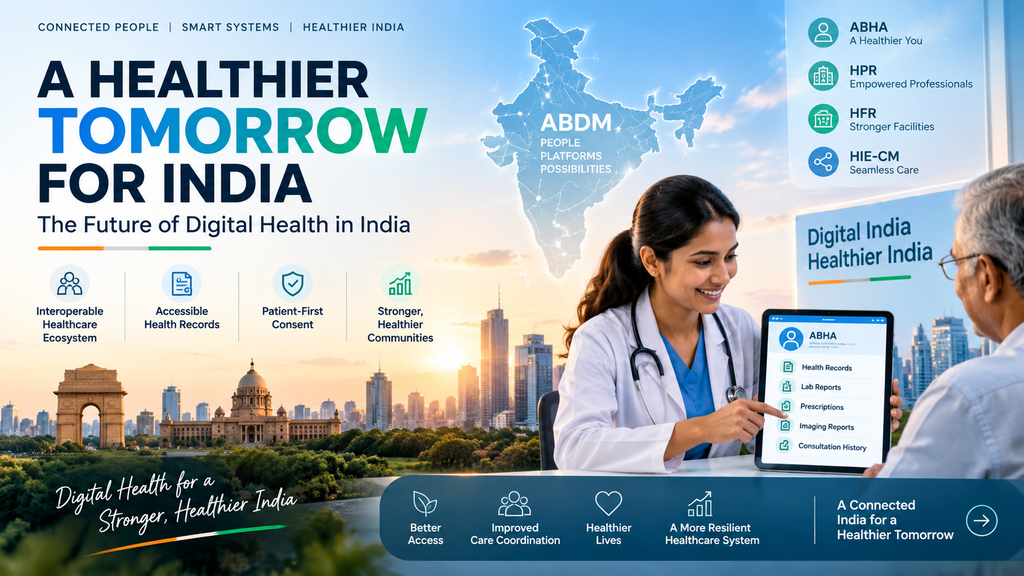
The objective is not for every healthcare provider to use the same software. ABDM explicitly supports interoperability between different digital health systems, and healthcare providers can continue using digital solutions of their choice.
This is an important development for Digital Health in India.
Clinics can continue using systems suited to their operational needs while preparing to participate in a more connected healthcare environment.
As digital health adoption grows, healthcare providers should evaluate technology not only for what it can do today but also for its ability to adapt to future requirements.
Key Takeaway
Choosing an EMR for the future of healthcare in India is about more than replacing paper records.
The right system should support efficient clinical documentation, practical patient management, structured information, and relevant digital health workflows without creating unnecessary complexity for doctors and staff.
As Digital Health in India continues to evolve, adaptable and interoperable technology can help healthcare providers prepare for a more connected healthcare ecosystem.
Before selecting an ABDM-compliant medical software for clinics, review the solution’s actual ABDM integrations, supported workflows, consent-related capabilities, usability, applicable security and validation processes, and long-term adaptability.
For the latest requirements and official guidance, healthcare providers should refer to the Ayushman Bharat Digital Mission and the ABDM certification framework.
Frequently Asked Questions
ABDM-compliant or ABDM-enabled EMR software supports relevant integrations and workflows within the Ayushman Bharat Digital Mission ecosystem. Depending on the solution, this may include ABHA-related workflows, health record processes, consent-based information exchange, and other applicable ABDM services.
No. ABDM follows a federated architecture. Health records continue to be created and stored in the systems used by healthcare providers, while ABDM facilitates secure and consent-based exchange between intended stakeholders.
Clinics should evaluate the software’s actual ABDM integrations, supported workflows, usability, consent-related capabilities, applicable security and validation processes, vendor support, and ability to adapt to future requirements.

