

“We are seeing more patients, but every increase in volume creates more calls, more scheduling work, and more pressure on the same team.”
This is a challenge many doctors face as their practices grow. More patients bring more appointment requests, cancellations, reminders, intake requirements, follow-ups, and routine questions. While growth is positive, the administrative work surrounding patient care can quickly increase.
Hiring more staff is not always the only solution. By identifying repetitive processes and using technology to automate clinic operations for growth, healthcare practices can create additional capacity without increasing administrative headcount at the same rate.
This guide explores practical ways to scale more efficiently and explains how healthcare practice automation can support sustainable practice growth.
1. Automate Routine Patient Calls
Patient calls can create a significant administrative workload. Many conversations involve routine requests, yet staff members may still need to answer every call, understand the patient’s needs, and coordinate the next step.
Patients commonly call to schedule appointments, change an existing visit, cancel an appointment, ask for office information, or reach the right department. As patient volume grows, handling these interactions manually can consume an increasing amount of staff capacity.
AI-powered call automation can help manage appropriate routine conversations by identifying the reason for the call and guiding the patient toward the relevant workflow.
For practices looking to automate clinic operations for growth, patient communication is often one of the most valuable places to start.
Healthcare Call Center Automation can help support AI-powered patient communication, intelligent routing, and appropriate automation for routine interactions.
2. Simplify Appointment Scheduling
Scheduling becomes more demanding as patient volume increases. Staff may spend a considerable part of the day managing new appointment requests, confirmations, cancellations, and rescheduling.
These tasks are essential, but many follow predictable workflows. When every request requires manual coordination, the administrative workload can increase alongside patient volume.
Appointment automation can support appropriate workflows involving new appointment requests, confirmations, rescheduling, cancellations, reminders, and other routine scheduling interactions.
This allows practices to manage increasing appointment activity more efficiently while staff focus on exceptions and requests that require individual attention.
Appointment Automation can help connect patient communication with appointment-related workflows.
For clinics focused on automating clinic operations for growth, scheduling is often one of the highest-impact areas to evaluate.
3. Reduce the Work Created by Cancellations and Rescheduling
Cancellations and appointment changes can create more administrative work than they initially appear to.
A simple request may require staff to locate the existing appointment, review available alternatives, update the schedule, and communicate new details to the patient. When these requests occur frequently, they can take significant time away from other responsibilities.
Structured automation can support appropriate appointment changes according to the scheduling rules established by the practice. Patients can be guided through available options while staff remains available for situations requiring additional assistance.
Reducing the manual effort associated with routine appointment changes is another practical way to automate clinic operations for growth.
4. Automate Patient Reminders and Routine Communication
As practices grow, routine communication requirements grow with them.
Staff may spend increasing amounts of time sending reminders, confirming appointments, communicating routine updates, and completing administrative follow-ups. Many of these interactions follow predictable processes and do not always require individual staff involvement.
Automation can support routine communication such as appointment reminders, confirmations, notifications, and other administrative updates.
The goal is not to automate every patient conversation. Instead, practices can identify predictable communication workflows and automate appropriate parts of the process.
Automated Patient Reminder Systems can support more consistent patient outreach while reducing repetitive administrative work.
This is another important part of scaling healthcare practice automation, particularly for practices managing increasing patient volumes.
5. Improve Patient Intake Before the Appointment
Administrative work often begins before a patient arrives at the clinic.
Manual intake processes can require staff to distribute forms, collect information, review responses, identify missing details, and prepare information for the next stage of the patient journey.
As patient volume increases, this repetitive work can place additional pressure on front-office teams.
Digital and automated intake processes can help collect appropriate information before an appointment and give staff greater visibility into missing details earlier in the patient journey.
This can help improve appointment readiness while reducing repetitive administrative work.
For growing practices, improving intake is one way to use scale healthcare practice automation to create more capacity without increasing manual work at the same rate as patient volume.
6. Use Intelligent Routing to Reduce Unnecessary Transfers
Not every patient call should reach the same person or department.
Without effective routing, staff may spend time identifying why a patient is calling, transferring the interaction, or asking questions that another team member has already asked.
AI-powered routing can help identify the purpose of an interaction and direct it toward the appropriate team, department, location, or workflow.
This can reduce unnecessary transfers and repetitive conversations while improving how staff capacity is used.
For practices working to automate clinic operations for growth, improving how patient interactions move through the organization can be just as important as increasing the number of interactions the practice can manage.
Healthcare Call Center Automation can support routing and patient communication workflows designed for healthcare organizations.
7. Create More Capacity From Your Existing Team
Scaling does not always require increasing headcount at the same rate as patient volume.
In many healthcare practices, existing staff already spend significant time on repetitive administrative work. Reducing that workload can create additional capacity without immediately adding more employees.
Automation can help reduce the time spent managing predictable scheduling requests, reminders, call transfers, routine information collection, and other repeatable administrative tasks.
The goal is not to replace healthcare staff. Instead, it is to allow staff to spend more time where human judgment, empathy, and experience provide the greatest value.
This is one of the key advantages of scaling healthcare practice automation. Practices can improve how their existing capacity is used rather than assuming every increase in volume requires proportional hiring.
8. Connect Workflows Instead of Adding Disconnected Tools
Growing practices often adopt separate tools to solve individual problems.
One platform may manage calls, another scheduling, and another patient communication. While each system may offer useful capabilities, disconnected technology can create additional work when staff need to move information manually between workflows.
A stronger approach is to focus on connected automation.
For example, when a patient calls to reschedule an appointment, the interaction should ideally move toward the scheduling workflow required to complete that request rather than creating another manual task for staff.
MantraAssist supports healthcare-focused AI and automation designed to connect patient communication with repeatable administrative workflows.
For organizations working to automate clinic operations for growth, connected workflows can help reduce the complexity created by multiple disconnected processes.
9. Standardize Repeatable Processes
Processes that work informally in a small practice can become difficult to manage as patient volume and staff responsibilities increase.
Different employees may develop different approaches to handling calls, scheduling appointments, managing cancellations, or completing follow-ups. Over time, this can create inconsistency and make training more difficult.
Standardizing repeatable workflows creates a stronger operational foundation.
Practices can establish more consistent approaches for patient calls, appointment requests, routine communication, intake, routing, and administrative follow-ups while ensuring complex situations still reach the appropriate staff.
This makes automating clinic operations for growth more sustainable as the practice expands.
10. Start With the Workflow Creating the Greatest Burden
Practices do not need to automate everything at once.
A better approach is to identify the administrative process creating the greatest amount of repetitive work and start there.
Doctors and practice leaders can ask:
Which tasks consume staff time every day without necessarily requiring clinical expertise?
The answer may be routine patient calls, appointment scheduling, cancellations, reminders, intake, call transfers, or repetitive administrative follow-ups.
Once the highest-volume workflow is identified, the practice can evaluate whether automation can support that specific process.
Starting with a clear operational challenge makes it easier to introduce automated clinic operations growth strategies gradually and measure their impact.
How MantraAssist Can Support Scalable Practice Operations
The most effective automation strategy is not about implementing AI everywhere. It is about identifying the workflows that repeatedly consume staff time and connecting technology to those processes.
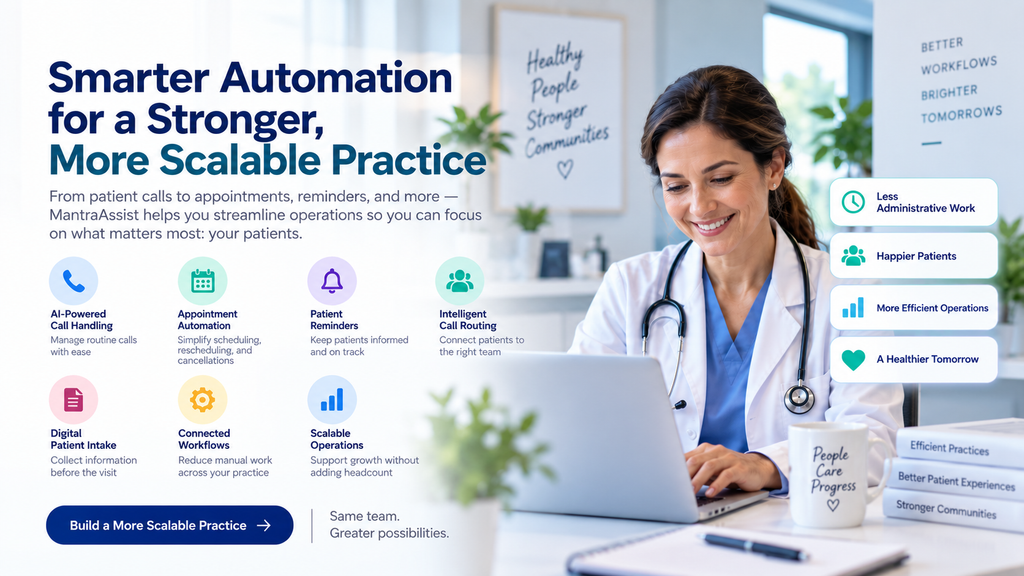
MantraAssist can support healthcare practices with AI-powered patient communication and workflow automation across areas such as call handling, intelligent routing, appointment scheduling, cancellations, rescheduling, reminders, and routine communication.
A connected approach can help patient interactions move toward the workflow required to address the request while ensuring complex situations can still reach the appropriate human team.
Key Takeaway
Scaling a healthcare practice without hiring more staff does not mean operating without people. Healthcare will always depend on clinical expertise, human judgment, and meaningful patient interaction.
The opportunity is to reduce the amount of staff time spent on predictable administrative work.
By using technology to automate clinic operations for growth, practices can create additional capacity, improve workflow consistency, and manage increasing patient volume more efficiently.
For organizations exploring scale healthcare practice automation, the strongest starting point is to identify the highest-volume repetitive workflows and determine where connected automation can provide meaningful operational support.
Frequently Asked Questions
Yes. Healthcare practices can manage growth more efficiently by automating appropriate repetitive administrative workflows. Automating areas such as routine patient communication, scheduling, reminders, intake, and call routing can help create additional capacity for existing teams.
High-volume, repetitive processes are often the best starting point. These may include routine patient calls, appointment scheduling, cancellations, reminders, patient intake, and call routing.
No. The purpose of automation is not to replace staff but to reduce repetitive administrative work. This allows healthcare teams to spend more time on complex patient needs, sensitive interactions, and tasks that require human judgment.

