
“I spend so much time managing calls, appointments, and administrative work that there is never enough time in the day.”
This is a challenge many doctors and clinic teams face. Patient care may be the priority, but every appointment is surrounded by administrative tasks. Calls need to be answered, appointments scheduled or changed, reminders sent, patient information collected, and routine questions managed.
The right software to grow a medical practice can help reduce this burden by automating appropriate, repetitive workflows. Instead of requiring staff to manage every routine interaction manually, AI-powered tools can support patient communication, appointment management, intake, and routing while helping doctors and teams spend more time on patient care.
This guide focuses on the best AI tools for doctors and how the right software to grow a medical practice can help clinics save time, improve operational capacity, and support sustainable growth.
Why Doctors Are Turning to AI-Powered Practice Tools
A busy medical practice involves far more than consultations and treatment.
Before a patient arrives, staff may need to manage appointment requests, reminders, intake information, and scheduling changes. After the visit, additional communication and follow-up tasks may be required.
As patient volume grows, these processes can place increasing pressure on doctors and staff. Clinics may respond by hiring additional administrative employees, but this does not always address the underlying issue: too many repetitive workflows still depend on manual effort.
This is where AI tools for clinic growth can provide value.
AI does not need to replace doctors or remove human interaction from healthcare. Its practical role is to help manage appropriate administrative tasks so healthcare teams can focus their time where human involvement matters most.
For many practices, the most effective software to grow a medical practice is software that improves the everyday workflows already consuming staff time.
The Best AI Tools for Doctors
The best AI tools are not necessarily the most complex. They are the ones that solve practical problems within the daily operations of a medical practice.
AI-Powered Patient Call Automation
Patient calls can create a significant administrative workload.
Clinics regularly receive calls about appointments, cancellations, rescheduling, office information, and other routine requests. When every call requires staff involvement, teams may spend a substantial amount of time managing repetitive conversations.
AI-powered call automation can help identify why a patient is calling and guide eligible requests toward the appropriate workflow.
For example, patients may call to:
- Schedule an appointment
- Reschedule an existing appointment
- Cancel a visit
- Ask for routine office information
- Reach the appropriate department
Healthcare call center automation can support healthcare organizations by automating appropriate patient communication workflows while providing pathways for complex or sensitive interactions to reach human teams.
For growing clinics, this type of software to grow a medical practice can help reduce the amount of routine communication that depends entirely on staff availability.
Appointment Scheduling and Management Automation
Scheduling is one of the most important administrative functions in any medical practice.
Patients need convenient ways to request appointments, while clinics need to manage provider availability, appointment types, scheduling rules, cancellations, and changes.
Without connected automation, staff may spend a significant part of the day coordinating these requests manually.
AI and automation can support eligible workflows involving:
- New appointment requests
- Appointment confirmations
- Rescheduling
- Cancellations
- Patient reminders
- Waitlist-related communication
Appointment automation helps connect patient communication with appointment-related workflows, supporting a more efficient approach to routine scheduling interactions.
For practices handling increasing patient volumes, appointment automation can become an important part of their software to grow their medical practice strategy.
Automated Patient Intake
The patient journey often begins before the consultation.
Collecting information manually can create additional work for patients and staff. Forms may need to be distributed, completed, reviewed, and transferred into other systems.
Digital and automated intake workflows can help practices collect required information before the appointment when appropriate.
This can help teams:
- Reduce repetitive information collection
- Identify missing information earlier
- Improve appointment readiness
- Reduce manual administrative work
- Create more structured intake workflows
For busy practices, automated intake is one of the practical AI tools for clinic growth because it can support increasing patient volumes without requiring the same increase in manual intake work.
How AI Can Help Clinics Grow Without Adding Administrative Work at the Same Rate
Growth does not always mean every administrative function should expand proportionally.
A clinic may see more patients without wanting to add more staff for every increase in calls, scheduling requests, reminders, and routine communication.
This is where tools to scale clinics without hiring staff can become useful.
The goal is not to eliminate employees. Instead, automation can help reduce the number of repetitive tasks that require staff to complete the same process manually every time.
For example, if staff spend a large part of the day answering routine appointment calls, AI can help manage eligible requests while staff focus on exceptions and more complex patient needs.
The same approach can apply to:
- Appointment reminders
- Patient intake
- Call routing
- Routine scheduling requests
- Administrative follow-ups
- Basic patient communication
The right software to grow a medical practice should help practices create additional operational capacity by improving how routine work is managed.
What Doctors Should Look for When Choosing AI Tools
Not every AI tool will solve a meaningful operational problem.
Doctors and practice leaders should begin by identifying where time is currently being lost. For many clinics, this includes patient calls, appointment coordination, intake, follow-up communication, and repetitive administrative tasks.
The technology should address these specific challenges.
Important capabilities to consider include:
Healthcare-Focused Workflows
The tool should support the operational requirements of a medical practice rather than forcing healthcare workflows into a generic system.
Connected Patient Communication
Patients should be able to move from a routine request toward an appropriate workflow rather than simply receiving information that creates another manual task for staff.
Workflow Automation
The technology should help automate appropriate, repeatable processes and reduce unnecessary administrative coordination.
Human Escalation
AI should not attempt to handle every situation independently. Complex, sensitive, clinical, or unusual requests should have clear pathways to appropriate staff.
Scalability
The platform should continue supporting the practice as patient communication and operational volume increase.
The best software to grow a medical practice is not simply software with AI features. It should help solve an operational problem that would otherwise require additional time, staffing, or manual coordination.
How MantraAssist Supports Practice Growth
When evaluating the best AI tools for doctors, it is important to look beyond individual features.
A clinic may use separate systems for calls, scheduling, and patient communication. However, disconnected technology can create additional work when staff need to move information manually between different processes.
MantraAssist provides healthcare-focused AI and automation designed to support patient communication and repeatable administrative workflows.
For medical practices, MantraAssist can support areas such as:
- AI-powered patient call handling
- Intelligent call routing
- Appointment scheduling workflows
- Cancellations and rescheduling
- Patient reminders
- Routine patient communication
- Workflow-based escalation
The value of a connected approach is that a patient interaction can move toward the workflow required to address the request.
For example, a patient calling to change an appointment does not simply need information. The request may need to move through an appointment workflow based on the clinic’s scheduling rules.
This makes connected automation an important consideration when selecting software to grow medical practice operations.
Rather than adopting technology simply because it uses AI, clinics should evaluate whether it helps reduce repetitive work and improve the management of everyday patient interactions.
AI Can Improve Staff Capacity Without Replacing Human Care
One concern about AI in healthcare is that automation may reduce the human element of patient care.
However, when implemented appropriately, automation can help protect staff capacity for interactions where human involvement is most valuable.
By reducing repetitive administrative work, staff may have more time for:
- Complex patient questions
- Sensitive conversations
- Workflow exceptions
- In-person patient support
- Requests requiring judgment
- Situations that cannot be resolved through a standard workflow
This is particularly important for clinics using tools to scale without hiring staff.
The objective should not be to automate every patient interaction. Instead, practices can automate appropriate, predictable processes while maintaining clear pathways for patients to receive human assistance.
For doctors, this can support greater operational capacity without reducing the importance of personal care.
Choosing the Right Starting Point
Clinics do not need to implement every AI tool at once.
The strongest starting point is usually identifying the administrative workflow creating the greatest burden.
A practice should ask:
Which tasks repeatedly consume staff time every day without requiring clinical expertise?
The answer may be patient calls, appointment coordination, intake, reminders, or routine follow-up communication.
Once the highest-volume repetitive workflows are identified, the practice can determine where automation may provide the greatest value.
| Practice Challenge | Potential AI or Automation Support |
|---|---|
| High volume of routine patient calls | AI-powered call handling and routing |
| Staff spend significant time scheduling | Appointment workflow automation |
| Frequent cancellations and appointment changes | Automated eligible appointment workflows |
| Repetitive patient communication | Automated reminders and notifications |
| Manual information collection | Digital or automated patient intake |
| Unnecessary call transfers | Intent identification and intelligent routing |
This approach helps doctors select technology based on actual operational needs.
The right software to grow a medical practice should make an existing process easier rather than creating another disconnected system for staff to manage.
The Role of AI in Long-Term Clinic Growth
As clinics grow, administrative demands usually increase alongside patient volume.
More patients can mean more calls, more appointment requests, more reminders, and more coordination.
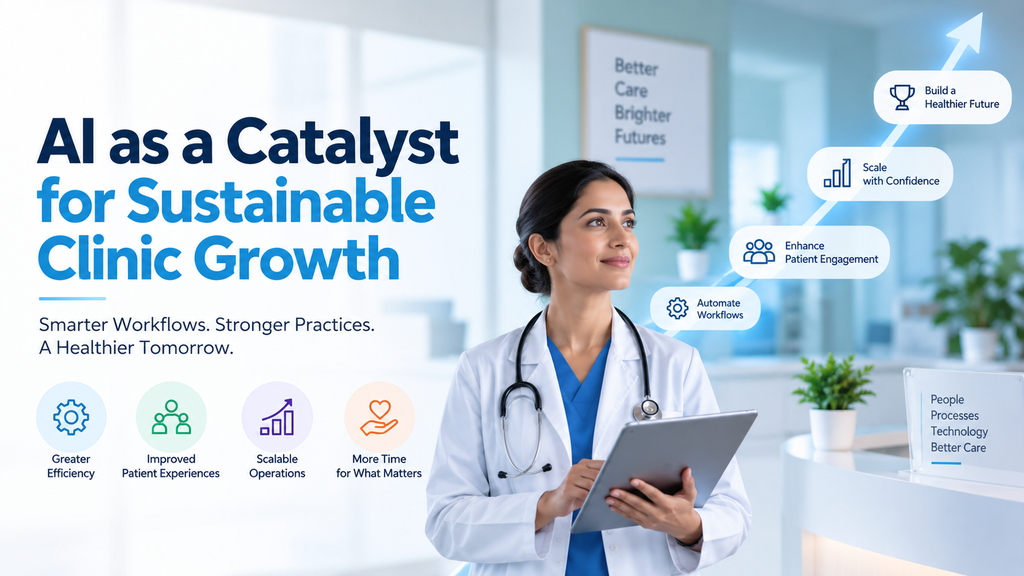
Without operational improvements, growth can place increasing pressure on doctors and staff.
This is why AI tools for clinic growth should be viewed as part of a broader operational strategy rather than a standalone technology investment.
A well-designed automation approach can help clinics:
- Reduce repetitive administrative work
- Support faster responses to routine requests
- Improve workflow consistency
- Reduce unnecessary call transfers
- Create additional staff capacity
- Support growth without increasing manual work at the same rate
For practices exploring tools to scale clinics without hiring staff, automation can help create additional capacity by improving how high-volume, repetitive administrative work is managed.
The strongest results usually come from matching technology to a clearly defined workflow challenge.
Key Takeaway
The best AI tools for doctors are not simply those with the most advanced technology. They are the tools that solve real operational problems and give doctors and staff more time to focus on patients.
The right software to grow a medical practice can support patient communication, appointment management, call handling, intake, and other repeatable administrative workflows.
For clinics looking to improve efficiency and build a more scalable operating model, MantraAssist can help connect AI-powered patient communication with appointment workflows, routing, and healthcare-focused automation.
Frequently Asked Questions
The best AI tools for doctors depend on the practice’s operational challenges. Useful areas can include AI-powered patient communication, appointment automation, digital intake, call routing, reminders, and workflow automation that reduces repetitive administrative work.
AI can help clinics manage increasing volumes of appropriate routine administrative work more efficiently. It does not remove the need for healthcare staff, but it can help teams focus more of their time on complex interactions and patient needs that require human support.
Doctors should look for healthcare-focused technology that supports their specific workflows, helps automate repetitive administrative tasks, scales with patient volume, and provides clear pathways for human escalation when required.

