
Patient calls are a major part of daily clinic operations, but front-desk teams often have to manage incoming calls while scheduling appointments, handling cancellations, assisting in-person patients, and responding to routine queries. When call volumes increase, even simple requests can lead to long wait times, missed calls, and additional administrative work.
AI patient call automation helps clinics manage routine interactions by answering calls, identifying patient needs, automating appointment scheduling and changes, and routing more complex requests to staff. This guide explains how clinics can automate patient calls and appointment scheduling while maintaining clear pathways for human assistance.
Why Clinics Need AI Patient Call Automation
For many clinics, the phone remains one of the primary ways patients access care. Patients call to book appointments, reschedule visits, cancel existing bookings, confirm appointment details, ask routine questions, or reach a specific department.
The challenge is that these calls often arrive while front-desk teams are already managing other responsibilities.
This can create several operational challenges:
- Long hold times during busy periods
- Missed calls when staff are assisting in-person patients
- Increased voicemail volume
- Delays in appointment scheduling
- Repetitive administrative work
- Unnecessary call transfers
- Slower responses to cancellations and rescheduling requests
Many of these interactions are routine and follow predictable workflows. This is where an AI medical receptionist can help by managing routine patient communication and reducing the volume of repetitive calls that require immediate front-desk attention.
The goal is not to eliminate human interaction. Instead, AI patient call automation can handle appropriate routine requests while allowing staff to focus on complex interactions, in-person patients, and situations that require human judgment.
What Is AI Patient Call Automation and How Does It Work?
AI patient call automation uses conversational AI to answer and manage patient phone interactions.
Unlike traditional phone systems that primarily depend on pre-recorded menus and keypad selections, conversational AI can understand the reason for a patient’s call and guide the interaction toward the appropriate next step.
Depending on the clinic’s workflow, an AI system may help with:
- Answering incoming patient calls
- Identifying why a patient is calling
- Responding to approved routine queries
- Scheduling appointments
- Rescheduling existing appointments
- Processing cancellations
- Confirming appointment details
- Collecting information for staff follow-up
- Routing calls to the appropriate department
- Escalating complex interactions to human staff
A typical workflow can be divided into four stages:
| Stage | How AI Supports the Call | Potential Outcome |
|---|---|---|
| Call answering | AI answers the incoming call | Patients receive an immediate response |
| Intent identification | AI identifies the purpose of the call | The patient enters the appropriate workflow |
| Request handling | AI manages eligible routine requests | Scheduling or information requests are completed |
| Escalation | AI transfers calls requiring human attention | Staff handle complex or sensitive interactions |
For example, a patient may call and say, “I need to schedule an appointment next week.” The AI can identify the request and guide the patient through the relevant scheduling workflow.
For clinics managing high volumes of phone-based patient interactions, Voice AI for healthcare can support conversational call handling and help patients complete routine requests without requiring staff to manage every interaction manually.
The value of this approach comes from separating routine communication from interactions that genuinely require human involvement.
How AI Automates Patient Calls and Routine Queries
Many patient calls involve questions and requests that follow predictable workflows.
Patients may call to ask about:
- Clinic hours
- Practice locations
- Services offered
- Provider availability
- Appointment requirements
- Upcoming appointment details
- General administrative information
When staff answer these questions repeatedly throughout the day, routine communication can consume a significant amount of administrative time.
AI patient call automation can provide answers based on approved clinic information and configured workflows. A patient calling after office hours, for example, may still be able to receive information, request an appointment, or manage an eligible scheduling change.
AI can also identify the reason for a call before determining the appropriate next step.
Instead of transferring every patient through multiple departments, the system can:
- Identify the purpose of the call
- Determine whether the request can be handled automatically
- Route department-specific requests
- Collect relevant information for staff
- Escalate interactions that require human assistance
This can help reduce unnecessary call transfers and repetitive front-desk work.
A connected healthcare call center automation workflow can help clinics manage routine inquiries, identify the purpose of incoming calls, and direct patients toward the appropriate department or next step.
However, automation should have clear boundaries. Requests involving clinical judgment, complex concerns, or situations outside the approved workflow should be escalated according to the clinic’s established processes.
The most effective approach is not to automate every conversation. It is to automate routine and repeatable interactions while ensuring patients can reach staff when necessary.
How AI Automates Appointment Scheduling and Management
Appointment scheduling is one of the most practical uses of AI patient call automation.
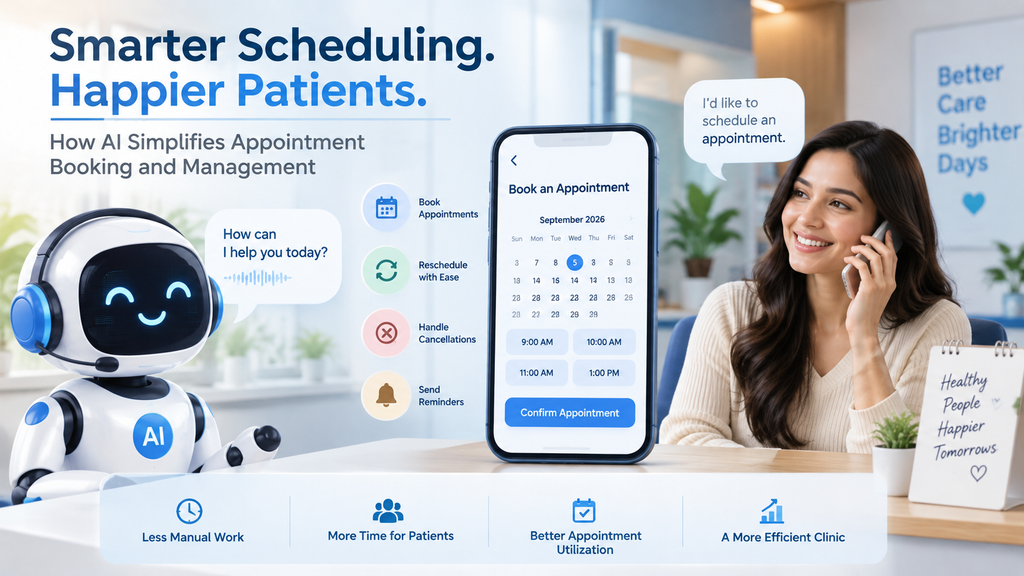
Without automation, a routine appointment request may require staff to:
- Answer the call
- Understand what the patient needs
- Identify the relevant provider or service
- Check appointment availability
- Discuss suitable options
- Update the appointment calendar
- Confirm the final booking
AI can support many of these steps through a connected scheduling workflow.
Appointment Booking
When a patient calls to schedule an appointment, AI may guide the conversation through steps such as:
- Identifying the requested service or provider
- Checking available appointment slots
- Presenting eligible appointment options
- Confirming the patient’s preferred time
- Updating the connected schedule
- Providing appointment confirmation details
This can reduce the manual coordination required for routine booking requests.
By connecting patient communication directly with scheduling workflows, AI appointment scheduling software can help clinics automate appointment booking and reduce the manual coordination required for routine scheduling requests.
The most useful systems connect the patient conversation with the appointment workflow. Instead of answering the call and creating another task for staff, automation can help move the request toward resolution.
Rescheduling and Cancellations
Scheduling is only one part of appointment management. Clinics also receive regular calls from patients who need to reschedule or cancel existing appointments.
Without automation, each request may require staff to:
- Locate the patient’s existing appointment
- Check alternative appointment availability
- Discuss suitable options with the patient
- Update the appointment calendar
- Communicate the revised appointment details
- Manage schedule gaps created by cancellations
AI patient call automation can simplify these workflows by allowing patients to manage eligible appointment changes through conversational self-service.
For example, AI can help patients:
- Request a new appointment time
- Check available appointment slots
- Select an alternative time
- Confirm the rescheduled appointment
- Cancel an appointment when necessary
- Receive updated appointment details
When an appointment is cancelled, the available slot can also become part of a broader scheduling workflow. Clinics may be able to use waitlist processes to identify patients who could fill the newly available appointment.
This can help reduce repetitive scheduling work while supporting better use of available appointment capacity.
Confirmations and Reminders
Appointment management should not end once the booking is complete.
Patients may forget appointments, need to confirm attendance, or need to make a change before the visit. Automated communication can support these interactions without requiring staff to manually contact every patient.
A connected workflow may include:
- Appointment confirmations
- Automated reminders
- Patient confirmation responses
- Rescheduling options
- Cancellation handling
- Pre-visit communication
- Waitlist outreach
The most useful reminder workflows allow patients to take action.
For example, a patient who cannot attend may be able to respond and enter an appropriate rescheduling or cancellation workflow instead of calling the clinic separately.
As explained in MantraAssist’s guide to automated appointment reminder systems, reminders can become part of a broader workflow that allows patients to confirm, reschedule, or respond without requiring staff to manage every interaction manually.
Call Routing, Outbound Calls, and Human Escalation
Not every patient interaction should be handled in the same way.
Some calls can be resolved through automation, while others need to reach a specific department or staff member. Effective AI patient call automation depends on accurately identifying the patient’s request and determining the appropriate next step.
Call Routing
Patients may call for:
- Scheduling assistance
- Billing questions
- Administrative support
- Department-specific requests
- Provider-related information
- Follow-up assistance
AI can identify the purpose of the interaction and follow configured routing rules.
For larger clinics and multi-specialty practices, this can reduce unnecessary transfers. Rather than requiring every caller to navigate the same phone menu, AI can help direct the patient based on what they need.
Outbound Patient Calls
Automation can also support proactive patient communication.
Clinics may use automated workflows for:
- Appointment reminders
- Appointment confirmations
- Follow-up scheduling
- Waitlist notifications
- Recall outreach
- Post-visit communication
For example, when an appointment becomes available because another patient cancels, an automated workflow may help notify eligible patients waiting for an earlier appointment.
For clinics looking to connect voice interactions with broader patient communication workflows, healthcare automation can help bring routine outreach, scheduling, reminders, and administrative processes into a more connected operational workflow.
Human Escalation
Automation should always have clear limits.
Patients may have complex questions, request direct assistance, or need to speak with a specific team member. The AI system should be able to recognize when an automated workflow is no longer appropriate and transfer the interaction according to established clinic processes.
A practical approach is:
AI handles routine requests → AI routes department-specific calls → Staff manages complex interactions.
This creates a division of work in which automation handles repetitive communication while staff focuses on situations requiring judgment, coordination, or direct human assistance.
Key Benefits of AI Patient Call Automation
When implemented around appropriate workflows, AI patient call automation can support both patient access and clinic operations.
Benefits for Clinics
- Reduced repetitive workload: Staff spend less time answering the same routine questions.
- Fewer missed calls: Patients can receive an immediate response when staff is unavailable.
- Improved scheduling efficiency: Routine booking and appointment changes can be automated.
- Better use of staff time: Employees can focus on in-person patients and complex tasks.
- Consistent workflows: Routine interactions follow approved communication processes.
- Improved call routing: Patients can reach the appropriate department more efficiently.
- Greater scalability: Clinics can manage growing call volumes without requiring every interaction to create additional manual work.
Benefits for Patients
- Faster responses: Routine calls can be answered without waiting for staff availability.
- Greater scheduling flexibility: Eligible appointments can be booked or changed through automated workflows.
- Convenient access: Routine assistance may be available beyond standard front-desk hours.
- Fewer unnecessary transfers: Calls can be routed based on the patient’s request.
- More self-service options: Patients can manage appropriate appointment requests independently.
The greatest benefit comes from reducing unnecessary friction. Patients do not necessarily need to wait for a staff member to complete routine scheduling tasks, while patients who require human assistance should still have a clear path to reach the appropriate team.
AI Patient Call Automation vs. Traditional Phone Handling
Traditional phone workflows depend heavily on staff availability. If the team is busy, patients may need to wait, leave a voicemail, or call again.
AI adds automation to the first layer of patient communication.
| Traditional Phone Handling | AI Patient Call Automation |
|---|---|
| Patients wait for available staff | AI can answer routine calls immediately |
| Staff identify the reason for every call manually | AI can identify call intent |
| Booking requires staff involvement | Eligible bookings can follow automated workflows |
| Staff repeatedly answer routine questions | AI can provide approved information |
| Rescheduling requires manual coordination | Patients may manage eligible changes through self-service |
| Calls are transferred manually | AI can route calls based on configured workflows |
| Outbound reminders require staff time | Routine outreach can be automated |
| More patient calls create more manual work | Automation can help manage repeatable interactions |
The purpose is not to eliminate front-desk staff from patient communication.
Instead, AI changes how routine work is distributed.
Staff remain essential for:
- Complex patient interactions
- In-person patient support
- Sensitive situations
- Workflow exceptions
- Requests requiring judgment
- Clinical or professional escalation
AI can handle the first layer of repeatable communication, allowing staff to focus on interactions where human involvement adds the most value.
What to Look for in an AI Patient Call Automation System
The effectiveness of an AI system depends on how well it fits into a clinic’s existing communication and scheduling workflows.
Before selecting a system, healthcare organizations should consider:
- Appointment scheduling integration: The system should work with the clinic’s scheduling environment.
- Natural conversation capabilities: Patients should be able to explain what they need without having to navigate complicated phone menus.
- Clear human handoffs: There should be defined pathways for transferring calls to staff.
- Configurable workflows: Different clinics and specialties have different scheduling and routing requirements.
- Complete appointment management: Booking, cancellations, rescheduling, reminders, and waitlist workflows should be considered together.
- Inbound and outbound communication: The system should support more than incoming calls alone.
- Privacy and security considerations: Healthcare organizations should evaluate how patient information is handled.
- Reporting and visibility: Clinics should be able to understand call volume, common requests, and escalation patterns.
The best system is not necessarily the one with the longest feature list. It is the one that supports the clinic’s actual patient communication needs without creating unnecessary complexity.
The Key Takeaway
AI patient call automation helps clinics manage routine patient communication and appointment workflows more efficiently. By connecting conversational AI with scheduling systems, clinics can automate appropriate tasks such as answering routine calls, booking appointments, handling rescheduling and cancellations, sending reminders, and routing patients to the right team.
The most effective approach is not to automate every interaction. It is to automate routine and repeatable workflows while maintaining clear pathways for human assistance.
When patient call automation and appointment scheduling work together, clinics can reduce repetitive administrative work, improve patient access, and allow front-desk teams to focus on the interactions where human attention matters most.
Frequently Asked Questions
Yes. When connected with appropriate scheduling workflows, AI can help patients check available appointment options, select an eligible time, and complete appointment bookings.
AI can support eligible cancellation and rescheduling workflows by locating appointments, checking available alternatives, and guiding patients through approved scheduling options.
No. AI is most useful for reducing repetitive call handling. Front-desk teams can focus on in-person patients, complex requests, and interactions requiring judgment or human assistance.

