
Every clinic knows the pressure that builds around the front desk. Phones start ringing before the day begins. Patients arrive for appointments. Staff answer questions, manage scheduling, check patients in, and handle administrative requests at the same time. When call volume rises, even a strong front-desk team can become overloaded. Virtual Medical Receptionist are changing how healthcare clinics approach this problem. They can answer calls, handle routine requests, support scheduling, and provide after-hours coverage.
The real decision is not whether AI or humans are better overall. It is about deciding which tasks each should handle.
How Is the Healthcare Front Desk Changing?
The front desk plays a central role in patient access. Receptionists answer phones, greet patients, schedule appointments, provide information, collect administrative details, and coordinate with other teams.
The Bureau of Labor Statistics reports that medical secretaries and administrative assistants had a median annual wage of $46,800 in May 2025. Medical secretaries in ambulatory healthcare services had a median annual wage of $45,390. These figures reflect employee wages and do not include the full cost of benefits, payroll taxes, technology, recruiting, or training.
The workload also involves frequent communication. BLS data shows that external verbal interactions are required constantly for 68% of medical secretaries and administrative assistants. Another 25.1% have these interactions more than once per hour.
This helps explain why phone volume can become a significant operational challenge.
AI voice technology offers another option. Instead of using employees for every incoming call, clinics can automate defined administrative tasks and reserve staff time for interactions that benefit from human involvement.
What is a Virtual Medical Receptionist for Healthcare?
An AI voice bot is software that communicates with callers using conversational speech. It can recognize what a patient is asking and respond according to configured workflows.
Unlike a traditional interactive voice response system, an AI receptionist does not always require callers to select numbered menu options. A patient can state a request in natural language. For example, a caller might say, “I need to reschedule my appointment for next week.”
If the AI has the necessary scheduling integration and permissions, it can identify the request and follow the clinic’s scheduling rules.
Depending on the platform, healthcare AI voice systems may support:
- Appointment scheduling and rescheduling
- Appointment cancellations
- Routine patient questions
- Office hours and location information
- Call routing
- After-hours call handling
- Intake and information collection
- Reminder and recall workflows
- Human handoffs
The exact capabilities vary by vendor. Clinics should verify integrations, security controls, workflow support, and pricing before selecting a platform.
What Human Receptionists Do Best
AI can handle many repetitive tasks, but human receptionists provide capabilities that remain important in healthcare.
Empathy and Emotional Support
Patients do not always call with simple administrative questions. A caller may be frustrated about a billing issue. Another may be anxious about an appointment. A family member may be upset because of a scheduling problem. A trained receptionist can listen, adapt their communication style, and recognize when a conversation needs more personal attention. That human connection can be especially valuable in smaller practices where staff build long-term relationships with patients.
Complex Situations
Healthcare interactions do not always follow predictable rules. A patient may explain a situation that does not fit a standard scheduling category. A receptionist can ask follow-up questions and decide which person or department should handle the issue. This does not mean a receptionist should make clinical decisions. Clinical judgment belongs with appropriately qualified clinical professionals.
However, experienced front-desk staff can recognize when an administrative request is becoming more complex and needs escalation.
In-Person Patient Support
A voice bot cannot greet a patient who walks into the clinic. Human staff can help patients check in, understand forms, find the correct department, or resolve an unexpected issue at the front desk. This physical presence remains an important part of the patient experience.
Relationship and Continuity
Patients may prefer speaking with someone familiar. A receptionist who knows the clinic’s workflows and recognizes returning patients can provide continuity that an automated system cannot fully reproduce. For practices that emphasize personalized service, this relationship can be an important part of the patient experience.
What Are the Benefits of a Virtual Medical Receptionist?
AI voice bots offer several operational advantages that are difficult for a single receptionist to match.
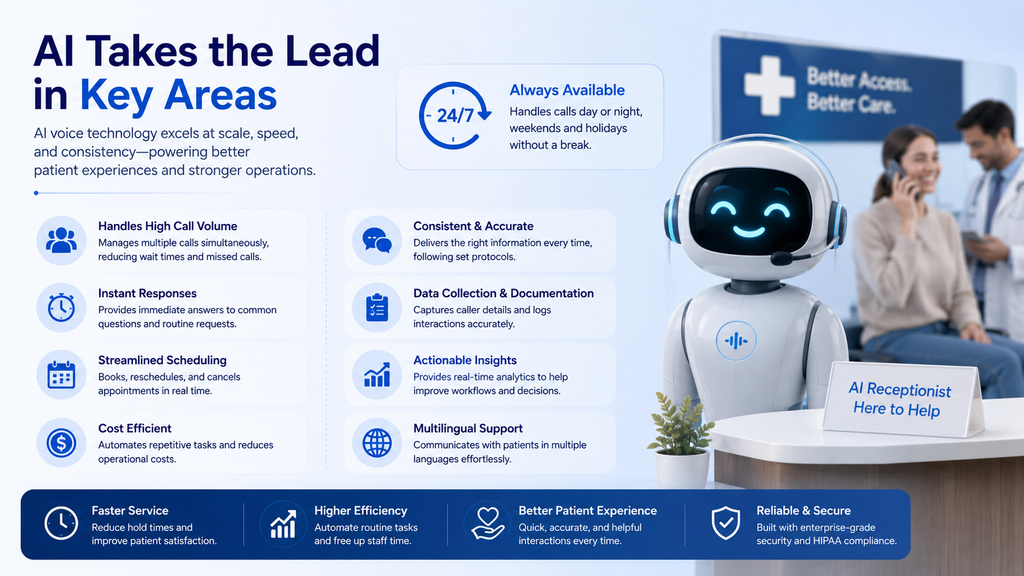
24/7 Availability
A human employee normally works within scheduled hours. An AI voice bot can be available outside regular business hours, depending on the platform and configuration. This can allow patients to make routine requests at night or on weekends without waiting for the office to reopen.
Simultaneous Call Handling
A receptionist can generally handle one conversation at a time. An AI system can potentially handle multiple calls simultaneously, depending on the platform’s architecture and capacity. This can be useful during predictable call spikes, such as Monday mornings or immediately after a clinic opens.
Faster Handling of Routine Requests
Routine questions do not always require a human. If a patient needs the clinic’s hours, location, scheduling instructions, or another approved piece of information, AI can respond without requiring staff involvement. The same principle can apply to defined administrative workflows.
Consistent Workflows
Human employees can make mistakes, especially when they are managing several tasks at once. An AI system follows its configured workflow consistently. When connected correctly to scheduling or other systems, it can reduce manual data entry for the tasks it is designed to perform.
However, AI is not automatically error-free. Incorrect configuration, outdated information, integration failures, or misunderstanding a caller can still produce errors.
Virtual Vs Human Medical Receptionists: Pros And Cons
| Factor | AI Voice Bots | Human Receptionists |
|---|---|---|
| Availability | Can provide 24/7 coverage | Usually limited to scheduled shifts |
| Call Capacity | Can handle multiple calls simultaneously, depending on platform | Limited by available staff |
| Routine Requests | Strong fit for defined workflows | Can handle them, but uses staff time |
| Complex Conversations | Requires escalation rules | Better suited to nuanced situations |
| In-Person Support | Not available | Essential |
| Emotional Support | Can use conversational responses | Stronger human connection |
| Scheduling | Can automate when integrated | Can manage exceptions and complex requests |
| Scalability | Easier to expand across call volume | Requires additional staffing |
| Cost Structure | Software and usage costs | Wages, benefits, recruiting, training, and other employment costs |
| Oversight | Requires monitoring and configuration | Requires management and training |
Neither option wins in every category. The best choice depends on the clinic’s patient population, call volume, workflows, staffing model, and goals.
The Cost of a Human Receptionist
The cost of front-desk staffing extends beyond hourly wages. BLS reported a $46,800 median annual wage for medical secretaries and administrative assistants in 2025.
A clinic’s actual employment cost may also include:
- Employer payroll taxes
- Health and other benefits
- Paid time off
- Recruiting costs
- Training
- Technology and workstation costs
- Management time
- Coverage during vacations and absences
- Overtime when call volume increases
These costs vary significantly by location and employer. Therefore, clinics should not use a single national wage figure as the total cost of employing a receptionist. Instead, calculate the clinic’s actual annual cost for the position. That figure provides a more useful baseline for an ROI comparison.
How Much Does a Virtual Medical Receptionist Cost?
Some platforms use monthly subscription pricing. Others combine platform fees with usage-based charges. Healthcare-specific integrations and advanced workflows may also affect the cost. Because pricing changes frequently and vendors use different models, clinics should not rely on a generic claim that every AI receptionist costs a specific amount per month.
A better approach is to calculate the expected cost using the clinic’s actual call volume.
Ask the vendor about:
- Monthly platform fees
- Per-minute or per-call charges
- Integration fees
- Setup costs
- EHR or scheduling integration
- Additional language support
- Human transfer charges
- Transcription or recording costs
- Minimum usage requirements
Then compare the total annual cost with the cost of the current staffing model.
How to Calculate Virtual Medical Receptionist ROI
The ROI calculation when it comes to virtual vs human medical receptionists as a subject should be based on measurable changes.
A simple formula is:
ROI = (Financial Benefit − AI Investment) ÷ AI Investment × 100
The financial benefit can come from several areas.
1. Labor Capacity
AI may reduce the amount of staff time spent on repetitive phone calls. This does not necessarily mean eliminating employees. A clinic may instead use the recovered time to handle more patients, improve check-in, reduce administrative backlogs, or support other workflows.
If a clinic does not reduce payroll after implementing AI, the benefit may appear as increased capacity rather than direct labor savings.
2. Missed-Call Recovery
Missed calls may represent missed scheduling opportunities. An AI receptionist can answer calls when staff are unavailable and potentially support appointment requests.
However, clinics should not assume that every missed call represents lost revenue.
To calculate this benefit, track:
Previously missed calls × percentage converted into appointments × contribution per completed appointment
3. After-Hours Access
A clinic may receive calls outside regular hours that would otherwise reach voicemail.
If AI can handle appropriate requests after hours, the clinic may improve access without adding another staffed shift.
Again, the value should be measured using actual call volume and completed outcomes.
4. Staff Productivity
AI can take repetitive calls away from staff.
This may allow employees to spend more time on patients who are physically present, complex scheduling situations, referrals, insurance coordination, or other work.
The financial value depends on how the clinic uses the additional capacity.
A Simple ROI Example
Consider a hypothetical clinic with one full-time medical receptionist.
Suppose the clinic’s total employment cost is $60,000 per year after adding wages, payroll taxes, benefits, and other expenses.
Now assume an AI platform costs $12,000 per year.
The simple difference is $48,000.
But that does not automatically mean the clinic has achieved $48,000 in savings.
If the receptionist remains employed and simply handles more valuable work, the financial benefit comes from additional capacity rather than payroll reduction.
The clinic should therefore measure what happens after implementation.
For example, it could track:
- Calls answered
- Calls resolved by AI
- Appointments scheduled
- Missed calls
- Staff hours spent on phone work
- Patient satisfaction
- Appointment conversion
- After-hours call volume
This provides a more realistic ROI picture.
Where AI Is Better Than a Human
AI voice bots are generally strongest when the workflow is repetitive and predictable.
Examples include appointment requests, routine scheduling questions, office information, after-hours calls, reminders, and defined administrative workflows.
AI can also be useful during call spikes.
A clinic may keep its regular staff but use AI as an overflow layer when call volume exceeds available capacity.
This can be more practical than hiring additional full-time staff solely to cover occasional peaks.
Where Humans Are Better Than AI
Human receptionists remain important for interactions involving ambiguity, emotional distress, complex exceptions, and physical presence.
They can also help patients who have difficulty navigating automated systems.
A strong healthcare workflow should therefore make human escalation easy.
Patients should not feel trapped inside an automated conversation.
The AI should know when it cannot complete a task and provide an appropriate next step.
Is an AI Receptionist Better Than Front Desk Staff?
The question is too broad.
An AI receptionist can be better at some tasks.
A human receptionist can be better at others.
For routine calls, AI may provide greater availability and scalability. It can also reduce the amount of repetitive work assigned to staff.
For sensitive conversations, unusual requests, and in-person interactions, humans remain essential.
This makes the hybrid model particularly practical.
The AI handles appropriate routine volume.
The human team handles complexity.
The result is not an AI-only front desk. It is a front desk where technology and people have clearly defined roles.
How to Choose Between AI, Humans, or Both
Start with the clinic’s call data.
Identify when calls arrive and what patients are calling about.
Separate routine administrative requests from calls that require human attention.
Then evaluate staffing capacity.
If the front desk is overwhelmed mainly because of repetitive calls, AI may provide meaningful support.
If the biggest problem is in-person check-in or complex patient communication, adding more human capacity may be more appropriate.
For many clinics, the answer will be both.
Step 1: Audit Call Volume
Review call volume by day, time, and reason.
Identify after-hours calls and peak periods.
Look for repetitive requests that follow predictable workflows.
Step 2: Calculate Current Costs
Include wages, benefits, payroll taxes, training, recruiting, and other relevant expenses.
Use your actual numbers rather than a generic industry estimate.
Step 3: Identify Automation Opportunities
Choose tasks that are repetitive, administrative, and clearly defined.
Avoid starting with workflows that require complex clinical judgment.
Step 4: Pilot the AI
A focused pilot can begin with after-hours coverage or overflow calls.
This allows the clinic to measure performance without immediately changing every front-desk workflow.
Step 5: Measure the Results
Compare the results with the baseline.
Track call answer rates, resolution rates, transfers, appointment completion, staff workload, patient feedback, and total cost.
Then decide whether to expand the program.
How MantraAssist Can Support a Hybrid Model
MantraAssist positions its platform as a healthcare-focused AI solution for patient communication and administrative workflows.
Its current website describes AI reception capabilities that include answering patient calls, scheduling appointments, handling follow-ups, supporting patient communication, and providing 24/7 availability. The platform also describes human handoffs when an interaction requires staff involvement.
For clinics considering AI voice technology, this type of model can help create a balance between automation and human support.
The key consideration is not simply whether an AI receptionist can answer calls.
Clinics should evaluate whether it can work with their existing systems, follow their scheduling rules, support appropriate escalation, and provide enough reporting to measure performance.
Vendor capabilities and pricing should always be confirmed directly before implementation.
Conclusion
The virtual vs human medical receptionists debate does not need to end with one winner.
Healthcare clinics need both technology and people.
AI voice bots are well suited to high-volume, repetitive, and predictable administrative calls. They can extend coverage beyond office hours and provide additional capacity during busy periods.
Human receptionists remain essential for in-person interactions, complex situations, emotional support, exceptions, and relationship-based patient service.
The financial case for AI should also be based on real clinic data. BLS data provides a useful benchmark for medical administrative wages, but the true cost of a receptionist varies by location, benefits, staffing model, and turnover.
The most practical approach for many clinics is a hybrid model.
AI handles the volume.
Humans handle the complexity.
This model can improve access while allowing staff to focus on work where human judgment adds the most value.
For clinic administrators, the question is therefore not “Should we replace our receptionists with AI?”
It is:
“Which parts of the front-desk workload should AI handle, and where does the human touch matter most?”
That is the question that leads to a more realistic implementation strategy and a more meaningful ROI.
Frequently Asked Questions
It depends on the task. AI can be useful for routine calls, scheduling, after-hours coverage, and repetitive administrative workflows. Human receptionists remain important for complex conversations, in-person support, emotional situations, and exceptions.
The Bureau of Labor Statistics reported a median annual wage of $46,800 for medical secretaries and administrative assistants in May 2025. The total employer cost is higher after benefits, payroll taxes, training, recruiting, and other expenses.
Pricing varies by vendor, call volume, integrations, and features. Clinics should request a complete annual cost estimate that includes platform fees, usage, implementation, integrations, and other charges.
They can automate selected tasks, but they should not be viewed as a universal replacement for front-desk staff. A hybrid model can combine automated call handling with human support.
Compare the full cost of the AI solution with measurable benefits such as reduced phone workload, increased appointment capacity, after-hours access, missed-call recovery, and staff productivity. Use the clinic’s own baseline data rather than relying on generic ROI claims.

