
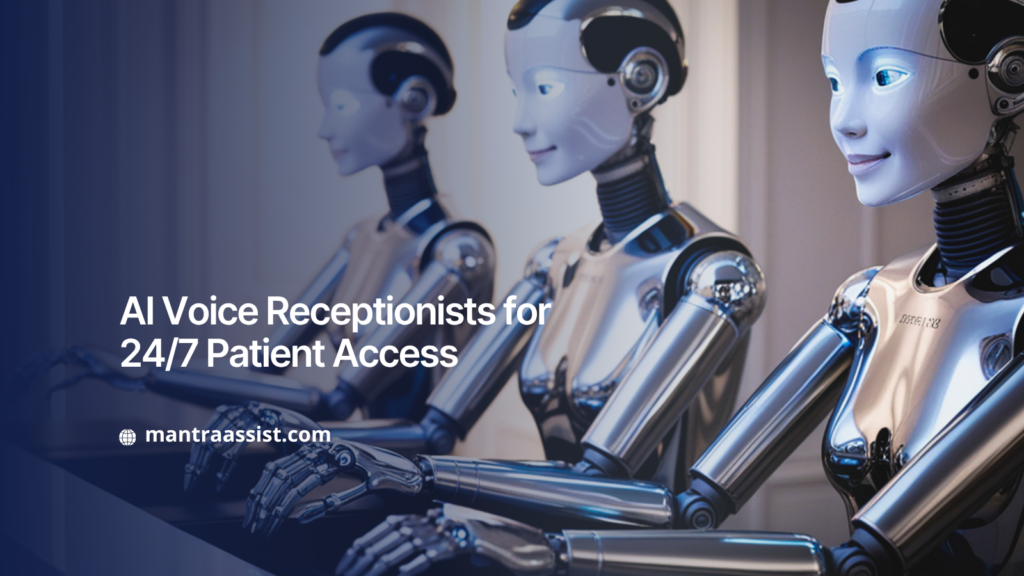
Healthcare does not stop when the front desk closes. Patients may call at night, on weekends, or during holidays to schedule an appointment, reschedule a visit, ask a routine question, or seek help with an existing care need. When those calls reach voicemail with no immediate response, patients may have to wait until the next business day or look for another source of care.
For healthcare practices, after-hours communication is therefore more than a convenience. It can affect patient access, staff workload, continuity of care, and the overall patient experience. An after hours medical answering AI solution can help practices provide a more responsive communication channel when their staff is unavailable.
AI voice receptionists offer one way to extend phone coverage beyond regular office hours. These systems can answer calls, understand routine requests, provide approved information, support appointment scheduling when properly integrated, and route calls that require human attention.
The After-Hours Patient Call Challenge
A practice may have a responsive front desk during business hours but still struggle with calls outside those hours. Traditional voicemail records the caller’s message but leaves the patient waiting for a response. Live answering services provide human coverage, but their availability, staffing model, and cost can vary.
After-hours calls can also involve different types of needs. A patient may want to change an appointment before the next business day. Another may need information about office hours or an existing appointment. Some callers may need a response from the appropriate care team rather than a routine administrative answer.
The importance of access is recognized in specific Medicare care-management requirements. CMS states that practices billing for Advanced Primary Care Management services must provide 24/7 access and continuity of care, including access for patients or caregivers with urgent needs to the provider or another member of the care team. This requirement applies to the APCM services and should not be interpreted as a universal 24/7 telephone requirement for every medical practice.
This distinction matters. Practices should evaluate their own patient-access obligations, payer requirements, and operational needs before deciding how after hours medical answering AI should work.
What Is an After Hours Medical Answering AI?
An after-hours AI voice receptionist is a conversational system that answers patient calls when staff is unavailable. It uses speech recognition and conversational AI to understand what the caller is trying to accomplish and then follows a predefined workflow.
For example, a patient might say, “I need to move my appointment from Thursday to next week.” If the after-hours medical answering AI is connected to the practice’s scheduling system and configured for that workflow, it may be able to identify the request, check appropriate availability, and complete the scheduling action.
The system can also answer approved administrative questions, collect information, create a message for staff, or route the caller according to the practice’s escalation rules.
The important distinction is that an AI receptionist should not simply replace voicemail with another automated message. Its value comes from being able to understand the request and take an appropriate next step.
How AI Voice Receptionists Help Prevent Missed Calls
The primary advantage of an AI voice receptionist is continuous availability.,When an AI answers after-hours calls, patients do not automatically have to wait until the next morning just to communicate a routine request. The system can respond immediately and determine what should happen next.
Routine requests may be resolved during the call when the necessary integrations and workflows are available. Other requests can be documented and routed to staff.
This creates a more structured process: answer the call, understand the request, complete appropriate tasks, and escalate when necessary.
1. 24/7 Call Coverage
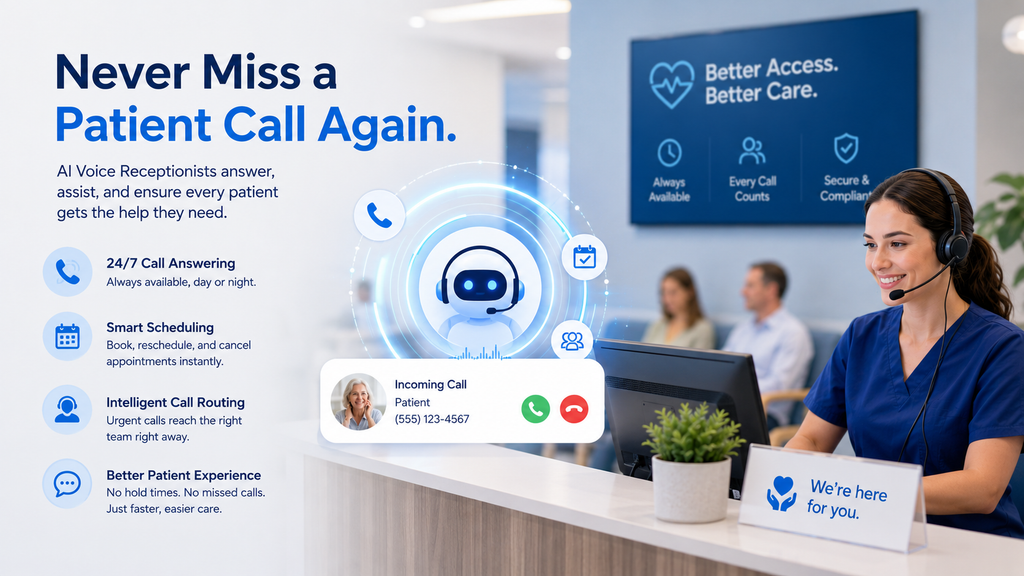
An AI receptionist can provide coverage outside normal office hours, including evenings, weekends, and holidays.
MantraAssist currently describes its AI Voice as a 24/7 healthcare solution that can answer calls, support appointment scheduling, and provide human handoffs when required. These are capabilities stated by the vendor and should be validated against a practice’s specific workflow before implementation.
2. Faster Access to Routine Services
Patients can receive an immediate response instead of leaving a voicemail and waiting for a callback. If the system is connected to the practice’s scheduling workflow, it may be able to handle appointment requests, cancellations, or rescheduling during the call.
MantraAssist states that its VoiceAI can book, reschedule, and manage cancellations through connected EHR workflows. Practices should confirm which actions are supported for their specific EHR and configuration.
3. Less Repetitive Work for Staff
After-hours calls often create work for the next business day. Staff may begin the morning with voicemail messages, appointment requests, and routine questions that could have been handled earlier.
An after-hours medical answering AI can resolve appropriate administrative requests immediately and organize information for staff when human follow-up is needed. This can help employees spend more time on complex requests instead of repeatedly returning routine calls.
4. Better Access Outside Office Hours
Patients have different work schedules and responsibilities. Some cannot easily call during standard business hours. After-hours AI can provide another access point for routine needs without requiring the practice to keep its entire front desk staffed overnight.
5. Consistent Handling of Routine Questions
A properly configured AI system can provide approved information consistently. This may include office hours, location information, appointment policies, scheduling instructions, and other administrative details. The practice should regularly review the information provided by the system to ensure it remains accurate.
What Should an AI Handle After Hours?
Not every patient call should be handled in the same way. A responsible implementation separates routine administrative requests from situations that require clinical judgment. Administrative tasks may include appointment scheduling, cancellations, rescheduling, office information, referral-related intake, and other predefined requests.
Clinical or potentially urgent concerns require a different pathway. The AI should follow the practice’s established escalation process rather than independently diagnose a condition or make a clinical decision.
Depending on the organization, escalation may involve an on-call clinician, nurse line, answering service, or another designated resource. The appropriate pathway should be determined by the healthcare organization and its clinical and compliance teams. The system should also have a defined fallback when the intended person is unavailable.
Why Do AI Voice Agents Need Strong Integrations?
A voice AI system can sound highly conversational and still provide limited operational value if it cannot connect to the systems the practice already uses. Scheduling is a good example.
If an AI can only take a message saying that a patient wants an appointment, staff still have to perform the scheduling work later. A deeper integration can allow the system to access appropriate availability and complete the booking according to configured rules.
MantraAssist describes EHR integration using FHIR standards and says its platform can support scheduling and patient information workflows. The exact functionality depends on the EHR and implementation, so practices should confirm the integration before signing a contract.
Before selecting a vendor, ask whether the integration is read-only or bidirectional. Also confirm which appointment types the AI can manage, what information can be written back to the EHR, and how exceptions are handled.
Security and HIPAA Considerations
Healthcare voice systems may process protected health information. Practices therefore need to evaluate security and privacy before allowing an AI vendor to handle patient information.
HHS explains that when a cloud service provider creates, receives, maintains, or transmits electronic protected health information on behalf of a covered entity or business associate, the provider generally qualifies as a business associate. In that situation, the parties need an appropriate Business Associate Agreement, and the covered entity or business associate must also conduct appropriate risk analysis and risk management.
Practices should therefore ask vendors how they handle patient information, access controls, data retention, recordings, transcripts, security incidents, and subcontractors.
A vendor’s statement that its product is “HIPAA compliant” should not end the evaluation. Organizations should review the vendor’s documentation and contractual terms, including the BAA when applicable.
SOC 2 certification may provide useful information about a vendor’s controls, but it is not itself a substitute for HIPAA compliance requirements or the organization’s own risk assessment.
How Should AI Voice Agents Handle Escalations?
After-hours automation should always include a clear human pathway.
Start by identifying the types of calls that require escalation. These may include urgent patient concerns, clinically complex questions, complaints requiring staff intervention, or requests that fall outside the AI’s approved capabilities.
Next, define where each type of call should go.
For example, an organization may route a particular category to an on-call clinician and another to a nurse line. The after-hours medical answering AI should also know what to do if the first escalation attempt is unsuccessful. These workflows should be tested before launch.
Practices should also review how disclosures, consent, recordings, transcripts, and patient information are handled. State laws and organizational policies may impose additional requirements, so legal and compliance teams should review the workflow where appropriate.
How MantraAssist Can Help
MantraAssist positions itself as a healthcare-focused AI platform for patient communication and administrative workflows. Its current website describes 24/7 call answering, appointment scheduling, multilingual support, warm transfers, waitlist management, referral follow-up, and EHR synchronization.
MantraAssist also states that its VoiceAI handles 95% of patient inquiries without human intervention. This is a vendor-reported claim rather than an independently verified industry benchmark. Practices should evaluate performance using their own call data before assuming a similar result.
The platform also reports serving more than 500 healthcare partners globally and raising $15 million in Series A funding from Impanix Capital. These are company-reported figures.
For a practice considering after hours medical answering AI automation, the important question is not simply whether the platform can answer calls.
The more useful question is whether it can support the practice’s actual scheduling, routing, escalation, documentation, integration, and patient communication requirements.
What to Look for in an After Hours Medical Answering AI
Start with the organization’s needs rather than choosing a platform based only on voice quality.
- Healthcare security: Confirm the vendor’s security practices, HIPAA approach, BAA availability when applicable, data handling, and access controls.
- Scheduling integration: Determine whether the AI can connect with the practice’s scheduling system and which actions it can complete.
- Human escalation: Ask how the system identifies calls that require human attention and how those calls are routed.
- Reporting: Look for reporting on call volume, resolution, transfers, escalations, and other relevant measures.
- Language support: Confirm which languages and voice experiences are actually available for the practice’s patient population.
- Configuration: Make sure the practice can update approved information, scheduling rules, and escalation workflows.
- Monitoring: Ask how the vendor supports testing, quality monitoring, and workflow changes after deployment.
A Practical Implementation Plan
A practice does not need to automate every phone workflow at once. Start by reviewing call data. Identify how many calls arrive after hours, what patients typically request, and which calls create the most work for staff the following day.
Next, choose a focused group of administrative tasks. Appointment scheduling, cancellations, rescheduling, basic office information, and message collection may provide a practical starting point. Then establish escalation rules. Define which calls require human involvement, who receives them, and what happens if the first contact is unavailable.
Run a controlled pilot before expanding the system. Measure performance against a baseline. Useful metrics include calls answered, calls resolved without staff involvement, transfers, abandoned calls, completed appointments, and patient feedback. These measurements provide a more reliable basis for evaluating the technology than generic industry claims.
The Business Case for After-Hours AI
The financial case should also be based on the practice’s own numbers. Start with the number of after-hours calls received each month. Then identify how many are routine requests, how many require staff follow-up, and how many result in completed appointments or other measurable actions.
Next, calculate the staff time spent returning calls and completing routine administrative work. This provides a baseline for comparing the cost of an AI solution with the current process.
Practices should avoid assuming that every missed call represents lost revenue or that every automated call produces a completed appointment. The value will vary by specialty, patient population, call type, scheduling availability, and implementation quality. A more realistic business case measures what actually changes after deployment.
Conclusion
AI voice receptionists are changing how healthcare organizations approach after-hours communication.
Instead of relying exclusively on voicemail or requiring staff to answer every call, practices can use conversational AI to provide another layer of patient access.
The technology can answer calls, handle appropriate administrative requests, support scheduling when integrated with the practice’s systems, and route complex interactions to humans.
However, the quality of the implementation matters as much as the technology.
Practices should verify integrations, define escalation rules, review security requirements, test workflows, and measure actual performance.
Vendor-reported statistics can help demonstrate what a platform may be capable of, but they should not be treated as guaranteed outcomes.
For healthcare organizations considering an after-hours AI receptionist, the best starting point is a clear operational problem.
Identify the calls that are being missed.
Understand what those patients need.
Automate the requests that are appropriate for automation.
And create a reliable human pathway for everything else.
That approach can help practices extend access beyond regular office hours without losing the human oversight that remains essential to healthcare.
Frequently Asked Questions
Yes, when the platform has the necessary scheduling integration and the practice has configured the appropriate workflow. Capabilities vary by vendor and EHR.
AI should not replace clinical judgment. Practices should establish clear escalation rules for urgent or clinically complex calls so patients can reach the appropriate care team or emergency resource.
When a vendor qualifies as a business associate because it creates, receives, maintains, or transmits PHI on behalf of a covered entity, HIPAA generally requires an appropriate BAA. HHS also expects covered entities and business associates to conduct appropriate risk analysis.
Track answer rates, resolution rates, transfers, abandoned calls, completed appointments, staff workload, and patient feedback. Compare these results with a baseline established before implementation.
It should not be viewed as a complete replacement for staff. AI is better positioned to handle defined, repetitive workflows while employees manage complex requests, patient concerns, and situations requiring human judgment.

