
Patients expect healthcare organizations to provide fast and convenient access. Yet phone calls remain a major source of frustration for many practices. Patients may wait on hold, leave voicemails, or call back several times before reaching the right person. AI voice agents are emerging as one way to address these challenges. Healthcare-focused voice AI can answer calls, understand patient requests, support appointment scheduling, provide routine information, and route more complex interactions to staff.
Adoption is also moving beyond experimentation. McKinsey’s 2026 research found that half of surveyed U.S. healthcare organizations had implemented generative AI, while administrative efficiency was the area healthcare leaders most frequently identified as having significant potential for AI and multiagent workflows.
For healthcare organizations, the opportunity is not simply to automate phone calls. The bigger opportunity is to make routine patient access faster while allowing staff to focus on interactions that require human judgment.
This guide explains the features to look for in healthcare voice AI, the operational benefits it can provide, and how AI voice agents reduce patient wait times in clinics. It also compares several healthcare-focused platforms, including MantraAssist, Hyro, Assort Health, and Artera.
Why Is Voice AI Becoming More Popular in Healthcare?
Front-desk and contact-center teams often handle a high volume of repetitive requests. These can include appointment scheduling, cancellations, rescheduling, prescription-related requests, directions, provider information, and other routine questions. When several patients call at once, staff capacity can become a bottleneck.
Voice AI can handle some of these interactions without requiring a staff member to answer every call individually. This can allow employees to spend more time on complex requests and patient-facing work.
There are already examples of healthcare organizations reporting measurable improvements.
Hyro’s Intermountain Health case study reports an 85% reduction in call abandonment and a 79% improvement in speed to answer after implementing conversational AI and smart routing. Intermountain also reported that 27% of inbound patient inquiries occurred outside normal working hours and were handled through Hyro’s AI assistants. These are customer-reported results from a specific deployment, not a universal industry benchmark.
Assort Health also reports that one customer reduced hold times from 11 minutes to 1 minute within 30 days. Again, this is a vendor-reported customer result and should not be treated as a guaranteed outcome for every organization.
These examples show why healthcare organizations are evaluating voice AI as an operational tool. However, results depend on the platform, workflow, integrations, patient volume, and how the technology is implemented.
What Features Should AI Voice Agents for Healthcare Have?
Not every voice AI platform is designed for healthcare. When evaluating a solution, healthcare organizations should look beyond how natural the AI sounds.
The more important question is what the agent can actually complete.
A strong healthcare voice AI platform should be able to understand patient requests, complete appropriate administrative tasks, connect with existing systems, and involve staff when automation is not appropriate.
- Natural conversational speech. Patients should be able to explain their needs naturally instead of navigating rigid menu options.
- EHR and practice management integration. The platform should connect with the systems the practice already uses. Depending on the vendor and EHR, this may include API, FHIR, HL7, or other integration methods.
- Context-aware human handoff. When an interaction requires a staff member, the system should pass relevant information to the team so the patient does not have to repeat the entire conversation.
- Multilingual support. Healthcare organizations serving diverse populations may benefit from voice AI that can communicate in multiple languages.
- Security and compliance controls. Healthcare organizations should evaluate how the platform handles protected health information, access, storage, transmission, and other security requirements. Compliance claims should be verified directly with the vendor.
For example, Artera says its Harmony platform integrates with EHR systems through API, FHIR, HL7, SFTP, and other methods. It also describes multilingual support, conversation transcripts, real-time monitoring, and configurable escalation rules.
The right capabilities will depend on the organization’s needs. A small practice may primarily need scheduling and after-hours call handling. A large health system may need complex routing, multiple integrations, and centralized monitoring.
How AI Voice Agents Reduce Patient Wait Times in Clinics
Reducing wait times is one of the clearest potential benefits of healthcare voice AI.
Traditional phone systems depend heavily on staff availability. When call volume increases, patients may be placed in a queue or asked to leave a voicemail.
AI voice agents can respond to multiple patients without requiring every call to reach a human immediately.
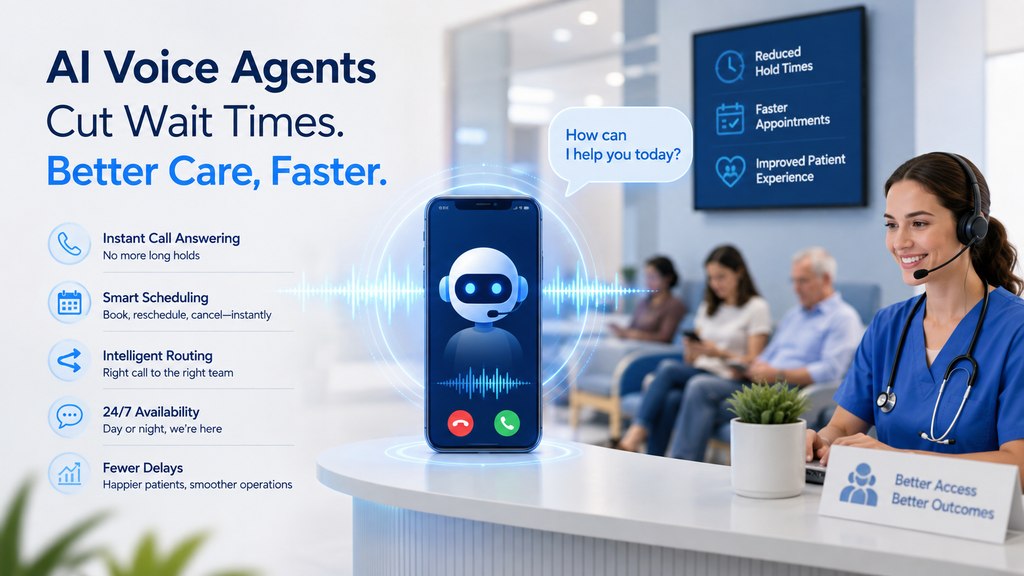
Here are some of the main ways showing how AI voice agents reduce patient wait times in clinics:
- Instant call answering. An AI agent can answer incoming calls immediately rather than placing every caller in a staff queue. This can be particularly useful during busy periods.
- Routine call resolution. Scheduling, cancellations, rescheduling, and other administrative requests can be handled automatically when the platform is configured to support those workflows. Hyro, for example, says its healthcare platform can automatically resolve or deflect more than 65% of incoming contact-center calls.
- 24/7 availability. Voice AI can provide access outside normal business hours. Hyro and MantraAssist both describe round-the-clock availability as part of their healthcare offerings.
- Intelligent routing. Calls that require staff can be directed to the appropriate team based on the patient’s request. This can reduce unnecessary transfers and help staff focus on the calls that require human involvement.
The impact can extend beyond the time a patient spends on hold.
When routine calls are resolved automatically, staff may have more capacity to answer complex calls. That can improve the overall flow of the contact center.
However, organizations should measure actual performance rather than assume automation will automatically reduce wait times. Useful metrics include average speed to answer, abandonment rate, resolution rate, transfer rate, appointment completion, and patient feedback.
Measurable Benefits Beyond Wait Times
Wait-time reduction is only one potential benefit of voice AI.
A well-integrated platform can also support operational efficiency across several patient-access workflows.
- Fewer missed calls can be one benefit. If the AI answers calls when staff are occupied, fewer patients may need to rely on voicemail or call back later.
- Greater scheduling capacity is another. AI can support appointment booking, cancellation, and rescheduling without requiring staff involvement for every interaction. Assort Health, for example, describes scheduling and appointment management as core capabilities of its platform.
- Better staff utilization can also matter. When AI handles appropriate repetitive tasks, employees can spend more time on complex patient requests and other work that requires human judgment.
- After-hours access can improve convenience. Patients can receive assistance outside traditional office hours instead of waiting until the next business day.
- More consistent communication is another potential advantage. An appropriately configured system can provide approved information consistently across large volumes of calls.
The actual benefits will vary by organization. Healthcare leaders should therefore establish baseline metrics before implementation and compare performance after deployment.
Use Cases in Practice
Healthcare voice AI can support a wide range of administrative and patient-access workflows.
Appointment Scheduling and Rescheduling
Scheduling is one of the most common applications. AI can understand why a patient is calling, identify the appropriate appointment type, and work within configured scheduling rules. It can also support cancellations and rescheduling. The level of automation depends on the platform’s integration with the practice’s scheduling system.
Insurance and Eligibility
Some healthcare AI platforms support insurance and eligibility workflows. Assort Health lists insurance and eligibility among its patient-access capabilities.
However, organizations should confirm exactly what the platform can verify, which systems it connects to, and when human review is required.
Prescription Requests
Routine prescription-related requests can also be captured and routed through AI. The system should follow the organization’s established workflow rather than make clinical decisions. Hyro identifies prescription management among the routine patient interactions its platform can automate.
Patient Intake and Follow-Up
AI can also support intake and post-visit communication. For example, Assort describes patient intake and post-visit follow-up as part of its platform. Artera also lists intake and follow-up workflows among the capabilities supported by Harmony.
After-Hours Routing
After-hours calls are another useful application. An AI agent can answer routine questions and route requests that require staff attention according to the organization’s escalation rules. This can be particularly useful for practices that do not have a full-time call center operating overnight.
Leading AI Voice Agents for Healthcare
Healthcare voice AI is not a single category with one solution that fits every organization.
Different platforms focus on different parts of the patient journey. Some emphasize contact-center automation. Others focus on specialty workflows or broader patient engagement.
MantraAssist
MantraAssist provides AI employees for healthcare practices and patient engagement. Its current website describes AI receptionists that can answer calls, book appointments, manage follow-ups, support patients, and automate administrative workflows 24/7. It also states that the AI receptionist can introduce itself as an AI assistant and offer a human at any point.
MantraAssist also describes specialty-trained AI capabilities, including AI receptionist, AI interpreter, AI scribe, AI nurse, and other healthcare-focused roles. For organizations evaluating the platform, specific integrations, workflows, and implementation requirements should be confirmed directly with MantraAssist.
Hyro
Hyro focuses on conversational AI and AI agents for healthcare organizations. Its healthcare platform supports patient access workflows such as physician search, scheduling, prescription-related interactions, and call-center automation. Hyro currently reports that its platform can automatically resolve or deflect more than 65% of incoming contact-center calls.
Hyro also reported in 2025 that its technology was deployed across more than 45 health systems and had supported interactions with more than 30 million patients. It reported that its AI agents can resolve up to 85% of routine patient interactions. These figures are company-reported.
Assort Health
Assort Health focuses on patient access and specialty healthcare workflows. Its platform includes appointment scheduling and management, intelligent routing, insurance and eligibility, patient intake, referral automation, medication refills, payments, and other patient-journey workflows.
Assort reports more than 200 million patient interactions and more than 62,000 care protocols on its platform. These are company-reported figures. The company also reports a 4.3/5 satisfaction score across AI-handled interactions. This should be treated as Assort’s reported platform metric rather than an independent industry benchmark.
Artera
Artera takes an omnichannel approach through its Harmony platform. The platform supports phone, text, web, and other patient communication channels. Artera describes workflows including scheduling, intake, referrals, payments, care gaps, reminders, and follow-ups.
Artera also states that Harmony can connect with EHR systems through API, FHIR, HL7, SFTP, and other methods. It describes configurable escalation rules, multilingual support, conversation transcripts, and performance monitoring. Artera emphasizes that its AI agents automate administrative workflows rather than provide medical advice, diagnosis, or treatment.
Comparison: What to Look For in a Healthcare Voice AI Platform
| Platform | Primary Focus | Notable Capabilities |
|---|---|---|
| MantraAssist | Healthcare practices and patient engagement | AI receptionist, appointment booking, follow-ups, patient support, administrative workflows |
| Hyro | Healthcare contact centers and patient access | Call automation, scheduling, routing, prescription workflows, conversational AI |
| Assort Health | Patient access and specialty workflows | Scheduling, intake, referrals, insurance and eligibility, medication refills |
| Artera | Omnichannel patient engagement | Voice, messaging, scheduling, intake, follow-ups, payments, EHR integrations |
This table summarizes capabilities published by the respective companies. Actual features, integrations, availability, pricing, and implementation requirements should be confirmed directly with each vendor.
How to Choose the Right Voice AI Platform
Choosing a healthcare voice AI platform is less about finding the “best” platform overall and more about finding the right fit for your organization.m Start with your call volume.
A large health system with multiple departments may need sophisticated routing and contact-center automation. A smaller practice may need a simpler AI receptionist that focuses on scheduling, routine questions, and after-hours coverage.
Then evaluate the platform against your workflows.
- Match the platform to your setting. Consider practice size, specialty, call volume, and the complexity of your scheduling and patient-access workflows.
- Ask for performance data. Request metrics such as resolution rate, abandonment rate, speed to answer, transfer rate, and patient satisfaction. Ask for results from organizations with similar workflows.
- Confirm actual system integration. Find out whether the platform can write information back into your EHR or practice management system, not simply retrieve information.
- Evaluate multilingual and after-hours capabilities. Confirm which languages are supported and what the AI can actually do outside business hours.
- Start with a focused use case. Scheduling, appointment management, or after-hours calls can be useful starting points. Once the workflow is working reliably, organizations can consider expanding to additional use cases.
Security should also be part of the evaluation. Ask vendors how they handle protected health information, access controls, recordings, transcripts, data retention, and human escalation. Do not rely solely on the phrase “HIPAA compliant.” Ask for documentation and understand exactly what the vendor’s compliance commitments cover.
Conclusion
The rise of AI voice agents in healthcare is closely connected to a practical problem: healthcare organizations need to handle large volumes of patient communication without continuously increasing front-desk workload.
Voice AI can help by answering calls immediately, resolving routine requests, supporting scheduling, and routing complex conversations to the right staff.
The evidence from current deployments shows that meaningful improvements are possible. Assort Health, for example, reports reducing hold times from 11 minutes to 1 minute in one deployment. Hyro reports resolving or deflecting more than 85% of incoming calls automatically. However, results depend on implementation.
The right platform should fit the organization’s size, specialty, workflows, technology stack, and patient population. It should also provide clear escalation paths when automation is not appropriate.
MantraAssist is one option for healthcare organizations looking to automate patient calls and administrative workflows. Its platform supports AI reception, appointment scheduling, routing, follow-ups, and human handoffs, with 24/7 availability.
If your practice is dealing with long hold times, missed calls, or repetitive front-desk requests, healthcare-specific voice AI may be worth evaluating.
Frequently Asked Questions?
They can answer multiple calls simultaneously, resolve routine requests without human involvement, provide after-hours coverage, and route complex calls to the appropriate team.
Implementation generally involves connecting the platform to relevant systems, configuring workflows and scheduling rules, testing the agent, and monitoring performance before expanding its use.
Healthcare organizations should evaluate each vendor’s security and compliance practices rather than assuming every AI voice platform is compliant. The platform should have appropriate safeguards for protected health information and support the organization’s compliance requirements.
It can improve the patient experience by reducing waiting times, missed calls, and unnecessary transfers. However, organizations should measure patient satisfaction directly rather than assuming that automation will automatically improve it.
Some platforms support multiple languages and specialty-specific workflows, but capabilities vary. Organizations should confirm the specific languages, specialties, and workflows supported before implementation.

