
“Press 1 for appointments OR Press 2 for billing OR Press 3 for prescriptions.” For years, traditional IVR systems have guided patients through healthcare phone menus using keypad selections and predefined options. While these systems can route calls, patients may need to navigate multiple menus before reaching the right department.Conversational IVR offers a more natural alternative. Instead of asking patients to select menu options, conversational AI allows them to explain why they are calling in their own words. The system can identify intent, guide the interaction, complete eligible administrative workflows, and escalate complex requests to staff.
This is why many healthcare organizations are exploring how to replace IVR with AI healthcare solutions that move beyond rigid medical phone trees.
Traditional IVR vs Conversational AI
A traditional IVR system follows predefined paths. Patients are expected to understand the available menu options and select the one that appears most relevant.
Conversational AI changes the starting point. Instead of asking, “Which option would you like?”, it can ask:
“How can I help you today?”
A patient can then say:
“I need to move my appointment from Thursday to next week.”
The AI can identify the purpose of the call and guide the patient into the appropriate workflow.
| Traditional IVR | Conversational AI |
|---|---|
| Patients navigate phone menus | Patients explain their request naturally |
| Relies on predefined selections | Identifies spoken intent |
| Primarily routes calls | Can support routing and workflow completion |
| Multiple menus may be required | Moves toward the relevant workflow directly |
| Patients may repeat information after transfers | Context can support smoother handoffs |
| Limited self-service options | Can support eligible administrative workflows |
The biggest difference is that traditional IVR is built around menu navigation, while conversational AI is built around understanding patient intent.
Why Traditional Medical Phone Trees Can Create Friction
Healthcare organizations often have multiple departments, specialties, services, and workflows. Patients may know what they need but may not know which department is responsible for handling the request.
A patient calling about an appointment, referral, billing issue, or test may therefore spend time navigating options that are designed around the organization’s internal structure rather than the patient’s actual need.
Long menus can also lead to:
- Incorrect selections
- Unnecessary transfers
- Repeated explanations
- Longer call journeys
Conversational AI removes some of this responsibility from the patient. The caller can explain the reason for the call, and the system can determine the appropriate next step.
How Conversational AI Replaces Medical Phone Trees
Replacing outdated IVR systems with conversational AI for healthcare call centers involves more than replacing recorded prompts with an AI voice.
The real value comes from what happens after the patient explains their request.
A conversational AI interaction can follow a simple process:
Patient explains the need → AI identifies intent → Appropriate workflow begins → Request is resolved or escalated
For routine and eligible administrative requests, the system may provide information, check available options, manage an appointment-related request, or direct the patient to the appropriate department.
For complex, clinical, sensitive, or unusual situations, the interaction can be escalated to a human team.
Healthcare Calls Conversational AI Can Support
Conversational AI is particularly useful for high-volume, repetitive patient interactions.
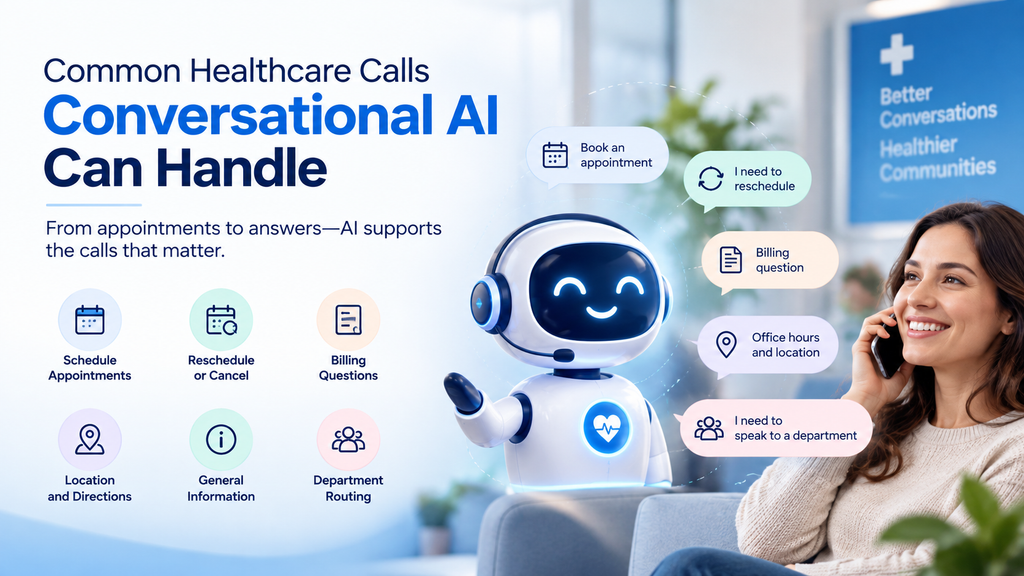
Appointment Scheduling and Management
Instead of navigating an appointment menu, a patient can explain what they need.
For example:
“I’d like to schedule an appointment next week.”
Depending on the configured workflow and connected systems, AI can guide the patient through eligible scheduling options.
It can also support routine appointment management, including rescheduling and cancellations. MantraAssist’s appointment automation platform connects patient communication with appointment scheduling, reminders, cancellations, and related workflows.
Routine Patient Questions
Patients frequently call for information such as office hours, locations, directions, or appointment details.
These interactions often follow predictable processes and may be appropriate for automated self-service.
Intelligent Call Routing
Conversational AI can identify the reason for a call before transferring it.
A patient who says, “I need help with a referral,” does not need to understand the hospital’s internal phone structure. The system can identify the intent and route the call according to configured workflows.
This can reduce unnecessary transfers and help patients reach the right team more directly.
Conversational AI Goes Beyond Call Routing
Traditional IVR systems are primarily designed to direct calls.
Conversational AI can support a broader journey:
Understand the request → Identify intent → Start the workflow → Resolve or escalate
For example, a traditional IVR may route a patient to staff for an appointment cancellation.
Conversational AI can potentially identify the cancellation request and guide the patient through an eligible workflow without requiring staff involvement at every stage.
The greatest benefit comes when the AI connects with the workflow behind the conversation rather than simply collecting information for someone else to process later.
This is why healthcare organizations evaluating conversational IVR should look beyond voice quality and ask whether the technology can support meaningful workflow completion.
How Conversational AI Helps Healthcare Call Centers
Many patient calls involve routine administrative work. Staff may spend considerable time answering common questions, transferring calls, managing appointment requests, and following up on routine interactions.
Conversational AI can handle appropriate requests while allowing human teams to focus on interactions that require greater attention.
Potential benefits include:
- Less phone menu navigation
- Fewer unnecessary call transfers
- Faster movement into relevant workflows
- Reduced repetitive administrative work
- Greater support for routine requests outside standard hours
MantraAssist’s healthcare call center automation platform supports this approach by helping healthcare organizations automate appropriate patient communication and route complex interactions to the relevant teams.
Traditional IVR vs Conversational AI: The Patient Experience
| Traditional IVR Experience | Conversational AI Experience |
|---|---|
| “Press 1 for appointments” | “How can I help you today?” |
| Patient selects from menus | Patient explains the request |
| Multiple options may follow | AI identifies the intent |
| Calls may require manual routing | AI directs the patient to a relevant workflow |
| Information may be repeated after transfer | Context can support smoother escalation |
| Most requests begin with navigation | Requests begin with the patient’s actual need |
The goal is not simply to make phone interactions sound more natural.
It is to reduce the effort required for patients to reach the right workflow and complete appropriate requests.
How Healthcare Organizations Can Transition From IVR to AI
Healthcare organizations do not need to replace every IVR workflow at once.
A practical approach is to start with high-volume, repetitive, and administrative call types where patients frequently encounter unnecessary menu navigation or staff handle the same request repeatedly.
The next step is to map what happens after the call. If staff must complete several manual actions after receiving a routine request, that workflow may present an opportunity for deeper automation.
Clear escalation rules are equally important. AI should know when a request requires human involvement, particularly for clinical questions, urgent concerns, sensitive situations, and workflow exceptions.
MantraAssist’s broader AI automation use cases in healthcare can help healthcare organizations explore where conversational AI and workflow automation may reduce repetitive administrative work.
What to Avoid When Replacing IVR With AI
Conversational AI does not automatically create a better patient experience.
One common mistake is automating the conversation without connecting it to the work required to resolve the request. If AI collects information but staff still need to manually complete every subsequent step, the operational benefit may be limited.
Healthcare organizations should also avoid making human assistance difficult to reach. AI should complement human teams rather than create another barrier for patients.
The strongest approach combines conversational automation with clear workflows and appropriate escalation.
Key Takeaway
Traditional IVR systems are built around phone menus. Conversational AI is built around patient intent.
Instead of asking patients to navigate medical phone trees, healthcare organizations can allow them to explain what they need naturally and connect the conversation with the appropriate workflow.
For organizations looking to replace IVR with AI healthcare solutions, the greatest opportunity lies beyond creating a more natural voice experience. Conversational AI can help connect patient communication with scheduling, routing, self-service, and other repeatable workflows while ensuring complex interactions reach human teams when needed.
A healthcare-focused platform such as MantraAssist can support this transition by helping organizations move beyond rigid IVR menus toward more natural AI-powered patient conversations and workflow automation.
Frequently Asked Questions
Conversational IVR uses AI to understand patients’ spoken requests in natural language instead of requiring them to navigate keypad-based phone menus. Patients can explain why they are calling, and the system can identify the appropriate workflow or route.
Conversational AI can replace many traditional IVR functions by allowing patients to speak naturally, identifying their intent, supporting eligible self-service requests, and routing complex interactions to the appropriate human team.
Conversational AI can reduce menu navigation, unnecessary call transfers, repetitive administrative work, and patient frustration. It can also help healthcare organizations connect patient conversations with scheduling, routing, and other workflows while maintaining human escalation when needed.

