
“Our call volume keeps increasing, but adding more staff is not a sustainable solution.” Hospitals manage a constant flow of patient calls, from appointment requests and cancellations to billing questions, follow-ups, referrals, and routine information. When nearly every interaction requires a staff member, higher call volumes can quickly translate into higher administrative costs.
AI and automation offer a different approach. Instead of assigning every routine interaction to a human agent, hospitals can automate appropriate, repeatable requests and reserve staff time for complex, sensitive, and clinical conversations. This guide explains 10 practical ways hospitals can lower call center expenses using AI and automation.
Why Hospital Call Center Expenses Keep Increasing
Call center costs extend beyond employee salaries. As patient communication volumes grow, hospitals may also face increasing expenses related to:
- Recruiting and hiring
- Staff training
- Overtime
- Employee turnover
- Missed calls and callbacks
- Voicemail management
- Manual call transfers
- Repetitive administrative work
- After-hours coverage
- Technology and operational infrastructure
The underlying challenge is often straightforward: skilled employees spend a significant amount of time handling repetitive requests that follow predictable workflows.
For example, answering a question about office hours does not require the same level of staff involvement as handling a complex patient concern. Treating both interactions the same can place unnecessary pressure on call center capacity.
A more efficient model separates calls into three groups:
- Routine and rules-based requests → Automated
- Requests requiring review or assistance → AI-supported
- Complex, sensitive, or clinical interactions → Human-handled
This is where healthcare call center automation can help hospitals manage demand without assuming that every increase in call volume requires proportional growth in staffing.
1. Automate Routine Incoming Calls
AI can handle appropriate high-volume questions that do not require staff involvement, such as:
- Office hours
- Locations
- Directions
- Basic appointment information
- Routine administrative FAQs
This reduces repetitive call handling and helps staff focus on requests that require human assistance.
A healthcare-focused AI call automation platform can help hospitals automate routine patient communication while routing more complex interactions to the appropriate team.
2. Support Appointment Scheduling With AI
Appointment scheduling can consume significant call center capacity.
AI can support eligible workflows involving:
- Appointment requests
- Available appointment options
- Booking confirmations
- Appointment details
The biggest benefit comes when AI connects directly with the scheduling workflow rather than simply collecting requests for staff to process later.
Hospitals can explore AI appointment scheduling automation to connect patient communication with scheduling, reminders, and related appointment workflows.
3. Simplify Rescheduling and Cancellations
Appointment changes can create substantial administrative work.
AI can support eligible patient requests to:
- Reschedule appointments
- Cancel appointments
- Review available alternatives
- Confirm appointment changes
When connected with waitlist workflows, cancellations may also create opportunities to offer available slots to other eligible patients.
4. Improve Call Routing
Manual call transfers consume staff time and can create frustrating patient experiences.
AI can identify the purpose of a call and route patients based on:
- Department
- Specialty
- Location
- Appointment type
- Service requested
This reduces unnecessary transfers and helps patients reach the appropriate workflow or team faster.
5. Reduce Missed Calls and Callback Work
A missed call often creates additional work through:
- Voicemail
- Callback requests
- Repeat calls
- Multiple contact attempts
AI-powered call automation can provide immediate support for eligible requests, helping hospitals reduce voicemail queues, routine callbacks, and repeat-call volume.
6. Provide Routine After-Hours Support
Hospitals can use AI to support appropriate non-clinical requests outside standard operating hours.
Examples include:
- Office information
- Directions
- Appointment details
- Routine scheduling requests
This can extend patient access without requiring human staff to manage every routine after-hours call.
Clear escalation pathways should remain in place for emergencies, urgent concerns, and clinical questions.
7. Automate Reminders and Routine Outreach
Outbound communication can also add to call center expenses.
Automation can support:
- Appointment reminders
- Confirmation requests
- Follow-up reminders
- Waitlist notifications
Instead of requiring staff to complete each outreach task manually, automated workflows can manage routine communication and trigger appropriate next steps.
8. Reduce Unnecessary Transfers
Patients often repeat information after being transferred between departments. AI can identify intent before routing the call and help direct the patient to the appropriate destination. Where supported, relevant context can also be carried into the handoff, reducing repeated conversations and unnecessary staff involvement.
Where AI Can Help Lower Hospital Call Center Expenses
| Cost Driver | How AI and Automation Can Help |
|---|---|
| High routine call volume | Automate eligible administrative requests |
| Scheduling workload | Support appointment management workflows |
| Appointment changes | Automate eligible rescheduling and cancellations |
| Missed calls | Provide immediate responses for routine requests |
| Callback queues | Resolve more interactions during initial contact |
| Manual routing | Identify intent and route calls appropriately |
| After-hours coverage | Support routine non-clinical communication |
| Outbound workload | Automate reminders and notifications |
| Unnecessary transfers | Direct patients to appropriate teams or workflows |
| Workforce scaling | Manage routine volume more efficiently |
The actual financial impact will depend on call volume, staffing costs, workflow complexity, automation rates, and integration requirements.
9. Improve Staff Capacity Instead of Continuously Adding Headcount
A traditional approach to call growth is:
More calls → More staff → Higher expenses
AI can help hospitals manage routine volume without assigning every additional call to a staff member.
This allows teams to focus more on:
- Complex patient situations
- Sensitive conversations
- Escalated requests
- Clinical coordination
- Insurance or referral issues
- In-person patient support
The benefit is not necessarily reducing staff. It is improving how existing staff capacity is used.
Hospitals can also explore broader AI use cases in healthcare to identify repetitive administrative workflows beyond patient call management.
10. Connect AI Calls With Complete Workflows
Automating a conversation alone does not always reduce workload.
For example, if AI collects an appointment request but staff must later review the request, check availability, update the schedule, and call the patient back, much of the work remains.
The greatest value comes from connecting communication with the workflow required to resolve the request:
Patient request → Intent identification → Workflow → Resolution or escalation
Depending on the hospital’s systems, this may involve connections with:
- Scheduling systems
- EHR platforms
- Practice management software
- Patient communication tools
- Referral workflows
The objective should be workflow completion, not simply automated conversations.
How Hospitals Should Decide What to Automate
Hospitals should not attempt to automate every interaction.
A better starting point is to identify call types that are:
- High volume
- Repetitive
- Rules-based
- Primarily administrative
- Appropriate for self-service
Good Candidates for Automation
Examples may include:
- Office hours and location information
- Directions
- Appointment confirmations
- Eligible scheduling requests
- Eligible cancellations
- Eligible rescheduling
- Routine reminders
- Frequently asked administrative questions
Good Candidates for AI Support With Human Oversight
These may include:
- More complex scheduling
- Multi-step administrative requests
- Referral coordination
- Insurance-related inquiries
- Requests requiring verification
Interactions That Should Be Human-Handled
Hospitals should maintain appropriate human processes for interactions requiring:
- Clinical judgment
- Emergency escalation
- Sensitive communication
- Complex problem-solving
- Significant exceptions to established workflows
The goal should not be to achieve the highest possible automation percentage.
The goal should be to automate the right work.
How to Measure Whether AI Is Actually Lowering Call Center Costs
Hospitals should avoid measuring success solely by the number of calls answered.
A better evaluation focuses on whether automation is reducing actual staff workload.
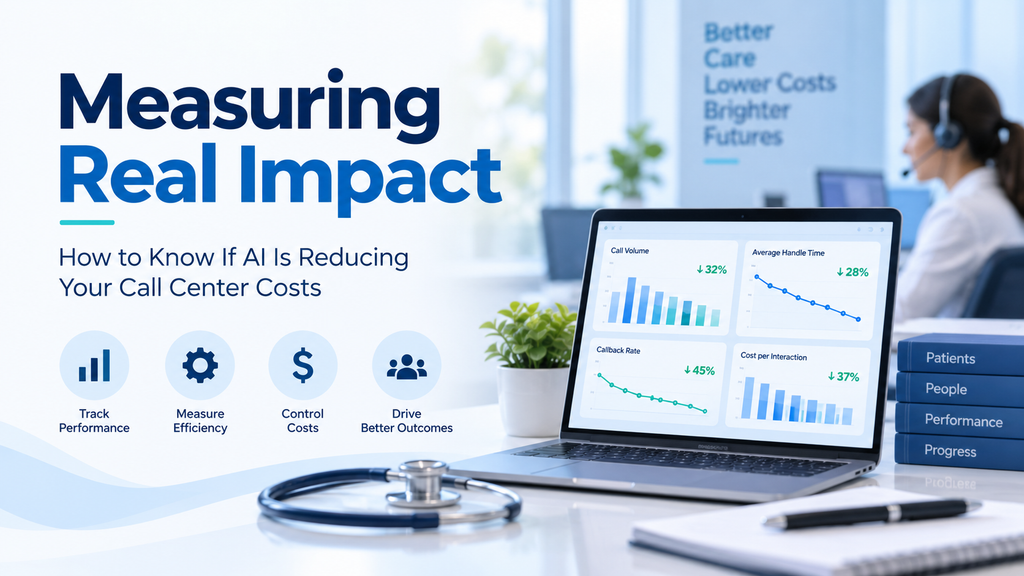
Useful metrics include:
- Percentage of eligible interactions resolved without staff involvement
- Average staff handling time
- Call abandonment rates
- Missed-call volume
- Voicemail volume
- Callback volume
- Repeat-call rates
- Transfer rates
- Escalation rates
- Staff time spent on repetitive requests
- Cost per completed interaction
A practical comparison is to measure a workflow before and after implementation.
For example:
Before automation: How many staff minutes are required to manage a routine rescheduling request?
After automation: What percentage of eligible rescheduling requests are completed without requiring staff intervention?
This provides a clearer picture of whether AI is reducing operational work rather than simply changing where the work occurs.
Common Mistakes Hospitals Should Avoid
AI implementation is less effective when automation is treated purely as a cost-cutting exercise.
Common mistakes include:
- Automating inappropriate clinical interactions
- Failing to create clear escalation pathways
- Using disconnected systems
- Automating conversations without completing workflows
- Ignoring staff feedback
- Failing to monitor automation outcomes
- Measuring call volume instead of workflow resolution
- Making it difficult for patients to reach human assistance when needed
The most effective approach combines automation with human expertise.
AI should handle appropriate repetitive work while staff remains available for the interactions where human judgment, empathy, experience, or clinical knowledge matters most.
Key Takeaway
Hospitals can lower call center expenses by identifying repetitive administrative work and using AI to automate appropriate workflows. From routine patient calls and appointment management to intelligent routing and follow-ups, automation can help reduce staff workload while improving operational efficiency.
The goal is not to replace human interaction, but to ensure staff spend their time on complex situations where human support matters most. For hospitals exploring how to reduce healthcare call center costs with AI automation, platforms such as MantraAssist can connect patient communication with scheduling, routing, follow-ups, and other repeatable healthcare workflows.
Frequently Asked Questions
AI can automate some repetitive administrative interactions, but human staff remains essential for complex, sensitive, clinical, and unusual situations. The strongest approach combines automation with appropriate human escalation.
Automation can handle appropriate routine non-clinical interactions outside standard operating hours, reducing the need to assign staff to every administrative request. Hospitals should still maintain clear escalation processes for urgent, emergency, and clinical situations.
Hospitals can measure outcomes such as automated resolution rates, staff handling time, missed calls, callback volume, repeat-call rates, transfer rates, escalation rates, and cost per completed interaction.

