

What would it mean for your practice if routine patient calls were answered consistently, appointments were managed efficiently, and administrative work did not come to a halt when one staff member was unavailable?
For many small practices, limited administrative capacity is a daily challenge. One receptionist may be responsible for answering calls, scheduling appointments, following up with patients, updating records, and assisting patients at the front desk—all at the same time.
This is why more practice owners are exploring the benefits of a healthcare virtual assistant. Rather than immediately expanding their in-house administrative team, practices can use virtual support to manage routine communication and administrative tasks while allowing existing staff to focus on more complex and patient-facing responsibilities.
In this guide, we explore the top 10 benefits of a healthcare virtual assistant and what small practices should consider before choosing a solution.
Why Small Practices Are Turning to Healthcare Virtual Assistants
Small practices often operate without the staffing redundancy available to larger healthcare organizations. When an administrative employee is absent or patient demand increases, the remaining team may need to absorb calls, scheduling requests, follow-ups, and other administrative work.
Medical secretaries and administrative assistants also perform highly communication-intensive roles. The U.S. Bureau of Labor Statistics reports that external verbal interactions are required constantly for 68% of medical secretaries and administrative assistants. This highlights the communication demands placed on healthcare administrative teams.
A healthcare virtual assistant can help practices manage selected routine tasks without requiring one person to handle every patient interaction manually. For small practices, the value is often not simply automation—it is the ability to create additional administrative capacity as demand changes.
Top 10 Benefits of a Healthcare Virtual Assistant
Small practices often face growing administrative demands with limited staff and resources. A healthcare virtual assistant can help streamline routine tasks, improve patient communication, and create additional operational capacity without immediately expanding the in-house team.
1. Frees Up More Time for Patient Care
One of the most important benefits of a healthcare virtual assistant is reducing the administrative pressure placed on providers and staff.
Healthcare teams often spend significant time managing documentation, communication, and routine administrative requirements. A virtual assistant can support tasks such as:
- Appointment preparation
- Patient follow-ups
- Information collection
- Appointment reminders
- Administrative communication
By reducing repetitive work, practices can give their teams more time to focus on patients and responsibilities that require professional judgment.
Virtual support should not replace clinical decision-making. Instead, it can help healthcare professionals focus their attention where their expertise provides the greatest value.
Practices exploring broader automation can also consider healthcare automation solutions.
2. Helps Reduce Missed Calls and Improve Patient Access
Small practices often receive calls during the same periods when front-desk staff are busiest.
A receptionist may be checking in patients, answering in-person questions, processing appointment changes, and coordinating with providers when another patient calls.
A virtual assistant for medical practice workflows can provide additional support for routine communication, including appointment requests, confirmations, common inquiries, and call routing.
This creates another layer of capacity instead of requiring one staff member to manage multiple conversations simultaneously.
For practices focused on improving patient communication, virtual support can also work alongside automated appointment and patient communication workflows to support reminders and follow-ups.
The objective is not to remove human communication. It is to ensure routine requests are handled efficiently while staff remains available for patients who need more personalized assistance.
3. Creates a More Flexible Administrative Cost Structure
Adding an in-house administrative employee involves more than salary costs. Practices may also need to consider recruitment, training, benefits, equipment, workspace, employee absences, and turnover.
A healthcare virtual assistant for small clinics can provide an alternative way to increase administrative capacity without necessarily taking on all the fixed costs associated with another full-time employee. This can be useful for practices with fluctuating patient demand. For example, a clinic may not need another full-time receptionist throughout the year but may need additional support during busy periods or staffing shortages.
However, practices should evaluate total costs rather than simply choosing the lowest-priced solution. Implementation, integrations, call volume, workflow scope, and staff oversight can all affect the overall value. The primary advantage is flexibility—allowing practices to align administrative support more closely with operational demand.
4. Extends Support Beyond Traditional Office Hours
Patients do not always contact a practice during regular office hours.
Someone may remember to reschedule an appointment after work, while another patient may want to confirm an upcoming visit in the evening.
Depending on the platform and workflow configuration, a healthcare virtual assistant can support routine communication outside traditional front-desk hours.
This may include:
- Answering common questions
- Providing office information
- Managing appointment-related requests
- Sending confirmations
- Collecting basic information
- Routing messages
This can improve accessibility without requiring front-desk employees to remain available around the clock. However, practices must establish clear boundaries around what virtual systems can handle. Urgent concerns, emergencies, and situations requiring clinical judgment should follow appropriate escalation procedures.
Practices can explore healthcare AI solutions to understand how AI-powered administrative support can fit into patient communication workflows.
5. Helps Reduce Administrative Burden
Administrative overload can affect both staff experience and operational efficiency.
Research into AI-supported healthcare workflows suggests that reducing repetitive administrative work may help relieve some of this burden. A 2025 multicenter quality-improvement study involving 263 ambulatory clinicians found that the proportion of participants reporting burnout decreased from 51.9% to 38.8% after 30 days of using an ambient AI scribe.
Although an ambient AI scribe is different from every type of healthcare virtual assistant, the findings highlight an important principle: technology that reduces repetitive administrative work can help reduce operational pressure.
For small practices, virtual support can allow staff to spend less time on repetitive communication and more time on responsibilities requiring judgment, problem-solving, and personal interaction.
6. Supports More Consistent Administrative Workflows
Manual processes can become difficult to manage when staff are busy. A receptionist may need to switch repeatedly between phone calls, patient check-ins, scheduling, messages, and documentation. A healthcare virtual assistant can help standardize selected routine workflows by following predefined rules for eligible tasks. For example, the system may support processes for:
- Appointment scheduling
- Information collection
- Reminder communication
- Call routing
- Escalating requests
Consistency can help practices reduce variation in how routine tasks are handled during busy periods. However, automation is only as effective as the workflow behind it. Before implementation, practices should clearly define which tasks can be automated, which require staff review, and when conversations should be escalated.
7. Makes It Easier to Handle Busy Periods
Patient demand is not always consistent. Practices may experience increased call volume because of seasonal demand, staff absences, outreach campaigns, or periods of high appointment activity.
Instead of immediately beginning a recruitment process whenever demand increases, a healthcare virtual assistant for small clinics can provide additional support for selected routine tasks. For example, routine calls and appointment-related requests can follow defined workflows while in-house staff focus on patients already inside the clinic. This additional flexibility can help temporary increases in demand become more manageable without placing excessive pressure on existing employees.
8. Supports Better Healthcare Data and Compliance Workflows
Healthcare data requires careful handling. Any virtual assistant provider that creates, receives, maintains, or transmits protected health information should be evaluated based on the practice’s specific workflow and applicable requirements. Practices should review:
- Data access controls
- Authentication
- Encryption
- Vendor agreements
- Staff permissions
- Audit capabilities
When a vendor qualifies as a business associate under HIPAA, an appropriate Business Associate Agreement may also be required. Practices should not rely only on general claims that a solution is “HIPAA compliant.” Instead, they should understand how patient information moves through the platform and what responsibilities belong to both the practice and the technology provider. This makes data handling and compliance an important consideration when selecting medical virtual assistant software.
9. Can Improve the Patient Communication Experience
A patient’s experience with a practice often begins before they meet the provider. It may start with a phone call, appointment request, reminder, follow-up message, or scheduling question. When communication is delayed, patients can become frustrated even when the clinical care itself is excellent. A healthcare virtual assistant can help provide more consistent support for routine interactions such as:
- Office hours
- Appointment availability
- Scheduling requests
- Appointment confirmations
- Basic practice information
Human staff can then focus more attention on complex patient concerns and situations requiring personal assistance. This creates a balanced approach in which technology manages routine communication while employees handle interactions requiring empathy and judgment.
10. Provides More Scalable Administrative Support
Large healthcare organizations can often distribute administrative responsibilities across multiple departments. Small practices may have only one or two people managing scheduling, calls, follow-ups, documentation, and front-desk responsibilities. An AI virtual assistant for healthcare can help smaller organizations build additional capacity without immediately creating a larger internal administrative department. Practices can start with one workflow, such as patient calls or appointment communication, and gradually expand virtual support as their needs grow. This scalability is one of the most practical benefits of a healthcare virtual assistant for growing practices.
Choosing the Right Medical Virtual Assistant Software
Not every healthcare virtual assistant provides the same capabilities. Before choosing a solution, practices should focus on four areas.
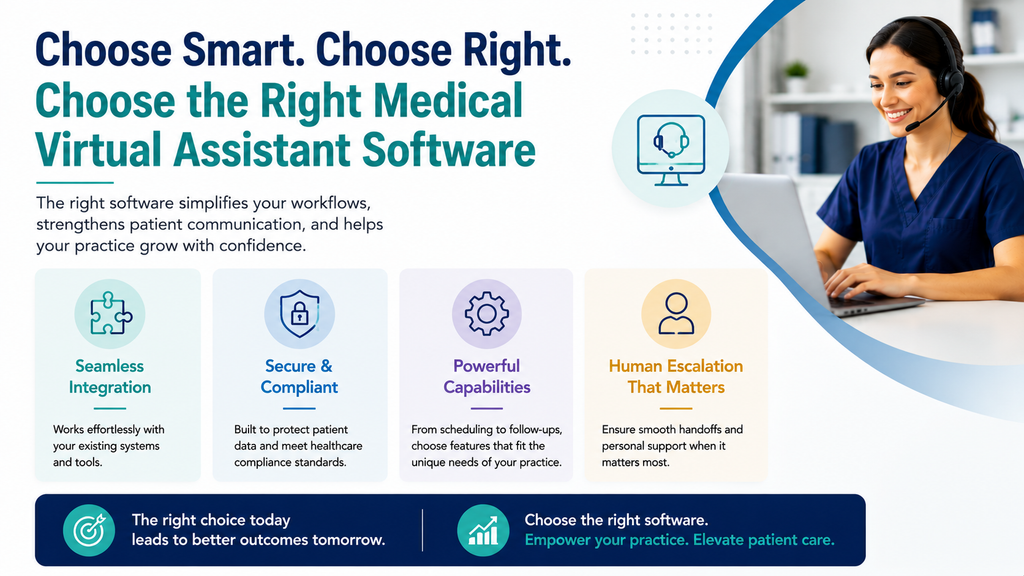
Integration With Existing Systems
- EHR Compatibility: Ensure the virtual assistant can connect with your electronic health record system to support smoother access to relevant patient and appointment information.
- Practice Management Platforms: Check whether the solution works with your existing practice management software to avoid creating separate or disconnected workflows.
- Scheduling Tools: The assistant should integrate with your scheduling system to support appointment booking, confirmations, cancellations, and rescheduling.
- Phone Systems: If the virtual assistant handles calls, confirm that it can work effectively with your existing phone infrastructure and call-routing processes.
- Patient Communication Software: Integration with messaging and communication tools can help create a more consistent experience across patient interactions.
Data Security and Compliance
- Business Associate Agreements: Determine whether the provider offers a Business Associate Agreement when required for your specific workflow.
- Data Storage: Understand where patient information is stored, how long it is retained, and how the provider manages sensitive data.
- Access Controls: Review who can access patient information and whether permissions can be customized based on staff roles.
- Encryption: Confirm how data is protected while being transmitted and stored within the system.
- Authentication: Look for secure login and identity-verification processes that help prevent unauthorized access.
- Audit Trails: Check whether the system records relevant user activity and data access for monitoring and accountability.
Scope of Tasks
- Call Handling: Determine whether the virtual assistant can answer and route routine patient calls based on your practice’s workflows.
- Appointment Scheduling: Review its ability to manage booking, cancellations, rescheduling, and appointment confirmations.
- Patient Follow-Ups: Check whether the solution can support routine follow-up communication after appointments or other patient interactions.
- Appointment Reminders: Evaluate whether automated reminders can be configured according to your scheduling requirements.
- Information Collection: Determine whether the assistant can collect basic patient information before passing the request to the appropriate staff member.
- Workflow Automation: Consider whether the platform supports broader administrative workflows beyond calls and scheduling.
Human Escalation
- Unresolved Requests: Understand what happens when the virtual assistant cannot answer a patient’s question or complete a requested task.
- Staff Transfer: Confirm whether conversations or calls can be transferred to the appropriate team member when human assistance is needed.
- Urgent Concerns: Review how potentially urgent or sensitive requests are identified and routed according to your practice’s established procedures.
- Custom Escalation Rules: Check whether you can define escalation workflows based on call type, patient request, urgency, or other requirements.
- Context Sharing: Determine whether relevant information from the interaction is provided to staff when a conversation is transferred, reducing the need for patients to repeat themselves.
AI Virtual Assistants for Healthcare: A Practical Approach
Modern healthcare virtual assistants can support voice, text, scheduling, and workflow-based interactions. Depending on the platform, they may also connect with patient communication systems and healthcare technology.
For small practices, the most effective approach is usually to begin with high-volume, repetitive tasks.
For example, a practice may start by automating routine appointment communication before expanding into other workflows.
This allows the team to evaluate performance, refine processes, and ensure appropriate escalation procedures are in place.
Practices can explore AI-powered healthcare workflows as part of a broader administrative automation strategy.
Conclusion
The benefits of a healthcare virtual assistant are particularly relevant for small practices with limited administrative capacity.
Virtual support can help manage routine communication, reduce repetitive work, provide greater operational flexibility, and allow staff to focus more time on patients and complex responsibilities.
The strongest approach is not necessarily replacing employees with technology.
Instead, it is building a workflow where each resource handles the work it performs best.
Virtual assistants and AI can support structured, repetitive tasks at scale, while human staff remains essential for empathy, judgment, complex problem-solving, and direct patient support.
For small practices, this hybrid approach can create additional capacity without requiring immediate expansion of the internal administrative team.
MantraAssist can help practices explore AI-powered patient communication and healthcare automation designed to support these workflows.
Sources
- JAMA Network Open — Ambient AI and Administrative Burden – Read the JAMA Network Open study
- U.S. Bureau of Labor Statistics — Medical Secretaries and Administrative Assistants – View the BLS occupational requirements data
- U.S. Bureau of Labor Statistics — Secretaries and Administrative Assistants – View the BLS Occupational Outlook Handbook
- MantraAssist — Healthcare AI and Virtual Assistant Solutions – Explore MantraAssist
Frequently Asked Questions
A healthcare virtual assistant can support routine patient communication, appointment-related tasks, follow-ups, information collection, and administrative workflows. This can create additional capacity and allow staff to focus on more complex responsibilities.
Not necessarily. In-house staff remains important for complex conversations, personal patient support, and responsibilities requiring judgment. For many practices, virtual support works best alongside human employees.
Compliance depends on the provider, technology, and specific workflow. Practices should evaluate data handling, access controls, vendor agreements, and whether a Business Associate Agreement is required.
Costs vary depending on the provider and scope of services. Practices should compare the cost with their administrative workload, staffing needs, patient volume, and operational requirements.
Some platforms integrate with EHRs, practice management systems, scheduling tools, and patient communication software. Practices should confirm compatibility with their specific technology before implementation.

