
It is 9 a.m. on a Tuesday. Several appointment slots are empty, the front desk is already calling patients to confirm upcoming visits, and staff members are spending valuable time managing gaps that may have been prevented. For healthcare organizations looking to reduce patient no-shows with AI, these tools can provide a more proactive way to manage reminders, confirmations, rescheduling, waitlists, and patient outreach.
Patient no-shows can disrupt continuity of care, leave valuable appointment capacity unused, and increase the workload for front-desk teams. An empty appointment slot represents more than lost revenue. It can also mean delayed care for one patient and a missed opportunity for another patient waiting for an appointment.
This guide explains how healthcare organizations can reduce patient no-shows with AI, the no-show reduction tools healthcare organizations can use, and how to reduce patient no-shows using automated appointment reminders and connected scheduling automation.
Understanding the Impact of Patient No-Shows
Patient no-shows can affect far more than a single empty appointment slot. When a patient misses a scheduled visit, provider time, clinical space, and staff resources may remain unused, while other patients who need care may continue waiting for an available appointment. Over time, repeated no-shows can make it more difficult for healthcare organizations to use their available appointment capacity efficiently. Tools such as AI appointment automation can help practices create more connected workflows around appointment confirmations, cancellations, and rescheduling.
The impact also extends to daily operations and patient care. Missed appointments can result in increased administrative workload, scheduling disruptions, delayed follow-ups, and interruptions in continuity of care. In addition, automated appointment reminder systems and AI-supported patient communication can help practices improve outreach and make it easier for patients to confirm or change their appointments.
Common Reasons Patients Miss Appointments
Before selecting technology, healthcare organizations should understand why patients miss appointments.
Common reasons include:
- Patients forget appointments scheduled weeks in advance.
- Work, transportation, or childcare conflicts arise.
- Patients do not receive or notice a reminder.
- Rescheduling feels inconvenient or requires repeated phone calls.
- Long gaps between booking and the appointment date reduce follow-through.
- Patients’ plans change, but they do not have an easy way to update the appointment.
Many no-shows result from friction rather than deliberate disengagement. For example, if a patient needs to call during business hours, wait on hold, and speak with staff simply to change an appointment, rescheduling may feel more difficult than doing nothing.
Therefore, connected scheduling workflows can help remove some of this friction. AI appointment scheduling automation can support a broader approach by connecting booking, cancellations, rescheduling, reminders, and waitlist management.
How to Reduce Patient No-Shows Using Automated Appointment Reminders
One of the most practical ways to reduce patient no-shows using automated appointment reminders is to create a structured reminder workflow that gives patients enough time to take action.
Research has consistently supported the use of appointment reminders. A systematic review of telephone, SMS, and automated reminders found that nearly all included studies reported improved attendance after patients received reminders before their appointments.
1. Use Multiple Communication Channels
Patients do not all respond to communication in the same way. SMS may work well for one patient, while another may be more responsive to a phone call or email.
Therefore, using multiple communication channels can help practices reach patients through their preferred method. Modern automated appointment reminder systems can combine SMS, voice, and email communication while also giving patients a convenient way to respond.
2. Send More Than One Reminder
A reminder sent immediately after booking may eventually be forgotten, while a reminder sent only minutes before an appointment may not provide enough time to reschedule.
Instead, a structured reminder sequence can give patients multiple opportunities to confirm or change their appointment. Research has also found that multiple digital notifications may be more effective at improving attendance than a single notification.
3. Make Confirmation and Rescheduling Easy
A reminder should do more than simply tell patients not to forget their appointment. It should also give them a clear and convenient way to:
- Confirm their appointment
- Cancel if necessary
- Reschedule without repeated phone calls
When self-service scheduling is easy to use, it can reduce friction and encourage patients to take action when their plans change rather than simply missing the appointment.
4. Provide Clear Appointment Details
Messages should provide enough information for patients to understand what the appointment is for and when it will occur.
Including the date, time, provider, location, and appointment type, where appropriate, can reduce confusion and help patients prepare accordingly.
5. Monitor Patient Responses
Healthcare organizations should track confirmation, cancellation, and rescheduling activity. By reviewing these response patterns, teams can identify whether reminder timing, communication channels, or message content need adjustment.
No-Show Reduction Tools Healthcare Organizations Can Use
Choosing effective no-show reduction tools for healthcare organizations requires looking beyond a basic reminder message.
A more complete solution may include:
- Automated appointment reminders
- SMS, voice, and email communication
- Appointment confirmation workflows
- Self-service cancellation and rescheduling
- Automated waitlists
- AI-powered patient outreach
- Scheduling analytics
- EHR and calendar integration
- Human escalation for complex patient needs
The right combination depends on patient demographics, appointment volume, specialty, communication preferences, and existing workflows.
For practices managing high call volumes, healthcare call center automation can also support appointment-related communication across voice, SMS, email, and other channels while routing more complex requests to staff.
However, the goal should not simply be to add more disconnected tools. Instead, healthcare organizations should create a connected workflow in which each patient response triggers the appropriate next step:
Reminder → Patient Response → Confirmation, Cancellation, Rescheduling, or Staff Follow-Up
This approach can reduce the manual effort required to manage every appointment individually while improving visibility across the scheduling process.
AI-Powered Strategies to Reduce Patient No-Shows
Healthcare organizations can reduce patient no-shows with AI by combining automated communication, predictive insights, self-service scheduling, and patient outreach within a connected workflow.
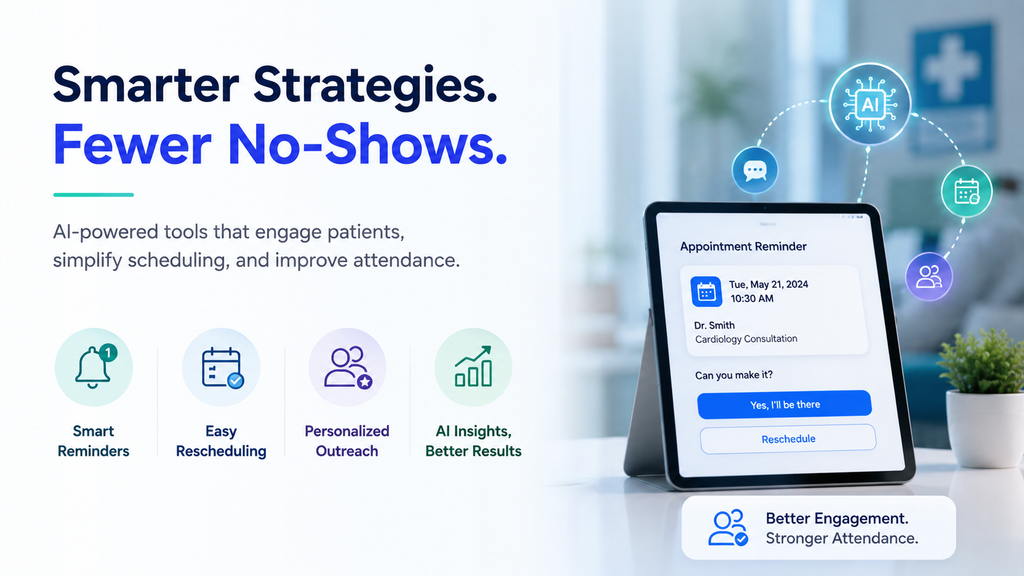
Depending on the system, AI may support:
- Identifying potentially higher-risk appointments
- Sending reminders automatically
- Managing appointment confirmations
- Answering routine scheduling questions
- Supporting rescheduling
- Contacting waitlisted patients
- Routing complex requests to human staff
For organizations looking to reduce appointment no-shows, AI technology can help connect these activities within a more consistent workflow.
The goal is not to replace front-desk teams. Instead, automation can handle repetitive communication tasks while staff members focus on patients and scheduling situations that require judgment, empathy, or more complex assistance.
This broader approach is also explored in AI healthcare automation use cases, where scheduling and patient communication are among the administrative workflows that can be supported by AI.
How to Measure Whether Your Strategy Is Working
Reducing no-shows requires more than implementing new technology. Healthcare organizations also need to measure whether their strategy is producing meaningful results.
1. Calculate Your Baseline No-Show Rate – Track missed appointments as a percentage of scheduled appointments over a defined period. Without a baseline, it becomes difficult to determine whether a new workflow is improving results.
2. Track Appointment Types Separately – No-show patterns may differ by provider, specialty, location, or appointment type. Therefore, breaking results down can help identify where additional intervention may provide the greatest value.
3. Monitor Reminder Responses – Review how patients respond to reminders and track:
- Confirmation rates
- Cancellation rates
- Rescheduling rates
- Unanswered messages
- Communication channel performance
4. Separate Rescheduling From No-Shows – A patient who reschedules is different from a patient who simply does not attend. Therefore, an increase in rescheduling combined with a reduction in no-shows may indicate that the workflow is making it easier for patients to take action when their plans change.
5. Review Results Regularly – Patient behavior and communication preferences can change over time. Regular reviews can help organizations adjust reminder timing, communication channels, and escalation workflows based on actual performance.
Common Mistakes to Avoid
Even strong no-show reduction tools for healthcare organizations can underperform when the underlying workflows are poorly designed.
- Sending Only One Reminder: A single message may not provide enough support for appointments booked far in advance.
- Making Rescheduling Difficult: If changing an appointment requires significant effort, patients may simply fail to attend.
- Ignoring Communication Preferences: Different patient populations may respond differently to SMS, voice, or email.
- Treating Every Patient the Same: Patients with repeated missed appointments may require a different approach from those experiencing a one-time scheduling conflict.
- Treating AI as Set-and-Forget: Automation should be monitored and improved over time.
Healthcare organizations should therefore review performance data regularly and refine communication workflows based on actual patient responses.
Best Practices for Implementation
A successful implementation depends not only on the technology itself but also on how it is introduced into existing workflows. By taking a structured approach, healthcare organizations can improve adoption, address challenges early, and achieve better results.
- Start With a Pilot: Test the workflow with one provider group, location, or appointment type before expanding.
- Involve Front-Desk Teams: Staff members who manage scheduling every day can provide valuable insight into common patient barriers.
- Keep Communication Clear: Automated messages should be concise, understandable, and easy for patients to act on.
- Create Human Escalation Rules: Define when automated systems should transfer a patient interaction to staff.
- Review Performance Data: Monitor no-show rates, appointment utilization, confirmation rates, and rescheduling activity regularly.
Where MantraAssist Fits In
MantraAssist is designed to support healthcare organizations with AI-powered patient communication and appointment workflows.
For practices looking to reduce patient no-shows with AI, a connected workflow can bring together reminders, confirmations, cancellations, rescheduling, and waitlist management.
Rather than requiring staff members to manually track every patient response, automation can help route each response to the appropriate next step. For example, a patient may:
- Receive an automated reminder.
- Confirm the appointment.
- Request to reschedule.
- Cancel the appointment.
- Be routed to staff if the request requires human assistance.
In addition, the same connected approach can support patients who prefer phone-based communication. AI-supported call workflows can manage routine appointment requests while allowing staff to handle more complex patient needs.
For clinics dealing with high call volumes, AI call center automation for medical clinics can complement reminder and scheduling workflows by supporting outbound patient communication and appointment-related conversations.
Conclusion
Patient no-shows remain a significant operational challenge; however, many of the factors contributing to missed appointments can be addressed through better communication and scheduling workflows.
Learning how to reduce patient no-shows using automated appointment reminders is an important starting point. In addition, self-service rescheduling, automated waitlists, AI-supported outreach, and predictive insights can help create a more proactive approach.
Organizations can also reduce patient no-shows with AI by using automation to make appointment confirmation, cancellation, rescheduling, and patient communication easier and more accessible.
For organizations exploring how to reduce patient no-shows automatically, the goal should be to reduce friction throughout the appointment journey.
The right combination of no-show reduction tools for healthcare organizations can help patients confirm, cancel, or reschedule more easily while reducing repetitive administrative work for staff.
AI does not replace the human role in patient scheduling. Instead, it can help healthcare teams spend less time chasing routine confirmations and more time supporting patients who need direct assistance.
Sources
- Using Digital Notifications to Improve Attendance in Clinic: Systematic Review and Meta-Analysis
PubMed - Using Digital Notifications to Improve Attendance in Clinic: Systematic Review and Meta-Analysis
BMJ Open Full Study - Use of Telephone and SMS Reminders to Improve Attendance at Hospital Appointments: A Systematic Review
PubMed - No-Show in Medical Appointments with Machine Learning Techniques: A Systematic Literature Review
Full Research Paper - Patient No-Show Prediction: A Systematic Literature Review
PMC Full Study
Frequently Asked Questions
Yes. Healthcare organizations can reduce patient no-shows with AI by automating reminders, confirmations, patient outreach, rescheduling, and waitlist workflows. Some systems may also analyze historical patterns to identify appointments that could require additional attention.
Use timely reminders, offer appropriate communication channels, make confirmation and rescheduling easy, and regularly review patient response data.
Clinics can combine automated reminders with self-service rescheduling, automated waitlists, AI-powered outreach, and connected scheduling workflows.
Useful capabilities can include multi-channel reminders, appointment confirmations, self-service rescheduling, automated waitlists, AI communication tools, scheduling analytics, and EHR integration.
Useful capabilities can include multi-channel reminders, appointment confirmations, self-service rescheduling, automated waitlists, AI communication tools, scheduling analytics, and EHR integration.

