
“We lost several new patients last week because no one picked up the phone during lunch.” This situation is familiar to many healthcare practices. Phones ring while front-desk staff is checking in patients, answering insurance questions, collecting information, and helping patients in person. Eventually, something has to wait – and too often, it is the next caller.
The receptionist is not necessarily underperforming. The reality is that one person cannot be in several places at once or manage an unlimited number of calls simultaneously.
That is why the AI Receptionist vs Human Receptionist discussion has become increasingly important for healthcare practices. It is no longer simply about adopting new technology. Instead, it is about improving patient access, managing administrative workloads, reducing missed communication opportunities, and helping staff focus on interactions that genuinely require human attention.
This guide provides a practical AI Receptionist vs Human Receptionist comparison, including availability, cost, workflow capabilities, patient experience, and the situations in which human front-desk support remains essential.
Why the AI Receptionist vs Human Receptionist Decision Matters
Patient communication is often one of the first points of contact between a healthcare practice and the people it serves. However, telephone access can become difficult when front-desk teams are managing a high volume of responsibilities at the same time.
Research on patient experiences with telephone access barriers has found that difficulties reaching healthcare organizations can create additional barriers to care and frustration for patients. Problems such as unanswered calls, incorrect transfers, and disconnections can affect the patient experience and may discourage patients from continuing to seek assistance through the same communication channel.
This is where the AI Receptionist vs Human Receptionist decision becomes more relevant.
The question is not simply whether AI can answer a phone call. Instead, healthcare leaders need to determine which tasks benefit from automation and which situations require human judgment, empathy, and experience.
For example, appointment scheduling, reminders, and frequently asked questions may be suitable for automation, while emotionally sensitive conversations or unusual patient concerns may require direct staff involvement.
As a result, the most useful comparison focuses on the strengths and limitations of each option rather than treating the decision as a simple replacement.
AI Receptionist vs Traditional Receptionist: How the Roles Differ
An AI receptionist vs traditional receptionist comparison begins with availability and capacity.
A traditional receptionist works within scheduled hours and may also need to manage patients standing at the front desk, paperwork, internal communication, and incoming calls. During busy periods, answering every call immediately may simply not be possible.
An AI receptionist, on the other hand, can provide automated support outside regular office hours and handle multiple routine interactions without requiring a staff member to manually manage every conversation.
This can include tasks such as:
- Scheduling and rescheduling appointments
- Sending appointment reminders
- Answering frequently asked questions
- Providing basic office information
- Routing calls to the appropriate department
- Collecting initial information before escalation
However, availability is only one part of the comparison. The differences become clearer when looking at call-handling capacity, consistency, response time, and the ability to manage complex patient interactions.
AI Receptionist vs Traditional Receptionist: A Quick Comparison
| Factor | AI Receptionist | Traditional Receptionist |
|---|---|---|
| Availability | 24/7, including nights and weekends | Fixed business hours only |
| Call Capacity | Handles multiple calls at once | One call at a time |
| Consistency | Same script and workflow every time | Can vary based on workload and circumstances |
| Speed to Answer | Immediate response with no hold time | Can be delayed during busy periods |
| Emotional Judgment | Limited; can escalate complex cases | Can recognize tone and offer reassurance |
| Sick Days or Turnover | None | Requires coverage or backup staff |
| Best Suited For | Scheduling, reminders, FAQs, and routine requests | Sensitive conversations, complex billing, and in-person support |
The table highlights why the AI Receptionist vs Human Receptionist decision does not have to be an either-or choice. AI can provide additional capacity for repetitive and high-volume communication, while human receptionists remain valuable for interactions that require empathy, flexibility, judgment, and personalized support.
Therefore, the AI receptionist vs traditional receptionist difference is often less about one option being universally better and more about capacity versus human judgment.
AI can manage a high volume of repetitive interactions consistently, while human staff can focus on conversations that require context, flexibility, and emotional understanding.
Healthcare practices can also explore how AI Call Center Automation can support routine patient communication while helping teams manage high call volumes.
The Cost Comparison: Virtual Receptionist vs Human Receptionist
A virtual receptionist vs human receptionist comparison should consider more than salary alone.
According to the U.S. Bureau of Labor Statistics, medical secretaries and administrative assistants had a median annual wage of $45,930 in May 2025. Receptionists and information clerks also represent an ongoing staffing expense, while the total cost of employing a team member may extend beyond wages to include benefits, recruitment, onboarding, training, and coverage during absences.
These additional costs can become increasingly important when practices experience frequent staffing changes or need additional coverage during busy periods.
AI receptionist platforms also involve costs, and pricing can vary depending on call volume, integrations, features, and the level of automation required. However, software-based systems do not have the same staffing requirements associated with employee absences, turnover, or repeated recruitment.
That does not automatically mean AI is less expensive for every practice.
A virtual receptionist vs human receptionist decision should consider the practice’s actual workload. A small practice with low call volume may not need extensive automation, while a growing or multi-location organization may benefit more from technology that can manage routine interactions at scale.
The most useful comparison is therefore based on total operational workload and cost, rather than salary alone.
Healthcare organizations can also explore broader Healthcare Automation strategies when evaluating where automation can reduce repetitive administrative work.
AI Medical Receptionist vs Front Desk Staff: Where Each Performs Best
An AI medical receptionist vs front desk staff comparison reveals two different sets of strengths.
AI performs particularly well when work is repetitive, predictable, and time-sensitive. For example, an AI system can provide immediate responses to routine calls, schedule appointments, answer common questions, and direct patients to the appropriate resource.
It can also help practices maintain communication during periods when staff members are unavailable or busy assisting patients in person.
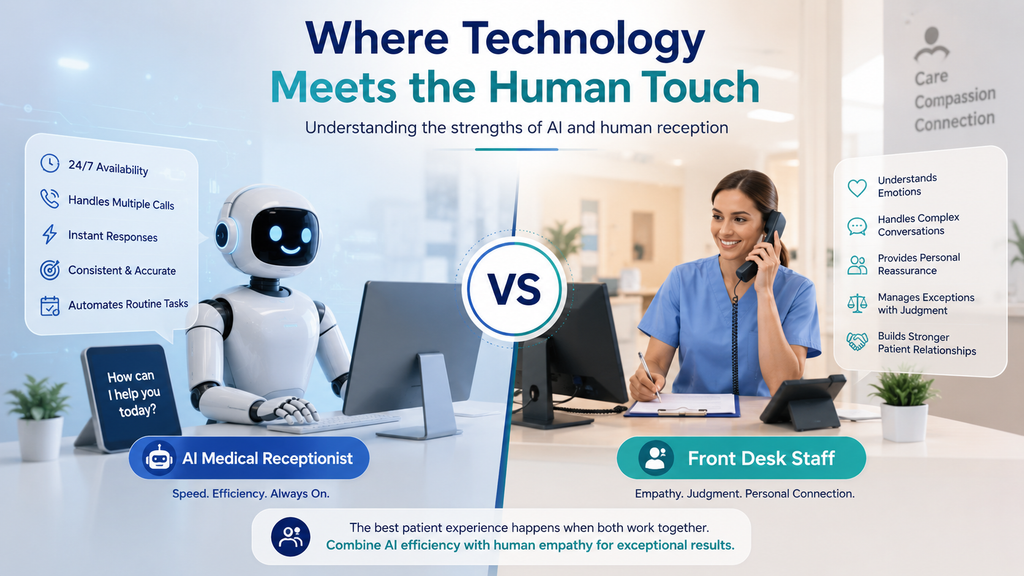
Human front-desk staff, however, remain essential for situations involving:
- Complex patient concerns
- Emotional or sensitive conversations
- Unusual scheduling situations
- Billing or administrative issues requiring investigation
- Situations that require judgment
- Escalations requiring trained staff
- In-person patient support
Therefore, the AI medical receptionist vs front desk staff discussion should not focus on which option is universally better.
Instead, healthcare practices should identify which tasks are repetitive enough to automate and which interactions benefit from direct human involvement.
This division of responsibilities can help reduce administrative pressure while preserving the human support patients may need.
For practices handling a high volume of phone interactions, Healthcare Voice AI can support routine conversations while allowing more complex requests to be escalated to staff.
Should I Replace My Receptionist With AI? Questions to Ask First
If you are asking, “Should I replace my receptionist with AI?”, the first step should be to evaluate your practice’s actual workload.
Start with your call data rather than assumptions.
How Many Calls Are Being Missed?
Review phone system reports to identify when calls are most frequently missed.
Are missed calls occurring:
- During lunch breaks?
- Before or after office hours?
- During morning rushes?
- When staff members are helping patients at the front desk?
Understanding these patterns can reveal whether the problem is staffing, call volume, workflow design, or limited coverage.
Which Tasks Take Up the Most Time?
Not every front-desk responsibility should be automated.
However, tasks such as appointment confirmations, reminders, basic scheduling, and frequently asked questions may consume a significant amount of staff time.
Automating repetitive interactions can allow employees to focus on more complex responsibilities.
What Requires Human Judgment?
Healthcare practices should clearly define which conversations require staff involvement.
Clinical concerns, emergencies, sensitive patient situations, and complex administrative issues should have appropriate escalation procedures rather than being treated as routine automated interactions.
Is Patient Volume Increasing?
A practice with stable and low call volume may have different needs from a multi-provider organization experiencing growth.
If administrative demand is increasing faster than staffing capacity, automation may provide a way to support additional patient interactions while reducing the pressure on existing staff.
Answering these questions can make “should I replace my receptionist with AI?” a more practical decision based on operational needs rather than assumptions.
When a Human Receptionist Still Makes Sense
AI is not automatically the right solution for every healthcare practice.
Very small practices with limited call volume may not see enough benefit from advanced automation. Similarly, practices with highly specialized workflows may require significant customization before an automated system can manage routine interactions effectively.
Some patient populations may also prefer direct human communication, particularly when discussing sensitive concerns or navigating unfamiliar healthcare processes.
In these situations, human front-desk staff may continue to provide the most effective experience.
However, this does not necessarily mean a practice must choose between full automation and no automation.
Even when a human receptionist remains central to daily operations, AI can still support specific tasks such as after-hours coverage, appointment reminders, call routing, and routine scheduling.
This is why the AI Receptionist vs Human Receptionist discussion should not automatically begin with replacement. For many practices, the better question is where automation can provide additional capacity.
The Hybrid Model: A Practical Answer for Most Practices
For many healthcare organizations, the AI Receptionist vs Human Receptionist decision does not require choosing one over the other.
A hybrid approach can combine the strengths of both.
AI can manage routine and repetitive interactions, including appointment scheduling, reminders, common questions, and initial call routing. Meanwhile, staff members can focus on patients and situations that require greater attention.
This can create several operational advantages.
Patients may receive faster responses for routine requests, while employees may spend less time repeating the same information throughout the day. At the same time, complex conversations can still be transferred to trained staff members.
MantraAssist can support this type of workflow by combining AI-powered patient communication with appointment and call-management processes. Routine interactions can be automated, while situations requiring human involvement can be escalated to staff.
In this model, the AI Receptionist vs Human Receptionist discussion becomes less about replacement and more about designing a workflow in which each resource performs the tasks it is best suited to handle.
Practices can also connect these workflows through AI Appointment Automation to support scheduling, reminders, confirmations, and patient communication.
How to Make an AI Receptionist Comparison for Your Practice
A meaningful AI receptionist comparison should evaluate more than pricing.
1. Review Healthcare Compliance and Data Handling – Healthcare practices should understand how patient information is handled and whether a platform supports the organization’s privacy and compliance requirements. Ask about:
- Data security
- Access controls
- Encryption
- Business Associate Agreements, where applicable
- Data retention practices
2. Evaluate Integration Capabilities – A system that only answers calls may offer limited value if staff members still need to manually update scheduling information. Therefore, practices should evaluate how well the platform integrates with existing EHR, scheduling, and communication systems.
3. Review Escalation Workflows – No automated system should attempt to manage every possible patient situation independently. Ask how the system handles conversations it cannot resolve and how it transfers calls to staff members when appropriate. A strong workflow should minimize unnecessary repetition and provide staff with relevant context.
4. Test Realistic Patient Interactions – A useful AI receptionist comparison should include realistic scenarios rather than relying only on demonstrations. Test situations such as:
- Appointment scheduling
- Appointment changes
- Frequently asked questions
- Complex requests
- Requests requiring escalation
This can provide a clearer understanding of how the system performs in real-world practice workflows.
5. Consider Implementation Support: Technology adoption depends on more than the product itself. Healthcare practices should understand how implementation works, what training is required, and how workflows can be adjusted after launch.
How AI and Human Receptionists Can Work Together
The strongest approach is often based on task allocation.
AI can support:
- High-volume routine calls
- Appointment scheduling
- Reminders and confirmations
- Basic patient questions
- Call routing
- After-hours communication
Human staff can focus on:
- Complex patient concerns
- Sensitive conversations
- Exceptions to standard workflows
- In-person patient support
- Complex administrative issues
- Situations requiring judgment
This approach allows practices to increase communication capacity while preserving the human role where it provides the greatest value.
For this reason, the AI Receptionist vs Human Receptionist comparison should be viewed as an opportunity to redesign the front-desk workflow rather than simply eliminate a position.
Conclusion
The AI Receptionist vs Human Receptionist decision is not ultimately about choosing technology over people.
AI can provide speed, consistency, and additional capacity for repetitive patient interactions. Human receptionists bring judgment, flexibility, and empathy that remain important in healthcare.
Therefore, for many practices, the most effective answer is a hybrid approach.
Organizations can use AI to support routine communication and reduce administrative pressure, while allowing staff members to focus on complex situations and direct patient support.
The right approach depends on call volume, staffing challenges, patient needs, workflow complexity, and existing technology.
Rather than asking which option is better in every situation, healthcare leaders should consider which combination of AI and human support creates the best experience for both patients and staff.
Sources
- How Do Patients Respond When Confronted With Telephone Access Barriers to Care? – View the study on PubMed
- U.S. Bureau of Labor Statistics — Secretaries and Administrative Assistants – View U.S. Bureau of Labor Statistics data
- U.S. Bureau of Labor Statistics — Receptionists – View U.S. Bureau of Labor Statistics data
Frequently Asked Questions
For routine administrative tasks such as appointment scheduling, reminders, call routing, and frequently asked questions, AI can provide consistent support and extended availability. However, situations involving complex judgment, sensitive concerns, or clinical issues should have appropriate human escalation processes.
Costs vary based on location, staffing requirements, call volume, software features, and integrations. Human staffing costs can include wages, benefits, recruitment, training, and turnover, while AI platforms typically use software-based pricing models. Practices should compare total operational costs rather than salary alone.
Automated systems should not replace established emergency or clinical triage processes. Healthcare organizations should ensure that urgent situations follow clearly defined escalation and safety protocols.
Patients may recognize that they are interacting with an automated system. However, transparency, clear communication, and an effective option to reach appropriate staff when needed can help create a better experience.
Not necessarily. Small practices should evaluate call volume, missed calls, staffing costs, workflow complexity, and patient needs. In many cases, AI may work best as additional support rather than as a complete replacement.

