
Every clinic administrator has had the conversation. Call volumes are rising. Staff are overwhelmed. Patients are waiting on hold for too long. Someone in the room suggests, “What if we just built our own AI call system?”
It sounds appealing. Full control. Custom workflows. No recurring SaaS fees. A solution built exactly for how your clinic operates – not how a vendor thinks you operate.
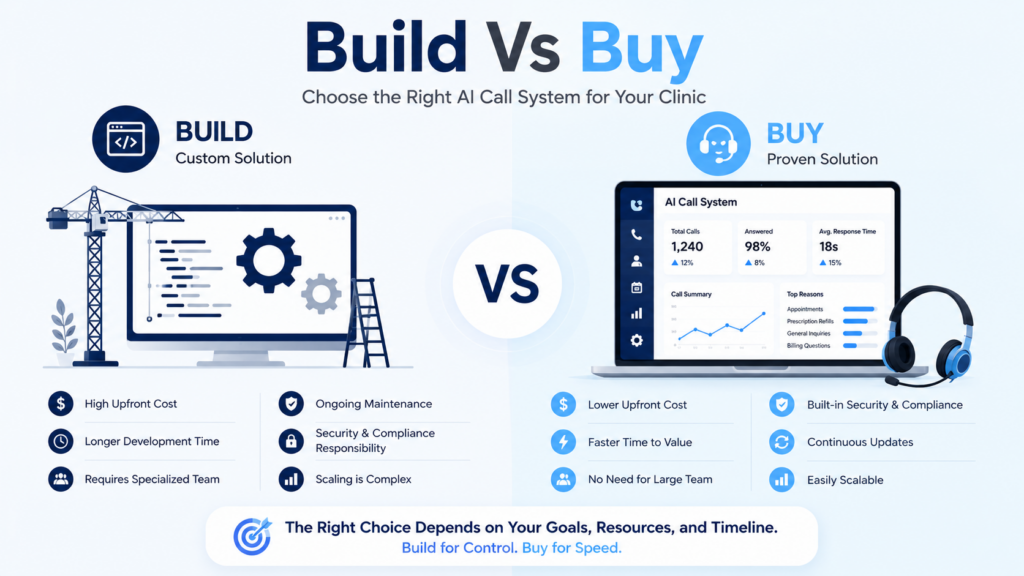
But the build vs buy decision in healthcare technology is rarely as simple as it sounds. Building a custom AI call system for clinics is a significant engineering undertaking. It carries ongoing maintenance costs, compliance obligations, and organizational risks that most clinical teams underestimate before they begin.
Buying, on the other hand, means trading customization for speed, simplicity, and vendor accountability – with purpose-built platforms like MantraAssist delivering HIPAA-compliant AI call center software for clinics that can be deployed in days rather than months.
This guide breaks down the build vs buy decision with honesty and specificity – so clinic leaders can make the right healthcare technology decision for their organization in 2026.
Why Clinics Are Evaluating AI Call Systems Now
The relative numbers make the case clear.
The average clinic receives between 200 and 500 patient calls per day. Front desk staff handles appointment scheduling, insurance questions, prescription refill requests, referral coordination, and general inquiries – often simultaneously, often under pressure.
A 2024 survey by the Medical Group Management Association found that front desk staffing is one of the top three operational challenges facing outpatient practices. Turnover in administrative roles runs at 30 to 40% annually in many markets. Training a replacement takes four to eight weeks. During that window, existing staff absorb the excess volume, which accelerates their own burnout.
AI call systems for clinics solve a specific and urgent problem. They
- Handle high-volume, repetitive inbound calls – appointment scheduling, reminders, basic FAQ responses, prescription refill routing – without human intervention.
- Operate 24 hours a day.
- Don’t call in sick.
And when configured correctly, they handle the majority of routine call volume, freeing staff for the complex and sensitive interactions that genuinely require human judgment.
The question is not whether to adopt AI call center software. The question is whether to build it or buy it.
What Building a Custom AI Call System for Clinics Actually Involves
Before evaluating the build option seriously, clinic leaders need an honest picture of what it requires.
The Technical Stack
A functional AI call system for a healthcare environment requires multiple integrated components.
Automatic Speech Recognition (ASR) converts spoken patient language into text. Building or licensing a healthcare-grade ASR model – one that accurately handles medical terminology, diverse accents, and variable call quality – is a significant technical undertaking.
Natural Language Understanding (NLU) interprets patient intent from that transcribed text. “I need to reschedule my appointment with Dr. Martinez for next Thursday” requires the system to identify intent, extract entities, resolve ambiguity, and trigger the correct workflow.
Dialog Management controls the conversation flow – handling multi-turn interactions, clarifying ambiguous inputs, managing interruptions, and escalating to a human agent when the AI cannot resolve the request.
Text-to-Speech (TTS) generates natural-sounding responses. Generic TTS sounds robotic. Healthcare-grade TTS – particularly for sensitive patient conversations – requires careful calibration and ongoing refinement.
EHR Integration is non-negotiable in a clinical context. A call system that cannot read and write to your patient record system – pulling appointment availability, verifying patient identity, updating scheduling records – creates manual reconciliation work that defeats the entire purpose.
HIPAA-Compliant Infrastructure covers data encryption, access controls, audit logging, Business Associate Agreements with every vendor in the stack, and ongoing security monitoring. This is not a one-time configuration. It is a continuous compliance obligation.
Building all of this from scratch – even using best-in-class APIs and cloud services – requires a skilled engineering team, a healthcare compliance specialist, and ongoing product management. For a mid-size clinic group, that typically means six to twelve months of development time before a minimally viable system is ready for production.
The True Cost of Building AI Call Center Software
The cost of building an AI call system for clinics in healthcare is almost always underestimated at the outset.
Here is a relative breakdown for a mid-size clinic group building a custom system:
Initial Development Costs
Engineering team (3–5 developers for 6–12 months): $300,000 – $700,000
Healthcare compliance consultant: $30,000 – $75,000
EHR integration development: $50,000 – $150,000
Infrastructure setup (cloud, security, monitoring): $20,000 – $50,000
QA testing and clinical validation: $30,000 – $60,000
Total initial investment: $430,000 – $1,035,000
And that is before a single patient call is handled.
Ongoing Annual Costs
Engineering maintenance and feature development: $150,000 – $300,000
Infrastructure and hosting: $24,000 – $60,000
Compliance monitoring and updates: $20,000 – $50,000
API and third-party service costs: $10,000 – $30,000
Annual ongoing cost: $204,000 – $440,000
Compare that to a purpose-built SaaS AI call system for clinics, which typically runs between $500 and $3,000 per month, depending on call volume and features. For most clinic groups, the buy option pays back within the first year – often within the first quarter.
What Buying Delivers That Building Cannot
The cost comparison alone often resolves the build vs buy healthcare software decision. But cost is not the only factor. Speed, compliance, and risk deserve equal weight.
Speed to Value
A SaaS AI call center software solution can be configured and deployed in two to four weeks. Training on clinic-specific workflows, EHR integration, and staff enablement can all happen in parallel. The system starts handling calls – and delivering ROI – within weeks of the decision to move forward.
A custom build will not be in production for six to twelve months at a minimum. During that period, the clinic continues absorbing full call volume with existing staff, continues losing the revenue that AI call handling would have recovered, and continues paying engineering costs for a system that has not yet delivered a single dollar of value.
Continuous Improvement
Healthcare AI call center software vendors improve their systems continuously – updating ASR models, refining NLU accuracy, expanding integration capabilities, and adding features across their entire customer base. When a vendor releases an improvement, every customer benefits immediately.
A custom-built system improves only when your engineering team has the capacity and priority to improve it. In most clinical organizations, that means the custom system falls behind the market within 18 to 24 months – and the gap widens over time.
Compliance Maintenance
HIPAA compliance requirements evolve. OCR guidance updates. State privacy laws expand. Security standards change. A SaaS vendor’s compliance team monitors and responds to these changes across their entire platform – meaning every customer remains compliant without dedicated internal effort.
For a custom-built system, compliance maintenance falls entirely on the clinic. That means legal monitoring, engineering updates, and ongoing security assessment – all at the clinic’s expense and risk.
Proven Clinical Validation
Reputable AI call system vendors have processed millions of patient calls. Their systems have been tested against real-world edge cases – confused patients, complex scheduling requests, emotional callers, and unusual clinical scenarios. That validation cannot be replicated by a clinic building its first AI system.
When Building Makes Sense
To be fair to the build option, there are scenarios where custom development is the right healthcare technology decision.
- Large health systems with unique workflows. If a health system operates highly specialized workflows that no commercial product supports – and has the engineering infrastructure to build and maintain custom software – a custom build may be justified.
- Organizations with existing AI infrastructure. Health systems that already operate mature data science and engineering teams, and that are building AI capabilities across multiple clinical and operational domains, can sometimes extend existing infrastructure to include call management more cost-effectively than smaller organizations.
- Competitive differentiation at scale. If a clinic group’s AI call capability is a genuine competitive differentiator – and the organization is large enough to treat technology as a core business function – the strategic case for building may outweigh the cost and risk.
For the overwhelming majority of outpatient clinics, group practices, community health centers, and specialty practices, none of these conditions apply. The build option is an expensive distraction from the core business of delivering patient care.
The Hybrid Option: Configure, Don’t Code
There is a middle path that many clinic leaders overlook.
The best AI call system for clinics in 2026 is not rigid, one-size-fits-all products. They are highly configurable platforms that allow clinical teams to define workflows, customize conversation scripts, set escalation rules, and integrate with existing EHR and practice management systems – without writing a single line of code.
This is not buying a generic solution. It is deploying a purpose-built foundation and configuring it to match your specific clinical environment. The result combines the speed and compliance of a SaaS solution with meaningful customization that reflects how your clinic actually operates.
For most clinics, this hybrid model – buy the platform, configure the workflows – delivers 90% of the value of a custom build at 10% of the cost and none of the risk.
Key Questions to Ask Before Making the Decision
Before committing to either path, clinic leaders should work through a clear decision framework.
What is the actual scope of our call management problem?
Document current call volume, staff time consumed, no-show rates, patient satisfaction with phone experience, and hold times. Quantify the cost of the current state before evaluating solutions.
Do we have the engineering capacity to build and maintain a custom system?
Be honest. Building AI call center software for healthcare requires sustained engineering investment – not a one-time project. If your organization does not have a dedicated technology team, the build option is not realistic.
What EHR integration do we need?
Identify your EHR system and confirm whether candidate SaaS vendors have existing, tested integrations. A vendor with a native Epic, Athenahealth, or Cerner integration eliminates months of custom development and significantly reduces implementation risk.
What is our HIPAA compliance infrastructure?
Assess your current compliance capabilities honestly. If your organization does not have dedicated legal and security resources, the ongoing compliance maintenance of a custom system represents a material operational risk.
What is our timeline?
If call volume is a problem today – and for most clinics it is – a six-to-twelve-month build timeline is not acceptable. Speed to value is a legitimate and important decision criterion.
How to Evaluate AI Call System Vendors
If the decision points toward buying – which it will for most clinical organizations – here is what to evaluate rigorously.
- HIPAA compliance credentials. Verify BAA availability, SOC 2 Type II certification, encryption standards, and audit logging capabilities before any other evaluation criterion.
- EHR integration depth. A surface-level integration that reads appointment availability is very different from a bidirectional integration that updates patient records, logs call outcomes, and syncs scheduling data in real time. Ask for a technical integration specification, not a marketing summary.
- Call handling accuracy. Request data on intent recognition accuracy, task completion rates, and escalation rates from comparable clinical environments. A system that misunderstands 15% of patient requests creates more problems than it solves.
- Escalation design. Evaluate how the system handles calls it cannot resolve. Smooth, context-preserving handoffs to human agents are essential. Patients should never have to repeat information when escalated.
- Implementation support. Assess the vendor’s implementation process, training resources, and ongoing customer support. A technically strong product with poor implementation support delivers poor outcomes.
- Pricing structure. Understand whether pricing is per-call, per-minute, per-seat, or flat monthly. Model the cost against your actual call volume to avoid surprises at scale.
Conclusion
The build vs buy decision for an AI call system for clinics in healthcare is not a close call for most clinical organizations.
Building a custom AI call system requires hundreds of thousands of dollars in upfront investment, six to twelve months of development time, ongoing engineering and compliance maintenance, and organizational focus that most clinic groups cannot sustain without compromising their core mission.
Buying purpose-built AI call center software for clinics delivers speed, compliance, proven performance, and continuous improvement – at a fraction of the cost and none of the build risk. For the overwhelming majority of outpatient practices, group clinics, and specialty organizations evaluating this decision in 2026, the answer is clear.
MantraAssist is purpose-built for exactly this use case – delivering HIPAA-compliant AI call handling, seamless EHR integration, and configurable clinical workflows that clinics can deploy in weeks rather than months. It is the kind of infrastructure that scales with patient volume, improves continuously, and lets clinical teams focus on what they do best: delivering patient care.
The question was never really whether to build or buy. It was whether to spend a million dollars and twelve months building something a proven platform already delivers – or to get there faster, cheaper, and with less risk.
For almost every AI call system for clinics, the answer is the same. Buy smart. Configure well. Scale confidently.
Frequently Asked Questions
Purpose-built SaaS platforms typically deploy in two to four weeks. Custom-built systems require six to twelve months of development before production deployment – making SaaS the only realistic option for clinics with immediate operational needs.
Initial development costs range from $430,000 to over $1 million for a mid-size clinic group. Annual maintenance adds $200,000 to $440,000. Most clinics find that SaaS alternatives deliver equivalent functionality at less than 5% of that total cost.
Yes. Leading AI call center software vendors maintain tested integrations with major EHR systems. Clinics should verify integration depth – specifically, whether the system supports bidirectional data sync – before selecting a vendor.
Reputable SaaS vendors maintain full HIPAA compliance, including Business Associate Agreements, SOC 2 Type II certification, and end-to-end encryption. Custom-built systems require the clinic to maintain all compliance obligations independently – a significant ongoing responsibility.
Clinical triage, urgent or emergency calls, sensitive mental health conversations, complex billing disputes, and any situation where a patient is distressed should always reach a trained human staff member. AI call systems should handle routine volume – not replace clinical judgment.

