
Growth is expensive in healthcare. Every new patient means more paperwork. More calls – prior authorizations – scheduling conflicts. Most clinic owners respond the same way – they hire a front desk coordinator or a billing specialist, or maybe another intake staff member.
But staffing costs are rising fast. The average medical receptionist now earns between $35,000 and $45,000 annually. Add benefits, training, and turnover – and the real cost climbs significantly higher. For small and mid-size practices, that math gets painful quickly.
Here’s the thing: most of the administrative burden in a clinic is repetitive, rule-based, and highly automatable. Appointment reminders. Insurance verification. Intake forms. Referral tracking. These tasks don’t require clinical judgment. They require consistency, speed, and accuracy – all things technology does better than humans at scale.
This guide breaks down exactly how to scale a clinic without hiring staff. From workflow automation to AI-powered front desk tools, the solutions exist. The question is knowing which ones to deploy first. Platforms like MantraAssist are specifically built for this – combining AI-driven scheduling, patient communication, and administrative automation into one system designed for growing clinical practices.
Why Admin Burden Grows Faster Than Patient Volume
The relationship between patient volume and administrative work is not linear. It compounds.
When a clinic doubles its patients, administrative tasks often triple. Why? Because more patients mean more insurance plans to verify, more prior authorizations to chase, more no-shows to manage, and more documentation to complete.
A 2024 report from the Medical Group Management Association found that physician practices spend an average of $99,000 per physician per year on administrative costs. That figure has risen consistently for the past decade. Meanwhile, a study published in Health Affairs found that for every hour a physician spends with patients, they spend nearly two additional hours on administrative tasks.
This is the scaling trap. Growth generates revenue. But unmanaged growth generates administrative chaos – which erodes that revenue through inefficiency, burnout, and errors.
The solution is not more staff. It is smarter systems.
The Six High-Impact Areas Where Clinics Can Automate
If you’re wondering how to scale a clinic without hiring staff, the answer often lies in automating the repetitive administrative tasks that consume the most time. From scheduling and patient intake to billing and follow-up communication, the right healthcare automation tools can significantly reduce workload, improve efficiency, and help clinics grow without adding headcount.
1. Appointment Scheduling and Reminders
Scheduling is the single highest-volume administrative task in most outpatient clinics. Staff spend hours each day booking, rescheduling, and confirming appointments – much of which could be handled entirely by software.
Online self-scheduling tools allow patients to book, cancel, and reschedule appointments 24 hours a day without any staff involvement. Studies consistently show that 40% or more of appointment bookings happen outside business hours. If your clinic requires a phone call to book, you’re losing those patients to competitors who don’t.
Automated reminders – sent by text, email, or phone – reduce no-show rates by an average of 29% according to a 2024 review published in the Journal of Medical Systems. That improvement directly increases revenue without adding a single staff member.
Healthcare Automation Tools to Consider: Zocdoc, Luma Health, NexHealth, and integrated EHR scheduling modules.
2. Patient Intake and Digital Forms
Paper intake forms are a clinical liability and an administrative drain. Staff manually enter patient information. Forms get lost. Handwriting gets misread. Data entry errors create downstream billing problems.
Digital intake eliminates all of this. Patients complete forms on their phone before arriving. Data flows directly into the EHR. Staff review rather than enter. The entire process takes seconds instead of minutes per patient.
For a clinic seeing 50 patients per day, automating intake can recover two to three hours of staff time daily. That is time better spent on tasks that actually require human judgment.
Healthcare Automation Tools to Consider: Phreesia, Klara, Paperfree, and EHR-native intake modules.
3. Insurance Verification
Manual insurance verification is one of the most time-consuming and error-prone tasks in clinic administration. Staff call payer lines, navigate automated systems, and manually record benefit details – for every patient, before every visit.
Automated eligibility verification tools check insurance status in real time, often within seconds. They flag coverage issues before the appointment rather than after – preventing claim denials and awkward billing conversations at checkout.
Claim denial rates average 5 to 10% across most practices. A significant portion of those denials stems from eligibility errors that automated verification would have caught. Reducing denials by even 3% has a meaningful impact on annual revenue.
Healthcare Automation Tools to Consider: Waystar, Availity, Change Healthcare, and payer-integrated EHR verification modules.
4. Prior Authorization Management
Prior authorization is widely recognized as one of the most burdensome administrative processes in American healthcare. A 2024 AMA survey found that physicians complete an average of 43 prior authorization requests per week, with each request taking nearly two hours of staff time to complete.
Automation tools now handle prior auth submission, status tracking, and follow-up without manual intervention. AI-powered platforms can predict which requests are likely to be denied and pre-populate supporting clinical documentation – reducing denial rates and appeal volumes simultaneously.
This is an area where automation delivers some of the highest ROI in clinical operations. Practices that automate prior authorization report recovery require between four and eight hours of staff time per week.
Healthcare Automation Tools to Consider: Infinitus, Rhyme (formerly Olive), Myndshft, and EHR-integrated prior authorization modules.
5. Medical Billing and Claims Management
Billing errors cost the US healthcare system an estimated $935 billion annually. For individual practices, billing inefficiencies translate directly into delayed payments, claim denials, and write-offs that compound over time.
Automated billing tools scrub claims before submission, flagging coding errors and missing information. They track claim status, generate patient statements, and follow up on unpaid balances – all without staff intervention.
Revenue cycle management platforms go further, providing real-time visibility into billing performance across the entire practice. They identify patterns in denials, flag high-risk claims, and optimize coding to maximize reimbursement.
Practices that implement automated billing consistently report improvements in days sales outstanding (DSO) and significant reductions in denial rates within the first 90 days.
Healthcare Automation Tools to Consider: Kareo, AdvancedMD, Tebra, Athenahealth, and specialty-specific RCM platforms.
6. Patient Communication and Follow-Up
Post-visit follow-up is where most clinics leak revenue and patient loyalty simultaneously. Patients don’t return for follow-up appointments. Preventive care gaps widen. Chronic disease patients fall out of care plans. All because no one followed up.
Automated patient communication platforms send post-visit summaries, care plan reminders, prescription refill prompts, and preventive care outreach – triggered by clinical data rather than staff memory. They personalize outreach by condition, age, and visit history.
For chronic disease populations – diabetes, hypertension, COPD – automated outreach has been shown to improve care plan adherence by 20 to 35%. That improvement translates directly into better clinical outcomes and reduced emergency utilization.
Healthcare Automation Tools to Consider: Klara, Luma Health, Relatient, and chronic care management platforms.
Building a Lean Operations Model for Clinic Growth
Automation tools work best when they are deployed within a deliberate operational framework. Here is a practical model for scaling clinic operations without expanding headcount.
- Audit first. When it comes to understanding how to scale a clinic without hiring staff, before buying any software, map where staff time actually goes. Track tasks by category for two weeks. Most clinics discover that 60 to 70% of administrative time is concentrated in three to four repeatable task types – and those are the highest-priority automation targets.
- Automate the volume, not the complexity. The goal is not to replace staff. It is to redirect staff from high-volume, low-judgment tasks to high-value, high-judgment work. Automation handles the repetitive. Staff handles the nuanced.
- Integrate before you stack. Adding standalone tools that don’t communicate with your EHR creates a new administrative burden rather than reducing it. Prioritize tools with native EHR integration or open API connectivity. Data that flows automatically is data that doesn’t require manual entry.
- Measure relentlessly. Define success metrics before implementation. Call volume. No-show rate. Denial rate. Staff overtime hours. Patient satisfaction scores. Track them monthly. If a tool isn’t moving the metrics, it is not working – and the data will tell you why.
- Train thoroughly. Technology adoption in clinical settings fails most often at the training stage, not the implementation stage. Staff who understand why a tool exists and how it improves their daily experience adopt it. Staff who feel it was imposed on them resist it.
What This Looks Like in Practice
Consider a primary care clinic seeing 80 patients per day with a front desk team of four. Before automation, the team spent roughly:
- 3 hours daily on appointment scheduling and confirmation calls
- 2 hours on insurance verification
- 1.5 hours on intake form processing
- 1 hour on referral coordination and follow-up
That is 7.5 hours of recoverable time per day – nearly one full-time equivalent – consumed by tasks that automation handles more accurately and consistently.
After implementing scheduling automation, digital intake, and real-time eligibility verification, that same team redirects those hours to patient experience, care coordination, and revenue cycle management. The clinic can absorb a 30 to 40% increase in patient volume without adding headcount.
That is not a theoretical outcome. It is the documented result of automation deployment across dozens of practices that have made this transition.
The Role of AI in the Next Generation of Clinic Operations
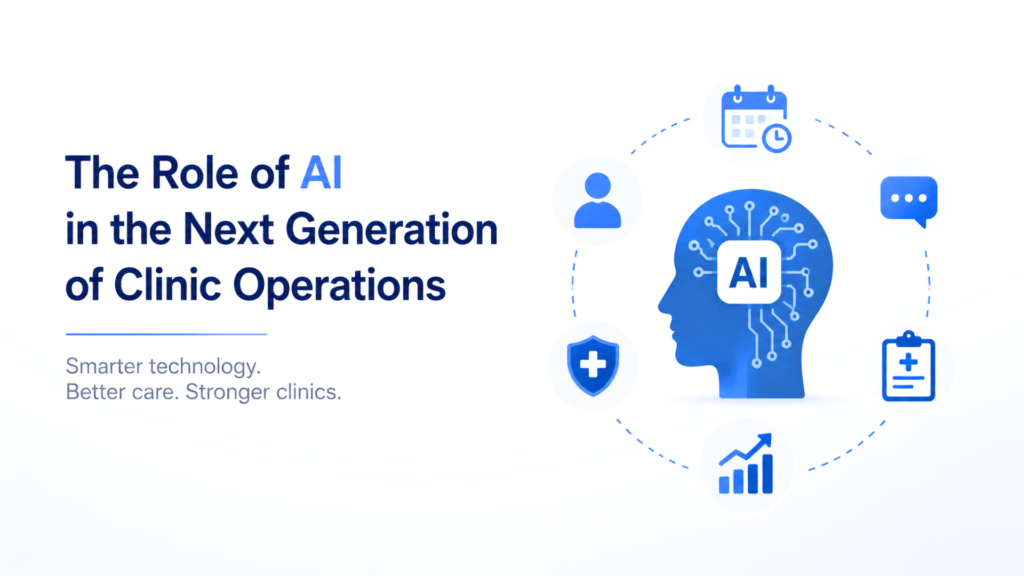
For clinics exploring how to scale a clinic without hiring staff, AI is quickly becoming the next step beyond traditional automation. While automation streamlines repetitive administrative tasks, AI adds intelligence to clinical and operational workflows, helping practices make better decisions while handling higher patient volumes.
Today’s AI-powered solutions can analyze patient communication, prioritize inquiries, predict appointment no-shows, identify scheduling bottlenecks, and support documentation workflows with minimal staff involvement. These capabilities enable clinics to improve efficiency, enhance patient experiences, and reduce administrative burden without expanding their teams.
As AI adoption accelerates, forward-thinking practices are using it to build more scalable operations. Clinics that combine workflow automation with AI-driven insights can grow patient capacity, improve service quality, and maintain operational efficiency – creating a sustainable model for scaling without adding administrative staff.
Conclusion
Scaling a clinic without hiring more staff is not a workaround. It is a strategic choice. The administrative infrastructure of most practices is significantly underoptimized, carrying manual processes that technology has been capable of replacing for years.
The six areas covered in this guide – scheduling, intake, insurance verification, prior authorization, billing, and patient communication – represent the highest-ROI automation opportunities available to most outpatient practices today. Deploying even two or three of them meaningfully changes the operational capacity of a lean team.
For clinics looking for a unified starting point, MantraAssist brings AI-powered scheduling, patient communication, and front desk automation together in a single platform – purpose-built for the operational realities of growing clinical practices. It is the kind of infrastructure investment that pays for itself in recovered staff time within the first quarter of deployment.
Growth does not have to mean more headcount. It has to mean smarter systems. The clinics building those systems now are the ones that will scale efficiently, retain their staff, and deliver better patient experiences – without the cost and complexity of constantly expanding their teams. For healthcare leaders exploring how to scale a clinic without hiring staff, investing in automation and AI-powered workflows is one of the most effective ways to increase capacity, reduce administrative burden, and support sustainable long-term growth.
Frequently Asked Questions
Most clinics report measurable improvements within 30 to 60 days of deployment. No-show rates, claim denial rates, and staff overtime hours typically show the earliest and most visible improvements following automation implementation.
Yes. Many automation tools are priced on a per-provider or per-patient basis, making them accessible for practices of any size. The ROI calculation is straightforward – recovered staff time and reduced denial rates typically outpace subscription costs within the first two to three months.
Research consistently shows high patient acceptance of automated scheduling, reminders, and digital intake – particularly among patients under 60. Clear, personalized, and well-timed automation improves the patient experience rather than depersonalizing it.
Deploying tools without integrating them into the existing EHR workflow. Standalone tools that require manual data transfer create new administrative tasks rather than eliminating them. EHR integration is the non-negotiable foundation of effective clinic automation.
Reputable automation platforms maintain HIPAA compliance, SOC 2 certification, and end-to-end encryption as baseline requirements. Clinics should verify compliance certifications and data processing agreements before deploying any patient-facing or data-handling tool.

