
The phones never stop ringing. It’s 9 a.m. on a Monday, and your front desk is already juggling appointment requests, prescription refill calls, insurance questions, and a waiting room full of patients. By noon, several calls have gone unanswered. By the end of the day, some of those patients have switched to another provider.
This is not an unusual day. It’s every day for thousands of clinics across the United States.
Managing high call volume in clinics has become one of the most pressing operational challenges in healthcare.
Patient expectations are rising.
Staff bandwidth isn’t keeping up.
And the cost of missed calls is far steeper than most practice managers realize. The good news? AI call handling in healthcare has reached a level of maturity where clinics can now absorb dramatically higher call volumes – without hiring a single additional staff member. Platforms like MantraAssist are leading this shift, helping clinics automate routine patient interactions and free their teams to focus on what truly requires a human touch.
The Scale of the Problem
The numbers paint a clear picture.
Primary care practices receive approximately 53 inbound calls per physician per day, covering appointment requests, prescription refills, clinical questions, billing inquiries, and referral coordination. A 4-physician practice handles 200+ calls daily – too many for a single receptionist to manage while also greeting patients, handling check-ins, and completing administrative tasks.
And that volume is growing. Since 2020, telehealth expansion has driven call volume up by 30–50% at many healthcare providers. Combined with staffing shortages and turnover rates exceeding 40–50% annually in healthcare call centers, operational efficiency has become a 2026 priority that directly impacts both patient care and financial sustainability.
The financial consequences are real. The average hold time in a healthcare call center is over four minutes, and 34% of patients have given up on booking an appointment because they couldn’t get through. Every missed call represents roughly $200 in lost revenue for a typical practice, adding up to an estimated $97,000 annually just from unanswered calls.
This financial strain is compounded by persistent staffing shortages, rising patient call volumes from an aging population, and the high cost of patient acquisition, where 30–40% of leads are lost due to poor call handling.
The traditional solution – hire more front desk staff – is no longer viable. Labor costs are high. Qualified candidates are scarce. Adding headcount to solve a volume problem is a short-term fix that creates a long-term expense.
Why Most Patient Calls Don’t Need a Human
Here’s a fact that changes everything: the majority of calls that flood clinic phone lines are routine.
Each day, a single agent can field anywhere from 50 to 100 calls covering prescription refills, appointment scheduling, class and event registrations, and general health concerns. Most of these follow predictable patterns. They require accurate information and a smooth interaction – not clinical judgment.
Think about what your front desk actually handles all day:
- Appointment scheduling and rescheduling
- Prescription refill requests
- Insurance and billing questions
- Office hours, directions, and general practice information
- Appointment reminders and confirmations
- Lab result notifications
- Post-visit follow-up calls
None of these requires a licensed clinician. Most don’t even require a trained specialist. They require a system that can listen, respond accurately, and take action – at scale, and without putting patients on hold.
What AI Call Handling in Healthcare Actually Does
Modern AI call handling in healthcare goes far beyond basic phone trees and IVR menus. Today’s systems use natural language processing to hold real, conversational interactions with patients. They understand context. They respond naturally. And they escalate to a human when the situation calls for it.
AI voice agents can offload up to 70% of front-desk call volume.
Voice AI accuracy on medical terminology has reached approximately 95%.
AI receptionists answer calls instantly and reduce no-shows – directly saving staff time in clinics and hospitals while improving patient access.
Over 60% of U.S. clinics now use or are considering AI for call handling, citing reduced administrative load and higher patient satisfaction. Industry data indicates AI reduces wait times by 75–90% and missed calls significantly. That’s not incremental improvement. That’s a structural change in how clinics operate.
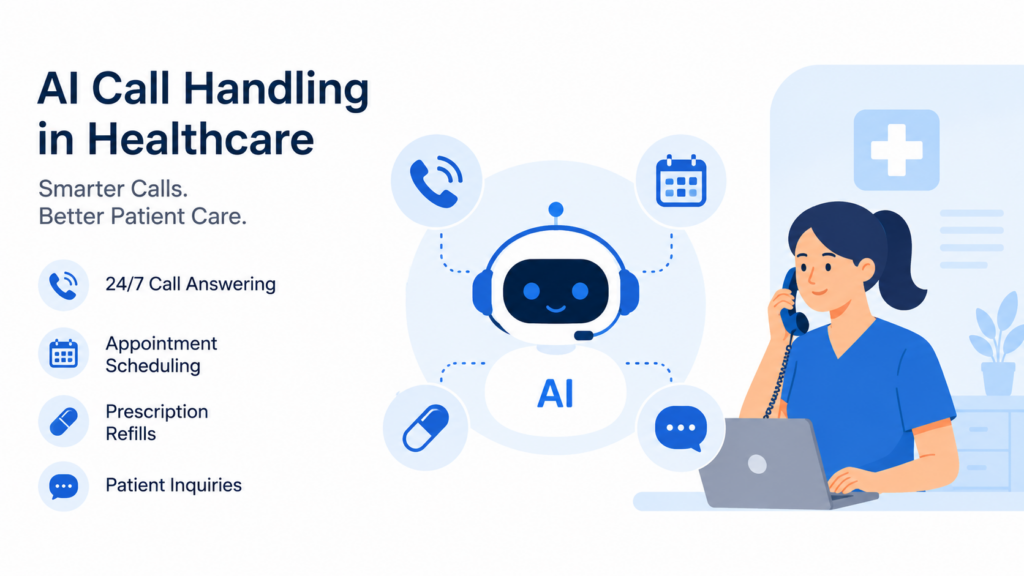
Here’s what a mature system for AI call handling in healthcare manages end-to-end:
Appointment scheduling
Patients call, state their need, and the AI books, reschedules, or cancels appointments in real time – synced directly with the clinic’s scheduling system. No hold time. No callback needed.
Prescription refill requests
The AI collects the medication name, dosage, pharmacy details, and patient information, then routes the request to the appropriate provider for approval. The patient gets a confirmation. The clinical team gets a clean, organized request.
After-hours coverage
More than half of patients (55%) expect 24/7 access to basic services like appointment scheduling, prescription refill requests, and general information – an expectation that has increased 23% since 2020. AI call systems don’t go home at 5 p.m. They handle calls at 10 p.m. on a Sunday just as effectively as they do at 10 a.m. on a Tuesday.
Automated reminders
Outbound AI calls confirm upcoming appointments, reducing no-shows. AI-powered reminders reduce missed appointments by 30–40%, and when a patient cancels at the last minute, an AI system can instantly contact patients on the waitlist and fill that slot in under five minutes.
Intelligent call routing
When a call requires a human – a clinical concern, a complex billing dispute, an urgent situation – the AI recognizes this and routes the call immediately to the right person, with context already provided.
The Real Cost of Call Overflow
When clinics underestimate their call overflow problem, the consequences compound quietly.
- Patients who can’t get through don’t always call back. Patients experiencing negative phone interactions are four times more likely to switch providers. A 7% abandonment rate on 2,000 daily calls results in an average of 140 abandoned calls each day, potentially translating to a daily revenue loss.
- Staff burnout accelerates. Front desk teams fielding 200 calls a day while managing check-ins, paperwork, and provider questions are being asked to do the impossible. When they can’t keep up, call quality drops – and so does patient satisfaction.
- Ineffective scheduling and customer service in healthcare contribute to more than $150 billion in lost revenue every year. That’s a systemic problem, and it’s one that clinics can start solving today – not by expanding staff, but by deploying smarter patient call management systems.
How to Reduce Call Wait Time Without Adding Headcount
Reducing call wait time in clinics doesn’t require a larger team. It requires a smarter one. Here’s a practical framework for clinics looking to handle 3× the call volume with the same staff:
Step 1: Identify Your Highest-Volume Call Types
Start by auditing what your calls actually cover. In most primary care clinics, appointment scheduling and prescription refills account for 60–70% of total call volume. These are the best candidates for automation. Identify them, quantify them, and treat them as the first wave of automation.
Step 2: Deploy AI for Tier-1 Calls
Use an AI call handling system to absorb all routine, predictable calls. Appointment scheduling, refills, reminders, and general inquiries are tier-1 calls. They follow consistent patterns. AI handles them faster, more accurately, and at any hour. Your human staff should not be answering “What are your office hours?” 40 times a day.
Step 3: Reserve Human Staff for Tier-2 and Tier-3 Calls
Once AI is handling the routine load, your human team becomes available for the calls that actually need them – clinical questions, complex insurance disputes, distressed patients, and situations requiring empathy and judgment. This is a better use of their skills, and it reduces burnout significantly.
Step 4: Integrate with Your EHR
The most effective patient call management systems integrate directly with your electronic health record. Selecting an AI solution that integrates with existing EHRs ensures seamless call routing and eliminates the need to switch between multiple screens, saving time and clicks on every interaction. Without EHR integration, AI becomes another silo. With it, it becomes a natural extension of your clinical workflow.
Step 5: Monitor and Optimize
Top-performing practices differentiate themselves in four critical areas: conversion rate, recovery speed, clinical prioritization, and revenue per interaction. Track call resolution rates, abandonment rates, and patient satisfaction scores after deploying AI. Adjust call flows based on what you see. The goal is continuous improvement – not a one-time setup.
Addressing Common Concerns
“Will patients accept talking to AI?”
More than most clinics expect. AI-powered systems mean calls get answered quickly, with less waiting and fewer dropped calls. Patients don’t have to repeat themselves or wait on hold forever – they get help right away, whether it’s for a late-night question or a quick appointment change. Patient acceptance correlates directly with call quality. If the AI handles their request accurately and quickly, most patients don’t care whether they spoke to a human.
“What about HIPAA compliance?”
Any AI call solution deployed in a healthcare setting must be HIPAA-compliant and operate under a Business Associate Agreement (BAA). Reputable platforms build PHI protection into their architecture from the ground up – with encrypted data handling, secure call logging, and audit trails. Always verify compliance certification before deployment.
“What happens when the AI can’t handle a call?”
Good AI systems are designed to recognize their own limits. When a call exceeds the AI’s capabilities – a patient in distress, a clinical question requiring judgment, a complex billing dispute – the system escalates immediately to a human agent, with full call context provided. No patient gets stuck.
The Staffing Math Makes the Case
Let’s put concrete numbers on it.
A four-physician primary care practice fields roughly 200 calls per day. At 70% AI containment, the AI handles 140 of those calls. Your human staff handles 60 – the ones that actually require human attention. Average handle time per call drops. Hold times drop. Abandonment rates drop.
One academic medical center generated $39 million in additional annual revenue through 49,000+ AI-powered appointments annually. The scale is different for a small clinic, but the principle is identical: faster call resolution means more appointments booked, more revenue captured, and less opportunity cost from missed calls.
The math isn’t complicated. You’re not replacing your staff. You’re removing the repetitive, high-volume work that buries them – and letting them do the work they were actually hired to do.
Conclusion
Managing high call volume in clinics is no longer a staffing problem. It’s a technology problem. And in 2026, the technology to solve it is available, proven, and increasingly accessible to practices of every size.
AI call handling in healthcare has moved from experimental to essential. Clinics that automate routine patient calls aren’t cutting corners – they’re reducing wait times, capturing more appointments, improving patient satisfaction, and giving their staff back the bandwidth to provide real care.
The question isn’t whether your clinic can afford to implement a patient call management system. It’s whether you can afford not to. Every unanswered call is a patient who might not call back. Every minute a patient spends on hold is a signal about how much you value their time.
If your clinic is ready to handle 3× the call volume without 3× the headcount, the path forward starts with AI – and platforms like MantraAssist are designed to make that transition practical, compliant, and measurable from day one.
Frequently Asked Questions
Implementing automated appointment reminders, online booking, and self-service portals eliminates a significant portion of inbound calls – allowing existing staff to focus on complex patient interactions that genuinely require human attention.
Yes. Modern AI voice systems handle appointment scheduling, prescription refill requests, and basic clinical queries accurately and naturally. Patients increasingly accept automated interactions when responses are fast, clear, and seamlessly escalated to a human when needed.
Most cloud-based call automation platforms deploy within two to four weeks. Configuration, staff training, and integration with existing EHR or practice management systems typically determine the timeline more than the technology itself.
Clinical triage, urgent or emergency concerns, complex billing disputes, sensitive mental health conversations, and any situation where a patient is distressed should always reach a trained human. Automation should filter and route – never replace clinical judgement.
Track average handle time, call abandonment rate, first-call resolution, patient satisfaction scores, and staff overtime hours before and after implementation. A meaningful improvement across three or more of these metrics confirms the intervention is delivering real operational value.

