
“Why does an ACO with excellent physicians and a strong quality record still lose shared savings to a smaller, less resourced competitor?”
A care management director at a multi-site ACO once put it simply: her organization had the clinical talent to deliver excellent care, but no reliable way to reach the patients who most needed follow-up before a gap turned into a hospital admission. That gap between good clinical care and good care coordination is exactly where AI ACO patient engagement AI tools have started to make a measurable difference.
This guide looks at how these platforms actually function inside an ACO’s operating model, what the current CMS data shows about shared savings performance, and what to evaluate before selecting a patient engagement and outreach platform for accountable care organizations. We will also touch on where a platform like MantraAssist fits into this picture.
Let’s begin.
Why Care Coordination Is Structurally Difficult for ACOs
Accountable care organizations operate under a model that only pays off if care stays coordinated across a fragmented system of independent providers, hospitals, and specialists. The scale of this challenge has grown substantially. The National Association of ACOs represents hundreds of accountable care organizations serving millions of beneficiaries, and the Medicare Shared Savings Program alone generated more than $2.1 billion in net savings in 2023, the largest in the program’s history, with ACOs earning $3.1 billion in shared savings payments that same year.
Beyond the Shared Savings Program, the ACO REACH Model added another dimension in 2026, its final performance year, with 74 accountable care organizations serving Medicare beneficiaries across all 50 states, the District of Columbia, and Puerto Rico. These organizations operate under either full financial risk or a shared risk arrangement, which means the financial consequences of poor care coordination fall even more directly on the ACO than under the standard Shared Savings Program structure.
Those figures represent real financial upside, but only for organizations that manage attributed populations well. CMS has also finalized changes that will shorten the maximum time an eligible ACO can remain in the one-sided BASIC track from seven to five performance years for agreement periods beginning in 2027, increasing the importance of risk-management and care-coordination capabilities for organizations moving toward downside risk. Manual processes cannot consolidate data across multiple sources, detect care gaps in real time, or identify patients requiring intervention at the scale a modern ACO population requires. This is precisely the gap that ACO patient engagement AI platforms have moved in to close over the past several years.
What AI Actually Does Inside Care Coordination Workflows
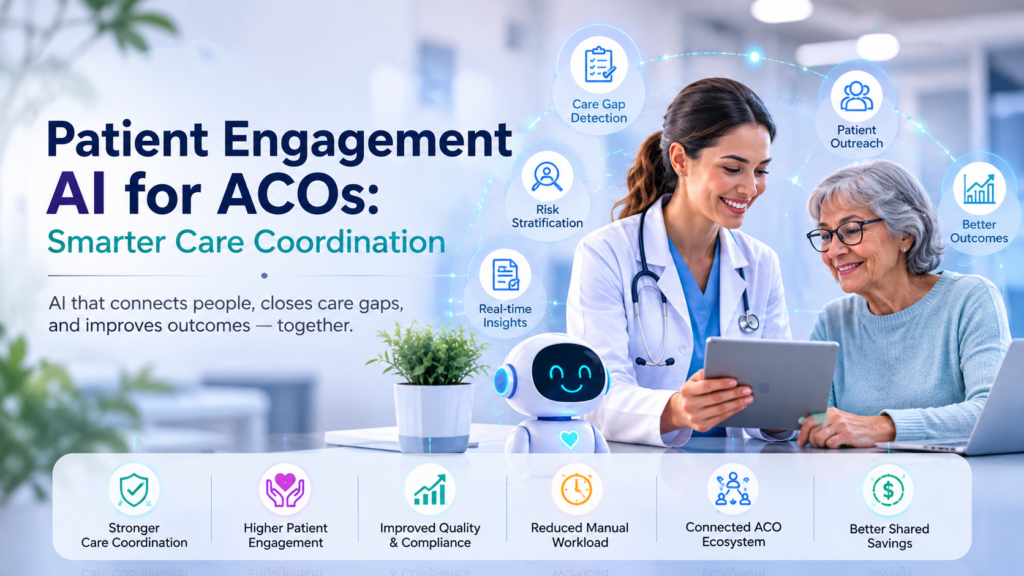
AI-powered platforms do not replace care managers. They change what care managers spend their time doing, shifting effort away from manually searching for at-risk patients and toward actually intervening once those patients are identified. This distinction matters: the value of ACO patient engagement AI comes from redirecting scarce clinical staff time, not from removing the human element of care management entirely.
- Risk stratification that continuously scores attributed patients based upon claims data, utilization patterns, and clinical history, rather than relying on a periodic manual review.
- Automated care gap detection that flags overdue screenings, missed follow-ups, and medication adherence issues as they occur, not weeks later during a retrospective quality review.
- Multichannel outreach that reaches patients by text, phone, or automated call based on documented response patterns, rather than defaulting to a single communication method for every patient.
- Care team alerting that routes flagged patients directly to the right care manager or provider, reducing the lag between identifying a gap and acting on it.
Comparing Traditional Outreach to AI-Powered Patient Engagement
| Factor | Traditional ACO Outreach | AI-Powered Patient Engagement |
|---|---|---|
| Risk identification | Periodic manual chart review | Continuous risk scoring using claims and clinical data |
| Care gap detection | Retrospective, often during quality reporting | Real-time, as gaps occur |
| Outreach method | Primarily phone calls by care coordinators | Multichannel: text, voice, automated calls |
| Staff time per patient | High; manual outreach and documentation | Lower; automation handles routine contact |
| Scalability across population | Limited by care manager headcount | Scales across larger attributed populations |
| Response tracking | Manual notes, inconsistent follow-up | Automated logging and escalation |
| Data integration | Often siloed across provider systems | Consolidated across claims and EHR sources |
This table reflects general patterns reported across the ACO technology landscape. Actual performance depends on population size, data integration depth, and how well a platform is configured for a specific ACO’s attributed population.
What ACO Patient Engagement AI Needs to Do Differently
Generic patient engagement software, built for a single practice or hospital, does not automatically translate to an ACO’s operating environment. ACO patient engagement AI has to work across multiple, often unaffiliated provider organizations that share financial accountability for the same attributed population.
This means the platform needs to align outreach priorities directly with CMS quality measures, since ACOs are evaluated on specific metrics such as the APP Plus quality measure set, including clinical quality measures, the CAHPS patient experience survey, and the hospital-wide readmission measure. A platform that flags care gaps unrelated to these measures may improve outcomes generally. Still, it may not directly support the quality performance requirements that influence an ACO’s eligibility to share in savings.
Attribution complexity adds another layer. Patients attributed to an ACO may see providers who are not directly employed by any single organization within that ACO, which means a genuinely useful platform needs data-sharing agreements and integration across every participating practice, not just one health system’s EHR.
Selecting a Patient Engagement and Outreach Platform for Accountable Care Organizations
A structured evaluation process helps ACO leadership avoid selecting a platform based on a polished demo rather than genuine fit for a multi-provider, value-based environment.
- Confirm data integration across all participating practices. A platform that only connects to one EHR in a multi-provider ACO will miss a significant share of the attributed population.
- Verify alignment with current CMS quality measures. Ask specifically how the platform’s care gap logic maps to the APP Plus measure set and the 2026 quality reporting requirements.
- Request documentation on data security and HIPAA compliance. Confirm a signed Business Associate Agreement with any vendor accessing claims or clinical data.
- Ask how the platform handles multi-provider attribution. Confirm the vendor has direct experience working across unaffiliated practices, not just single health systems.
- Review reporting capabilities for shared savings tracking. Confirm the platform can show measurable progress against the specific benchmarks tied to your ACO’s shared savings eligibility.
Where AI Engagement Delivers the Clearest Impact
Not every part of an ACO’s attributed population benefits equally from AI-powered outreach. Understanding where the clearest returns show up helps prioritize a rollout sensibly.
- Patients with multiple chronic conditions typically drive a disproportionate share of an ACO’s total cost of care, which makes them the natural priority for ACO patient engagement AI tools. Missed follow-ups and medication non-adherence can contribute to avoidable utilization and higher total costs, making this population a logical priority for targeted engagement.
- Recently discharged patients represent a narrow but critical window, since the risk of readmission is highest in the days immediately following a hospital stay. Automated outreach that confirms a follow-up appointment has been scheduled and checks in on medication pickup addresses a measurable share of preventable readmissions during this period.
- Patients overdue for preventive screenings affect an ACO’s quality measure performance directly, since several CMS-evaluated metrics tie back to screening completion rates. Automated reminders timed around a patient’s existing appointment cadence tend to outperform generic, disconnected reminder campaigns.
- Patients with social barriers to care, such as transportation or language access challenges, benefit from platforms that can flag these barriers during outreach and route them to a care manager equipped to help, rather than logging a missed contact attempt and moving on.
The Compliance and Data-Sharing Layer
Any patient engagement and outreach platform for accountable care organizations touches sensitive claims and clinical data across multiple provider organizations at once, which raises the compliance bar considerably compared with a single-practice tool.
A signed Business Associate Agreement remains the non-negotiable baseline, but ACOs need to go further given their multi-provider structure. Data-sharing agreements between the ACO and each participating practice need to clearly define what data flows into the engagement platform, who can access outreach records, and how a patient’s preferences around communication channel and frequency are documented and respected across every provider touching their care. A platform that cannot demonstrate this level of governance introduces real risk, both to patient trust and to the ACO’s standing with CMS during an audit.
Common Misconceptions About AI in ACO Care Coordination
As AI adoption increases across accountable care organizations (ACOs), misconceptions about its role remain common. While some assume AI replaces clinicians or makes independent care decisions, modern AI platforms are designed to support care teams by improving workflow efficiency, identifying high-risk patients, and enabling timely, patient-centered interventions.
- Does AI replace the need for care managers? No. These platforms identify which patients need attention and reduce the manual search time involved, but the actual clinical judgment and relationship-building in complex cases still requires a trained care manager.
- Is this only relevant for very large ACOs? Not necessarily. Smaller ACOs with limited care management staff often see proportionally larger benefits, since automation extends the reach of a small team across a population that would otherwise be difficult to monitor manually.
- Does better patient engagement guarantee higher shared savings? No single intervention guarantees results. Shared savings depend on total cost of care and quality performance across many factors, though improved care coordination is consistently associated with better outcomes on the measures CMS evaluates.
Conclusion
Most ACOs should begin with a defined patient subset rather than deploying AI-powered engagement across the entire attributed population. A pilot can validate outreach effectiveness, data integration, care-gap closure, and quality performance before broader rollout.
Governance is equally important. Assign a single owner, such as a care management director or quality lead, to review results, coordinate with participating practices, manage data-sharing questions, and decide whether to expand the program.
Finally, communicate the rollout clearly to participating practices. Care teams should understand how the platform works, how flagged patients are routed, and how it fits into existing workflows. Before expanding, identify the quality measures furthest from target and determine whether patient engagement AI can address those specific gaps.
Frequently Asked Questions
ACO patient engagement AI aligns outreach with CMS quality measures and shared savings benchmarks, and it works across multiple unaffiliated provider organizations rather than a single practice or health system’s patient population.
The APP Plus measure set, including clinical quality measures, the CAHPS patient experience survey, and the hospital-wide readmission measure, since these directly affect shared savings eligibility under current CMS rules.
Yes. Smaller ACOs with limited care management staff often see proportionally larger benefits, since automation extends a small team’s reach across an attributed population it could not otherwise monitor manually.
No. Shared savings depend on total cost of care and quality performance across many factors, though improved care coordination is consistently associated with stronger performance on CMS-evaluated measures.
Most ACOs should expect a phased pilot for several months, focused on a defined patient subset before evaluating results and expanding to the full attributed population.

