
A hospital in Seoul misses a call at 10 PM. A patient – looking to reschedule a procedure – hangs up, searches online, and books with a different clinic the next morning. That outcome is common, costly, and entirely preventable.
South Korea runs one of the world’s most advanced digital economies. With some of the fastest internet speeds on the planet, near-universal smartphone adoption, and strong government support for artificial intelligence innovation, the country is not short on technology ambition. But across its hospitals, clinics, hotels, and service businesses, the same gap persists: call volumes that outpace front-desk capacity, particularly after hours, on weekends, and during the crush of Monday morning scheduling. Every missed call is a missed appointment, a missed booking, or a patient who moved on.
AI receptionists close that gap directly. They answer every inbound call simultaneously, 24 hours a day, in Korean as readily as English, and complete the task – booking, routing, answering, escalating – without adding headcount. For South Korean businesses, the economics are compelling: a full-time receptionist carries significant annual labor costs and still handles only one call at a time. AI changes that equation permanently.
South Korea’s business environment adds a specific layer of complexity. Korean-language accuracy is the baseline – not just standard Korean, but regional speech patterns, honorific registers, and the natural cadence of how Koreans actually speak on the phone. Data handling must comply with South Korea’s Personal Information Protection Act (PIPA), one of the region’s most comprehensive privacy and data protection frameworks. And for healthcare providers, the Ministry of Food and Drug Safety (MFDS) and Ministry of Health and Welfare (MOHW) add sector-specific compliance layers that generic platforms often overlook.
The four AI receptionist companies in South Korea represent some of the leading AI receptionist solutions available to South Korean businesses today.
What Is an AI Receptionist?
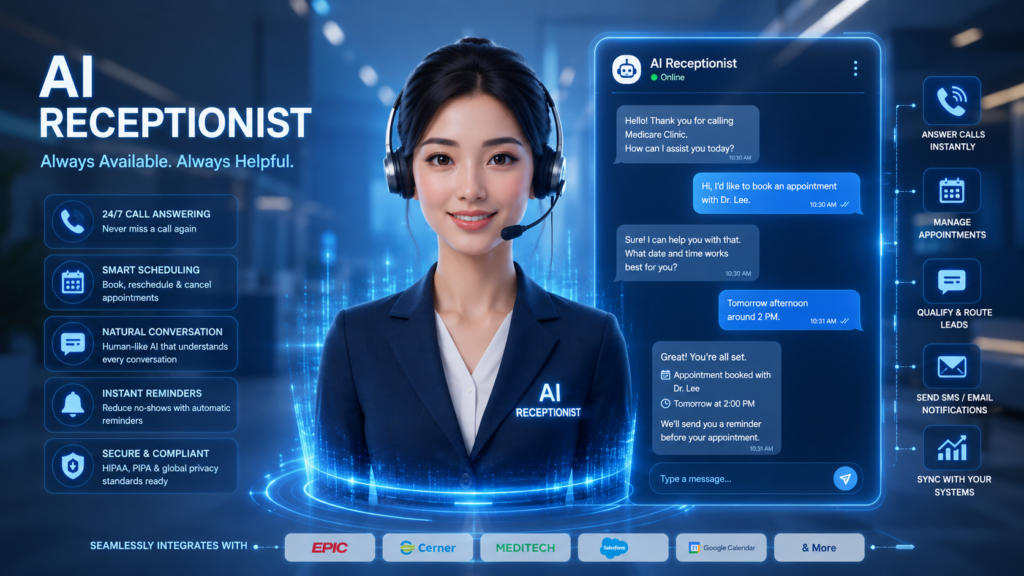
An AI receptionist is a voice-based or multichannel system that handles inbound customer or patient calls automatically – understanding the caller’s concern in natural language and taking the appropriate next step: booking or rescheduling an appointment, answering a question about hours or services, qualifying a lead, or routing an urgent case to a human staff member.
Unlike IVR phone trees, modern AI receptionists hold genuine conversations. They handle interruptions, follow the caller’s train of thought, and complete the task – including writing the outcome into a structured log or, where integration is available, directly into a CRM, calendar, or practice management system. In the South Korean context, native Korean-language fluency with accurate honorific handling, compatibility with local EHR and scheduling tools, and compliance with PIPA’s consent and data handling requirements are the baseline conditions for a platform that delivers real value rather than friction.
From Missed Calls to Instant Responses: Top AI Receptionist Companies in South Korea
As customer expectations for fast, seamless communication continue to rise, businesses across South Korea are turning to AI receptionists to ensure every call is answered promptly and professionally. These intelligent solutions help organizations automate call handling, improve customer experiences, and stay available around the clock without increasing staffing costs.
1. MantraAssist
Best for: Hospitals, multi-specialty clinics, and healthcare providers in South Korea needing deep EHR integration alongside 24/7 multilingual patient communication
MantraAssist, one of the best AI receptionist companies in South Korea, is one of the few AI receptionist platforms with a documented operational address in South Korea. The company’s contact page lists a Seoul office at 21 Baekbeom-ro 31-gil, Gongdeok-dong, Mapo-gu, Seoul – a meaningful signal for Korean healthcare providers evaluating vendor reliability and local support access.
The platform automates calls, intake, and scheduling for clinics using AI voice agents and serves healthcare organizations through AI-powered patient communication and workflow automation. Its healthcare focus and global customer base make it a strong option for hospitals evaluating AI-powered patient communication and workflow automation.
According to the company, MantraAssist automates a significant portion of routine patient inquiries while providing 24/7 patient support. It prevents double-bookings, fills last-minute cancellations, and sends proactive reminders to reduce no-shows. Integration with EHRs via FHIR standards automates patient intake and record updates. The platform is designed to reduce administrative workload and help healthcare teams spend more time on patient care.
What sets MantraAssist apart from most other platforms on this list is its clinical workflow depth. Beyond scheduling and communication, the platform automates prior authorizations, prescription checks, and approvals – reducing delays and preventing errors that typically require manual staff time. The platform covers the full patient journey, from first inquiry through post-visit follow-up, across voice, SMS, email, and chat, with specialty-specific workflows spanning OB-GYN, orthopedics, mental health, and more.
For South Korean healthcare providers, Korean-language support and local PIPA compliance should be confirmed directly with the vendor before deployment.
Key Features:
- 24/7 patient call handling across voice, SMS, email, and chat
- Seoul office confirmed at Mapo-gu, Gongdeok-dong
- EHR integration via FHIR standards with real-time read/write capability
- Appointment scheduling, no-show reminders, and cancellation management
- Prior authorization and prescription check automation
- Specialty workflow support across multiple clinical areas
- 500+ global healthcare partners
2. DeepCura
Best for: Independent practices, small-to-mid-size clinics, and multi-specialty groups in South Korea wanting a full-stack clinical AI platform – scribe, receptionist, billing, and intake – in a single subscription at accessible pricing
DeepCura is an agent-operated clinical AI platform that consolidates the full front-office workflow under one product. A network of AI agents answers calls, manages patient intake, handles scheduling, processes faxes, and automates billing – all from a single platform at USD 129/month. The company reports over 6,000 clinicians across 50+ specialties on the platform, and the founder holds a Forbes Business Council membership.
The AI receptionist function answers every inbound call, routes callers intelligently, and -through a feature designed to improve information collection when voice capture becomes difficult during a call – can send the caller a live SMS mid-call when voice capture fails, allowing the patient to type the required information directly, with the reply injected back into the call flow in seconds. This eliminates the call-loop failure mode where AI systems repeatedly re-ask for information that the caller cannot provide clearly by voice.
DeepCura integrates with major EHR platforms, including Epic, eClinicalWorks, Athena, and Veradigm for bidirectional data flow. All PHI is encrypted at rest and in transit, Business Associate Agreements are signed with every customer, and the platform has passed a Cloud Application Security Assessment (CASA) Tier 2 independently verified by TAC Security. The platform supports 17+ languages, which prospective South Korean clients should verify includes Korean-language call handling before committing.
Key Features:
- USD 129/month full-stack platform: AI receptionist, scribe, billing, intake, and fax
- Live SMS fallback mid-call when voice capture fails
- Integrates with Epic, eClinicalWorks, Athena, and Veradigm (bidirectional)
- HIPAA-compliant; CASA Tier 2 certified; BAA signed with every customer
- 6,000+ clinicians across 50+ specialties
- 17+ language support – Korean-language accuracy should be confirmed with the vendor
- Rated 4.6/5 on G2
3. Luma Health
Best for: Health systems, FQHCs, specialty practices, and enterprise healthcare organizations in South Korea with Epic or other major EHR infrastructure, needing deeply integrated AI-powered patient engagement across scheduling, intake, reminders, and referrals
Luma Health is a patient success platform built on over a decade of patient engagement and EHR integration experience. Its core AI engine, Spark, is a healthcare-native AI trained on real clinical workflows – not synthetic data – and coordinates AI capabilities across scheduling, intake, communication, and care coordination. The platform serves more than 1,000 healthcare organizations in the United States, Canada, and the United Kingdom and supports the care journeys of more than 100 million patients.
For scheduling and front-office automation, Luma Health is particularly well suited to enterprise health systems requiring advanced EHR integration. Its bidirectional EHR integration – with Epic, athenahealth, Cerner, and others – enables real-time schedule syncing when a patient confirms, cancels, or reschedules, without manual staff intervention. According to independent analyst reviews, the platform’s ARIA product offers extensive Epic integration for AI-powered patient engagement.
Language support is a documented Luma strength. The platform lists Korean among its supported communication languages, alongside Arabic, Chinese (Simplified and Traditional), Hindi, Spanish, Vietnamese, and 20+ others – relevant for Korean-speaking patients and multilingual clinical environments. Luma also supports AI-assisted translation and automated fax processing.
Pricing is custom and quote-based, scaling by number of providers and patient volume. Pricing is customized based on organizational requirements, provider count, and implementation scope. South Korean organizations should confirm PIPA-compliant data handling arrangements and confirm Korean-language NLU accuracy in voice contexts directly with Luma before deployment.
Key Features:
- Healthcare-native Spark AI core trained on real clinical workflows
- Deep EHR integration (Epic, athenahealth, Cerner, and others) – bidirectional, real-time
- Korean is listed among 25+ supported communication languages
- Automated scheduling, reminders, waitlist management, intake, and payment
- AI-assisted translation and automated fax processing
- Serves 1,000+ healthcare organizations; 100M+ patient journeys supported
- Custom pricing based on organizational requirements and implementation scope
4. Kore.ai
Best for: Enterprise organizations, contact centers, telecommunications providers, and large healthcare systems in South Korea wanting a globally deployed agentic AI platform with a documented South Korea office and Korean language support
Kore.ai is an enterprise agentic AI platform trusted by nearly 500 Global 2000 companies and recognized as a leader in the Forrester Wave for Cognitive Search Platforms 2025. The company maintains a physical office in South Korea – confirmed in Crunchbase and G2 company profiles – alongside offices in India, the UK, the Middle East, Japan, and Europe.
Korean is listed among the platform’s supported NLU languages, making it suitable for organizations serving Korean-speaking customers and patients. The platform’s XO (Experience Optimization) platform supports multi-engine NLU with 30+ channels deployable from a single configuration – voice, chat, SMS, and digital channels simultaneously.
For healthcare, Kore.ai, another of the best AI receptionist companies in South Korea, offers HIPAA-compliant, pre-built AI applications designed for providers, payers, and life sciences organizations. These cover patient self-service, appointment scheduling, symptom evaluation, prior authorization, billing inquiries, and care gap closure. A published Kore.ai case study describes a healthcare deployment where pre-built AI agents automated high-volume, repeatable patient interactions across channels and languages, delivering measurable reductions in call volume and post-call documentation burden.
For South Korean enterprise and contact center deployments, Kore.ai’s in-country presence, Korean NLU capability, and Forrester leader recognition are the differentiating signals relative to other platforms on this list. Deployment timelines vary depending on the complexity of integrations, workflows, and enterprise requirements – organizations with near-term deployment needs should factor this into vendor selection.
Key Features:
- Documented South Korea office; offices in 8+ countries
- Korean language support through the platform’s NLU capabilities
- HIPAA-compliant healthcare AI applications for providers, payers, and life sciences
- 30+ channel deployment from a single XO Platform configuration
- Pre-built AI agents for appointment scheduling, patient self-service, billing, and care coordination
- Forrester Wave leader (Cognitive Search Platforms, 2025)
- Used by enterprises across multiple industries worldwide
- Custom enterprise pricing based on business requirements and deployment scope
Comparison Table: AI Receptionist Platforms for South Korea
| Platform | Best For | Primary Focus | Industry Focus | Deployment |
|---|---|---|---|---|
| MantraAssist | Hospitals, multi-specialty clinics, and healthcare providers | AI-powered patient communication and clinical workflow automation | Healthcare | Cloud |
| DeepCura | Independent practices and multi-specialty clinics | AI receptionist, scribe, billing, and patient intake | Healthcare | Cloud |
| Luma Health | Enterprise health systems and specialty practices | AI-powered patient engagement and scheduling automation | Healthcare | Cloud |
| Kore.ai | Large enterprises, contact centers, and healthcare systems | Enterprise AI voice agents and omnichannel automation | Multi-industry | Cloud |
How to Choose the Right AI Receptionist for South Korea
South Korean businesses need more than basic call automation. Choose a platform that combines accurate Korean-language support, reliable integrations, and automation tailored to your daily workflows.
Choose MantraAssist
If you run a hospital or multi-specialty clinic in South Korea and need deep EHR integration via FHIR standards, prior authorization automation, and 24/7 multilingual patient communication – and you value a vendor with a confirmed Seoul office for local support. Confirm Korean-language NLU performance and PIPA compliance directly before deployment.
Choose DeepCura
If you run an independent practice or small-to-mid-size clinic and want a single platform that covers the full clinical front-office workflow – AI receptionist, scribe, intake, billing – at a published, accessible price. Its live SMS mid-call fallback addresses a real failure mode that other platforms leave unresolved. Confirm Korean-language call handling before committing.
Choose Luma Health
If your organization operates on Epic or another major EHR and needs the deepest possible integration between AI-powered patient engagement and your clinical scheduling infrastructure. Korean is listed as a supported language, and the platform’s scale – 1,000+ healthcare organizations, 100 million patient journeys – signals proven enterprise reliability. Validate Korean-language voice accuracy and PIPA-compliant data handling for Korean operations before full deployment.
Choose Kore.ai
If you run an enterprise contact center, large health system, or telecommunications operation, and need a platform with documented South Korean presence, Korean language support, Forrester recognition, and the flexibility to deploy across 30+ channels from a single configuration. Consider implementation timelines based on the complexity of your integrations and workflows.
Conclusion
South Korea’s AI receptionist market continues to grow as organizations invest in automation technologies that improve customer service, operational efficiency, and accessibility.
MantraAssist combines a verified Seoul office with advanced clinical workflow automation, making it a strong option for healthcare organizations evaluating AI reception platforms. DeepCura offers an accessible entry point for independent practices, with a full-stack product and a live SMS fallback feature at USD 129/month. Luma Health provides the deepest EHR integration for enterprise health systems, particularly those on Epic. And Kore.ai delivers a broad enterprise footprint – with documented South Korea presence, Korean language support, and Forrester recognition for organizations that need a platform scaled to contact center or multi-channel enterprise complexity.
None of these platforms eliminates the need for human judgment in sensitive, complex, or high-stakes interactions. What they do is ensure that when a patient calls a Seoul clinic at 9 PM, the call is answered, the task is completed, and the business does not lose that caller to the next provider who picks up.
Frequently Asked Questions
Korean has distinct formal and informal registers, and patient-facing calls demand consistent formal speech. Not all platforms handle this accurately. Request a live Korean-language demo before committing, and test specifically with formal patient or customer scenarios.
Integration depends on the platform and your existing HIS or EHR. MantraAssist and Luma Health support FHIR-based integration, which can simplify connectivity with many modern healthcare systems. Compatibility should be confirmed with your existing HIS or EHR. DeepCura integrates with Epic, athenahealth, and others. Confirm compatibility with your specific system before deployment.
Setup varies significantly by platform. DeepCura and Luma Health are designed for faster deployment. Setup timelines vary by platform, integration requirements, and workflow complexity. Confirm expected go-live timelines with any vendor before signing, particularly if you have near-term coverage gaps.

