
What Does a Russian Patient Do When No One Picks Up the Phone?
They try again. Then again. Then they stop trying—and the clinic loses them.
Across Russia’s public and private healthcare system, this plays out thousands of times a day. Polyclinics operating under Russia’s Compulsory Health Insurance (CHI or OMS) system handle large patient populations with limited administrative staff. Private clinics in Moscow and St. Petersburg face intense competition and must respond to inquiries quickly. In both settings, every missed call can mean a lost patient, an unfilled appointment, and delayed care.
Russia’s Digital Economy programme is accelerating AI adoption. The initiative continues to expand digital health services and support the integration of AI into healthcare workflows.
AI receptionists automate routine administrative work that does not require a medical license. They help reduce costs while supporting clinics across Russia’s regional healthcare network. The five AI receptionist companies in Russia represent the range of solutions operating in this market today.
What Is an AI Receptionist?
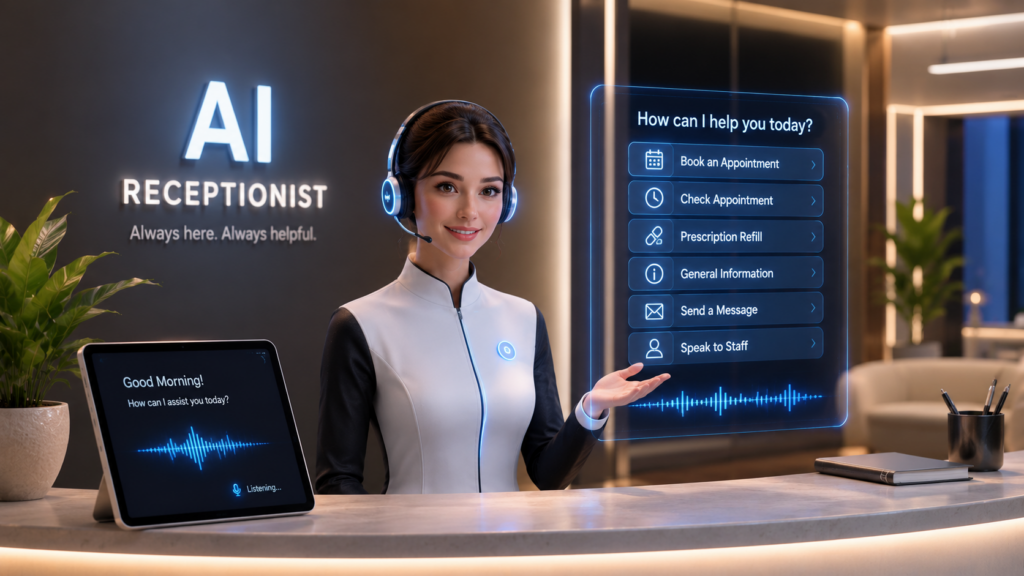
An AI receptionist is a voice-based or multichannel system that handles inbound patient calls automatically – understanding the caller’s concern in natural language and taking appropriate action: booking or cancelling an appointment, recording a prescription request, answering a common question about clinic hours, or routing an urgent call to clinical staff.
Unlike rigid IVR menus, modern AI receptionists conduct genuine dialogues. They handle interruptions, follow the caller’s train of thought, and complete the task – including writing the outcome into a structured log or, where integration is available, directly into the medical information system (MIS) or CRM. In the Russian context, Russian-language accuracy, on-premise or Russia-hosted data storage, and compatibility with domestic MIS platforms such as UDP.MIS, Samson, and regional RMIS systems are the baseline requirements for enterprise deployment.
The Future of Customer Communication: AI Receptionist Companies in Russia
Customer expectations have never been higher, and missed calls can mean missed opportunities. AI receptionist companies in Russia are helping businesses stay responsive around the clock, ensuring every inquiry receives prompt and professional attention.
1. MantraAssist
Best for: Healthcare providers, clinics, and medical practices needing multilingual AI with EHR integration
MantraAssist is the AI-powered front-desk automation platform built by MantraCare, which operates across more than 80 languages and serves 500+ healthcare partners globally. The platform handles the full patient communication cycle – inbound call answering, appointment scheduling, reminders, and post-visit follow-up – through voice, SMS, and chat.
MantraAssist handles 95% of patient inquiries 24/7, eliminating hold times, voicemails, and IVR menus for faster patient support. Its scheduling automation prevents double-bookings, fills last-minute cancellations, and sends proactive reminders to reduce no-shows. Deep clinical integration is delivered through FHIR standards, automating patient intake, record updates, and data accuracy across connected EHR and practice management systems. The platform cuts administrative tasks by saving 2–3 hours per FTE daily, reducing burnout and operational inefficiencies.
MantraCare’s broader platform covers specialties including Orthopedics, OB-GYN, mental health, and urgent care, with specialty-specific workflow customization built in. Its multilingual capability – supporting 7 languages on the VoiceAI layer and 80+ across the broader platform – positions MantraAssist as a fit for Russia’s multilingual clinical environments, particularly private clinic networks serving diverse urban populations and international patient groups.
Key Features:
- 24/7 patient call handling across voice, SMS, and chat
- EHR integration via FHIR standards with real-time read/write capability
- Appointment scheduling, cancellation, and no-show reminders
- Prior authorization automation and prescription refill processing
- Specialty-specific workflow customization
- Multilingual support across 80+ languages (7 on VoiceAI)
- Saves 2–3 hours per FTE daily on administrative tasks
2. Robovoice
Best for: Russian businesses and medical centers wanting a no-code AI voice bot platform with omnichannel capability, built and hosted domestically
Robovoice is a Moscow-based AI voice bot platform founded in 2018. In January 2024, a majority stake was acquired by SL Soft – a major Russian enterprise software group – for $1.12 million, bringing Robovoice into one of Russia’s largest domestic software ecosystems and providing infrastructure for further development. The platform is registered in Russia’s Register of Domestic Software (Реестр отечественного ПО, entry No. 9214 from 20.02.2021) and is a participant in the Skolkovo innovation program.
Robovoice’s voice bots understand natural speech using NLU (natural language understanding), synthesize human-sounding responses via TTS and pre-recorded audio, and can improvise using LLM integration and a built-in knowledge base. The platform handles both inbound and outbound calls, supports omnichannel deployment (calls, SMS, and messaging apps), and can be deployed in the cloud or on-premise within a client’s own contour – an important option for Russian healthcare organizations with data sovereignty requirements. The no-code visual script builder allows non-technical staff to create and modify dialogue flows, with pre-trained bots available for rapid deployment.
Robovoice’s documented deployments span healthcare, banking, real estate, fitness, insurance, and HR sectors. In the healthcare segment, the platform serves the Elegra clinic network and has been used by MEDSI, one of Russia’s largest private healthcare groups, through SL Soft’s broader AI agent offering. The platform’s key published metrics: reduces call center costs by 25% or more; handles 1,000+ simultaneous calls; operates 24/7/365. Pricing is usage-based – clients pay per minute of traffic consumed, with no fixed subscription fee for the cloud service.
Key Features:
- NLU + LLM + TTS voice bot platform – natural Russian-language dialogue
- No-code visual script builder; pre-trained bots for fast deployment
- Inbound and outbound calls; omnichannel extension to SMS and messaging apps
- Cloud and on-premise deployment options for data sovereignty compliance
- 1,000+ simultaneous calls; 25%+ call center cost reduction documented
- Registered in the Russian domestic software register; Skolkovo participant
- Majority-owned by SL Soft since January 2024; serving healthcare, banking, real estate, and HR sectors
- Documented deployments: Elegra clinic network, MEDSI (via SL Soft AI agent)
3. Zvonobot
Best for: Small and mid-sized Russian businesses wanting a fast-to-deploy, usage-based voice automation service for outbound and inbound calls
Zvonobot is a Russian AI-powered voice automation service founded in 2017, backed by the Internet Initiatives Development Fund (IIDF) – Russia’s largest early-stage technology fund. The company is headquartered in Moscow and is led by CEO Rinat Shamsiev. Its core product is an automated voice robot that conducts outbound and inbound calls using voice recognition and synthesis, enabling businesses to communicate with large customer volumes without expanding call center staff.
Zvonobot’s platform allows businesses to manage customer bases, run cold call campaigns, conduct telephone surveys, send promotional and operational notifications, and automate daily customer communications – all without a call center. In healthcare, the platform facilitates appointment scheduling, interactions, and automated reminder calls. Key documented capabilities include voice broadcasting at scale, CRM integration for comprehensive data management, and callback request automation for improving patient or customer service response.
The platform is structured as a self-service cloud tool. Users access it via a personal account, purchase packages of voice bot minutes, and pay only for consumed traffic – there is no fixed subscription fee, making it accessible to small practices and businesses with variable call volumes. It has received early-stage investment from IIDF, which has also backed Zvonobot through startup competition programs including Banktech 3.0 and StartupBase (Uzbekistan).
Key Features:
- Automated voice robot for inbound and outbound calls with voice recognition
- Outbound use cases: cold calls, surveys, promotional and operational notifications, reminders
- Inbound use cases: appointment scheduling, callback requests, and FAQ handling
- CRM integration for customer data management
- Usage-based pricing – pay per traffic consumed, no fixed subscription
- Backed by Internet Initiatives Development Fund (IIDF)
- Founded in 2017, headquartered in Moscow, CEO Rinat Shamsiev
4. Speech Technology Center (STC)
Best for: Enterprise healthcare organizations, government health programs, and regional hospital networks requiring industrial-grade Russian-language speech recognition and voice biometrics
Speech Technology Center (STC) is one of Russia’s oldest AI companies, founded in 1990 in St. Petersburg. Since 2019, Sberbank has held a 51% controlling stake in the company. STC develops speech recognition, voice biometrics, and audio analytics solutions that have been deployed in more than 5,000 projects across 70+ countries, serving organizations including Gazprombank, Rostelecom, Russian Railways, and VTB.
In healthcare, STC powers Voice2Med, a Russian-language medical speech recognition platform piloted across seven Moscow city clinics in 2020. The system achieved 93% accuracy at launch and has since reported accuracy approaching 98%, using a vocabulary of 2.5 million medical imaging protocols.
Unlike the other companies on this list, STC is a foundational AI technology provider, not a standalone AI receptionist platform. Its speech recognition, voice biometrics, and synthesis technologies support patient-facing voice AI solutions across Russia’s healthcare sector.
Key Features:
- Founded in 1990, St. Petersburg; 51% owned by Sberbank since 2019
- Voice and facial biometrics, speech recognition, and audio/video analytics at enterprise and national scale
- Voice2Med: Russian medical speech recognition platform, 98% accuracy on medical terminology; trained on 2.5 million imaging protocols
- Piloted across 7 Moscow Department of Health clinics; reduces radiology report time from ~10 min to ~8 min vs. keyboard input
- Deployed in 5,000+ projects across 70+ countries
- Clients include Gazprombank, Rostelecom, Russian Railways, VTB, and Sberbank
- Technology underpins Russia’s Unified Biometric System for identity verification
5. RT MIS
Best for: Regional governments, public healthcare administrations, and polyclinic networks seeking integrated MIS digitalization with AI-powered patient contact center functionality
RT MIS is a Russian healthcare information technology company positioned as one of the country’s largest developers of medical information systems for government and regional healthcare. The company’s product portfolio includes UDP.MIS (a medical information system), UDP.LIS (a laboratory information system), and the K-Vrachu patient services platform. Its main business area is the digitalization of regional healthcare – the development and integrated implementation of solutions across medical organizations in entire Russian regions, not individual clinics.
RT MIS serves 4.5 million patients across 10 regions of Russia, helping them access medical services under the CHI (Compulsory Health Insurance) policy – the Russian public health insurance framework that covers the majority of the population. The company’s published contact center capability is directly relevant to the AI receptionist category: its AI-powered contact center accepts up to 50% of patient calls and reduces the cost of maintaining a regional contact center. This functionality is integrated with the broader UDP.MIS system, meaning appointment booking and patient data flow within a unified regional health information infrastructure rather than as a standalone add-on.
RT MIS’s integration with Russia’s national health data frameworks – including connections to the Pension Fund, Federal Bureau of Medical and Social Expertise (FB MSE), and the unified State Services portal for online appointment booking – means it operates at a level of healthcare system depth that consumer-facing AI receptionist tools do not reach. For regional health authorities and large polyclinic networks operating within the CHI system, RT MIS represents one of the most deeply integrated options available.
Key Features:
- Serves 4.5 million patients across 10 regions of Russia under the CHI healthcare system
- AI-powered patient contact center: accepts up to 50% of patient calls, reduces regional contact center operating costs
- Integrated with UDP.MIS (MIS), UDP.LIS (LIS), and K-Vrachu patient services
- Connects to Pension Fund, FB MSE, and the State Services portal for online appointment booking
- Regional-scale implementation: entire regions transition to UDP, replacing fragmented local solutions
- Supports electronic prescriptions, electronic health records, and paperless workflow for polyclinics
- Positioned as a federal project-aligned solution for healthcare digitalization under Russia’s Digital Economy program
Comparison Table: AI Receptionist Platforms for Russia
| Platform | Best For | Primary Focus | Industry Focus | Deployment |
|---|---|---|---|---|
| MantraAssist | Hospitals, clinics, and healthcare providers | AI-powered patient communication and appointment automation | Healthcare | Cloud |
| Robovoice | Businesses seeking AI voice automation | AI voice agents and automated call handling | Multi-industry | Cloud |
| Zvonobot | Sales, marketing, and customer outreach teams | Automated outbound calling and voice campaigns | Multi-industry | Cloud |
| Speech Technology Center (STC) | Large enterprises and government organizations | Voice biometrics, speech recognition, and AI communication | Enterprise | Cloud / On-premise |
| RT MIS | Businesses requiring AI telephony and virtual reception | AI receptionist and business call automation | Multi-industry | Cloud |
How to Choose the Right AI Receptionist for Russia
Every healthcare organization has different operational priorities, from multilingual patient support to regional MIS integration. These recommendations can help you identify the AI receptionist that best matches your size, workflows, and digital transformation goals.
Go with MantraAssist
If you run a private medical practice or healthcare facility and need deep clinical workflow automation – EHR write-back via FHIR, specialty-specific scheduling logic, prior authorization handling – alongside multilingual patient communication across voice, SMS, and chat. Its 500+ healthcare partner footprint and 80+ language coverage make it a strong fit for international clinics and multi-specialty private practices in Moscow and St. Petersburg.
Go with Robovoice
If you manage a Russian medical center, clinic network, or healthcare business that needs a domestically registered, no-code AI voice bot capable of cloud or on-premise deployment. Particularly well-suited to organizations with data sovereignty requirements, teams that want to build and iterate on dialogue flows without technical staff, or businesses scaling across multiple regions simultaneously.
Go with Zvonobot
If you run a small or mid-sized Russian healthcare practice or business and want a fast-to-launch, usage-based voice automation service primarily for outbound appointment reminders, patient surveys, and notification campaigns – with inbound call handling available as a complement.
Go with Speech Technology Center
If you are a large healthcare organization, hospital network, or government health body that requires industrial-grade Russian medical speech recognition as the foundation of a voice AI implementation – or if you are building AI systems that need to process Russian clinical vocabulary at the highest available accuracy level. STC is a technology layer, not an off-the-shelf receptionist product.
Go with RT MIS
If you are a regional health authority, CHI-covered polyclinic network, or public healthcare administration looking for an AI-powered patient contact center integrated within a complete regional MIS infrastructure. RT MIS is the natural choice where the goal is system-wide digitalization under federal health program requirements, not point-solution call automation.
Conclusion
Russia’s AI healthcare market is no longer experimental. Federal digital economy targets, updated telemedicine regulations, Skolkovo-backed startups, and Sberbank-owned enterprise technology companies have created a domestic ecosystem with genuine depth – one that ranges from lightweight, self-service voice bots accessible to a dental clinic in Ryazan to regional MIS platforms serving 4.5 million patients under the national insurance system.
The five platforms above reflect that range: a globally deployed multilingual clinical platform, two domestically registered Russian voice bot services with distinct scale and pricing models, a 35-year-old enterprise speech technology company that defines the ceiling of Russian medical voice AI, and a regional healthcare IT leader whose AI contact center is integrated into the public health infrastructure of ten Russian regions.
For Russian healthcare organizations deciding where to start, the question is not which platform is technically superior in the abstract – it is which one operates at the right layer of your infrastructure, within your data residency requirements, and at the call volume and budget your clinic or system actually handles today.
Frequently Asked Questions
Yes. Front-desk AI – call answering, scheduling, routing – requires no medical license since it performs no clinical functions. Data handling must comply with Federal Law No. 152-FZ (personal data) and No. 323-FZ (health data protection). Public healthcare deployments typically require on-premise or Russia-hosted storage.
Robovoice and Zvonobot use usage-based pricing – pay per traffic minute, no fixed subscription. STC and RT MIS operate on enterprise/government contract pricing. MantraAssist prices on a custom basis. Usage-based AI receptionists can significantly reduce administrative staffing costs, while enterprise platforms are typically priced according to deployment size and integration requirements.
Quality varies sharply by platform. Russian’s case inflection, formal registers, and regional accent variation make general English-first platforms a poor fit. Robovoice uses proprietary NLU trained for Russian business dialogue. STC’s Voice2Med sets the clinical benchmark – 98% accuracy on medical terminology, trained on 2.5 million radiology protocols. Always request a live Russian-language demo before committing.

