
Healthcare leaders keep hearing the same warning: fee-for-service is fading- value-based contracts are growing. And the providers who win under these models are the ones who close care gaps early, cut avoidable costs, and keep patients engaged between visits through AI Value-Based Care.
That is where AI value-based care enablement comes in. It is not one product. It is a mix of tools that help care teams find at-risk patients faster, automate the busywork that eats up staff time, and hit the quality benchmarks that value-based contracts are built on.
This guide breaks down five platforms that can support AI-enabled value-based care, from patient engagement and administrative automation to population health analytics and AI-assisted diagnostics.
Why AI Value-Based Care Enablement Matters Now
Value-based contracts pay providers based on outcomes, not visit volume. That means quality scores, HEDIS measures, readmission rates, and cost per patient all directly affect revenue.
Doing this manually is hard. Care teams juggle spreadsheets, EHR alerts, and payer portals. Patients fall through the cracks. Screenings get missed. Staff burn out on repetitive outreach calls.
AI changes the math. It flags high-risk patients before a costly event happens, automates outreach so no patient is forgotten, and pulls scattered data into one view, so care teams stop guessing. This is exactly how AI enables healthcare providers to succeed in value-based care programs: by turning reactive care into proactive care.
Below are five platforms healthcare leaders should evaluate, starting with the one built specifically to close the administrative gap that undermines most value-based programs.
Top 5 AI Value-Based Care Enablement Platforms
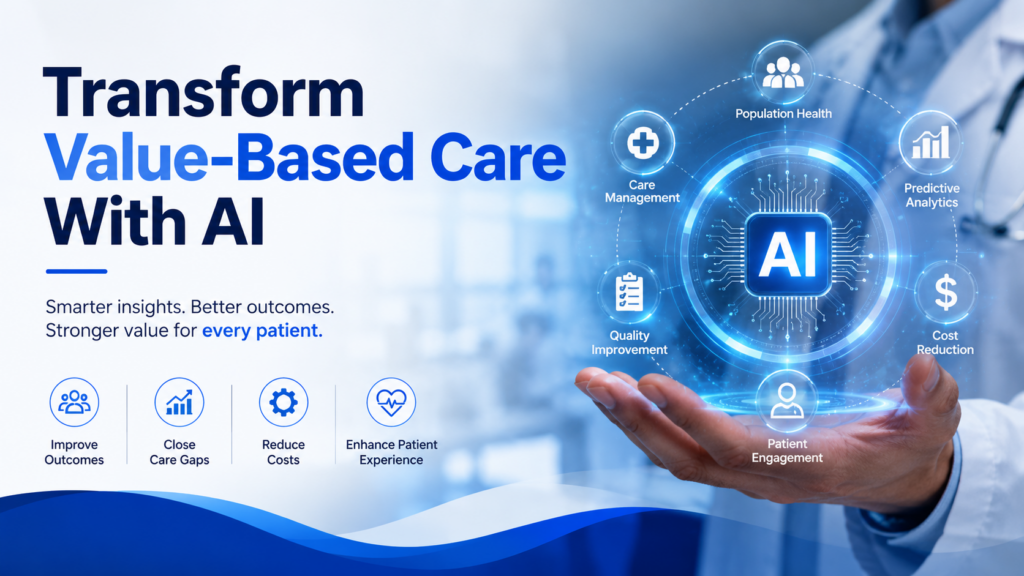
AI value-based care enablement platforms help healthcare organizations improve outcomes, close care gaps, and reduce administrative burden. These five platforms support different areas, from patient engagement and population health to analytics and AI-powered diagnostics.
1. MantraAssist
MantraAssist is an AI-powered front-desk and patient communication platform built by MantraCare. It automates patient calls, texts, and chats across multilingual workflows and serves healthcare partners worldwide.
Administrative friction is one of the quietest threats to value-based care performance. Missed calls mean missed screenings. Missed reminders mean missed annual wellness visits. Delayed intake means delayed care. MantraAssist targets this exact gap.
Key capabilities:
- 24/7 patient communication. MantraAssist handles the large majority of patient inquiries around the clock over voice, SMS, email, and chat, removing wait times and voicemail backlogs that often cause patients to skip follow-up care.
- Smart scheduling and no-show reduction. The platform syncs with provider calendars, fills last-minute cancellations, and sends proactive reminders, directly supporting the preventive visit and screening rates that quality measures track.
- EHR integration via FHIR. Patient intake, record updates, and follow-up data flow directly into existing EHR systems, keeping the longitudinal record accurate for risk scoring and quality reporting.
- Prior authorization and prescription automation. MantraAssist automates prior authorizations and prescription checks, reducing the delays that often lead to gaps in chronic disease management.
- Intent-based call routing. The system distinguishes routine requests from urgent ones, routing complex cases to staff with full context so nothing gets lost in the handoff.
For organizations trying to improve quality scores without adding headcount, MantraAssist can serve as a practical AI-enabled patient-engagement layer that supports the communication and scheduling workflows behind care-gap closure.
2. Kore.ai
Kore.ai is an agentic AI platform used across payer, provider, and life sciences organizations. Its healthcare offering focuses on patient and member self-service, built on a HIPAA-compliant conversational AI foundation.
Key capabilities:
- Agentic patient and member self-service. Kore.ai automates repeatable interactions such as appointment booking, symptom evaluation, and revenue cycle questions, reducing staff burden across large member populations.
- Real-time agent assistance. Human agents get automated summaries and next-best-action recommendations during live interactions, keeping every conversation informed and consistent.
- Omnichannel care coordination. The platform unifies digital self-service and human-assisted engagement in one service model, which matters for organizations managing complex, multi-touch care journeys.
- Billing and claims support for members. AI agents provide real-time claim status, balance details, and personalized payment guidance, reducing confusion that often delays care-seeking behavior.
Kore.ai’s strength is scale. It is designed for enterprise-scale patient and member interactions, making it particularly relevant to large payers and health systems.
3. Oracle Health
Oracle Health takes an enterprise approach to value-based care, combining clinical data, population health management, and analytics to help healthcare organizations identify risk and improve outcomes. Its Oracle Health Data Intelligence and related clinical analytics capabilities help connect patient information and support more informed care-management decisions.
Key capabilities:
- Unified healthcare data: Brings clinical and operational information together to provide a broader view of patient and population health.
- Risk stratification: Helps identify higher-risk patients and prioritize populations that may benefit from earlier intervention.
- Population health analytics: Supports organizations in monitoring clinical outcomes, utilization, and quality performance across patient populations.
- Clinical decision support: Provides data and insights that can help care teams identify trends and make more informed decisions.
- Value-based care support: Helps healthcare organizations use population-level data to monitor performance and manage care more proactively.
For large health systems, ACOs, and other organizations managing complex populations, Oracle Health can serve as an enterprise data and analytics layer for AI-enabled value-based care initiatives.
4. Epic Healthy Planet
Epic’s Healthy Planet population health platform is integrated into its broader EHR ecosystem and supports organizations managing value-based care, population health, quality, and care management workflows.
Key capabilities:
- Risk scoring and stratification. Healthy Planet uses predictive analytics to assign risk scores to patients and explains the specific factors driving that score, so care teams know exactly where to intervene.
- Chronic disease registries. Built-in registries for conditions such as diabetes, heart failure, and depression track patients due for screenings or follow-up, automating outreach workflows.
- Cogito and SlicerDicer analytics. Epic’s embedded analytics tools, including a conversational AI agent for population data queries, let care teams track performance and prioritize effort without waiting on IT reports.
- Quality and contract reporting. Healthy Planet generates reports for ACOs, bundled payment arrangements, and MIPS, aggregating data across the health system for accurate quality submissions.
Because Healthy Planet is integrated into the Epic EHR ecosystem, it can lower the adoption barrier for organizations already using Epic, particularly those expanding their population health and value-based care workflows.
5. PathAI
PathAI takes a different approach to value-based care by applying AI to diagnostic workflows. Its digital pathology platform, AISight, helps pathologists analyze tissue samples with greater consistency and efficiency. Its role in value-based care is complementary, supporting more timely and accurate diagnostic pathways rather than directly managing value-based contracts.
Key capabilities:
- AI-assisted slide analysis: Helps pathologists identify and quantify disease markers from digital pathology images.
- Primary diagnosis support: AISight Dx has FDA 510(k) clearance for primary diagnosis.
- Biomarker analysis: Supports the identification and quantification of biomarkers relevant to treatment decisions.
- Workflow interoperability: Integrates with existing laboratory workflows, allowing organizations to adopt digital pathology without completely replacing their infrastructure.
For oncology and specialty-care organizations, PathAI demonstrates how AI can extend beyond patient engagement and population analytics to support diagnostic accuracy and more efficient clinical workflows.
Comparison Table
| Platform | Primary Focus | Best For | Standout AI Feature |
|---|---|---|---|
| MantraAssist | Patient communication and front-desk automation | Practices and clinics reducing administrative gaps | 24/7 multilingual patient contact with EHR sync and smart scheduling |
| Kore.ai | Agentic self-service for payers and providers | Large payers and health systems at scale | Omnichannel agentic automation across the patient journey |
| Oracle Health | Population health analytics and contract tracking | Health systems and ACOs needing enterprise analytics | Unified healthcare data with AI-driven risk stratification |
| Epic Healthy Planet | EHR-embedded population health | Organizations already running on Epic | Predictive risk scoring and care registries inside the EHR |
| PathAI | AI-powered digital pathology | Oncology and specialty care needing diagnostic accuracy | FDA-cleared AI slide analysis for more consistent diagnostics |
How to Choose the Right Platform
Healthcare leaders should not choose a platform based on features alone. The right AI value-based care enablement solution depends on where the organization is losing value and which gaps it needs to address first.
- Start with your biggest leak. If missed calls and no-shows are hurting screening rates, a communication platform like MantraAssist addresses that gap directly. If risk-adjustment accuracy is the issue, a population health and analytics platform matters more.
- Check EHR compatibility first. Any AI-driven tool needs to sync cleanly with existing systems. A platform that requires manual data entry defeats its own purpose.
- Weigh implementation time against contract deadlines. Enterprise analytics platforms can take months to fully deploy. Communication-focused tools often go live faster, which matters if a quality reporting deadline is close.
- Ask for outcome data, not just feature lists. Vendors should be able to show measurable results, such as improved screening adherence, reduced no-show rates, or fewer avoidable readmissions.
- Plan for more than one tool. Most organizations that succeed under value-based contracts combine platforms. A communication layer, a population health layer, and sometimes a diagnostic layer often work together rather than replacing each other.
Ultimately, how AI enables healthcare providers to succeed in AI value-based care enablement programs comes down to consistency. The organizations that win are the ones that close gaps every single day, not just during audit season.
Frequently Asked Questions
It refers to the use of AI tools, such as predictive analytics, automated patient communication, and population health platforms, to help healthcare providers meet the quality and cost benchmarks required under value-based payment contracts.
Smaller practices often see the fastest return from patient communication tools like MantraAssist, since front-desk automation requires less infrastructure than enterprise population health platforms.
No. Each platform automates administrative or analytical tasks. Clinical decisions remain with licensed providers.
Communication-focused platforms often show results, such as reduced no-shows, within a few months. Population health and analytics platforms typically take longer, since they depend on data integration across multiple systems.
Yes. Many health systems combine a patient communication tool, a population health analytics platform, and an EHR-embedded module to cover the full range of value-based care requirements.

