
“The phone rings the second you sit down. You answer one. Two more are waiting.” – Anonymous clinic staff member, Bangkok.
Thai hospitals and clinics handle hundreds of patient interactions every day. In addition to providing medical care, front-desk teams answer calls, schedule appointments, verify insurance, manage walk-in patients, and respond to routine inquiries. During busy hours, these responsibilities often overlap, making it difficult for staff to answer every phone call promptly. AI Receptionist Companies in Thailand are helping address this challenge by supporting clinics with automated patient communication. Missed calls can translate into missed appointments, delayed patient care, and lost revenue.
This is one reason healthcare providers across Thailand are exploring AI-powered administrative tools. While AI cannot replace doctors, nurses, or experienced receptionists, it can automate repetitive communication tasks that consume valuable staff time. AI receptionists answer calls around the clock, schedule appointments, send reminders, provide basic information, and route urgent calls to the appropriate department. Instead of replacing human interaction, they allow healthcare professionals to focus on patients who need personal attention.
Thailand’s healthcare AI market was estimated at approximately USD 860 million in 2025, reflecting growing investment in digital healthcare technologies. Adoption, however, varies considerably between organizations. Large private hospital groups have generally embraced automation faster than smaller clinics, investing in technologies that streamline patient registration, appointment management, and administrative workflows.
One example is Bangkok Hospital, which has implemented self-service kiosks, AI-powered facial recognition, and an AI symptom checker at one of its health check-up centers to simplify registration and reduce waiting times. Although these solutions are not AI phone receptionists, they demonstrate that healthcare providers in Thailand are increasingly comfortable using AI to improve patient-facing administrative processes.
For clinics considering AI receptionists, technology is only one part of the decision. Data privacy is equally important.
This guide compares 3 AI receptionist companies in Thailand, marketed toward healthcare organizations that may be relevant for Thai clinics and hospitals. Rather than focusing solely on features, it also considers healthcare integrations, multilingual capabilities, compliance considerations, and publicly documented connections to Thailand, helping providers make a more informed purchasing decision.
What Is an AI Receptionist?
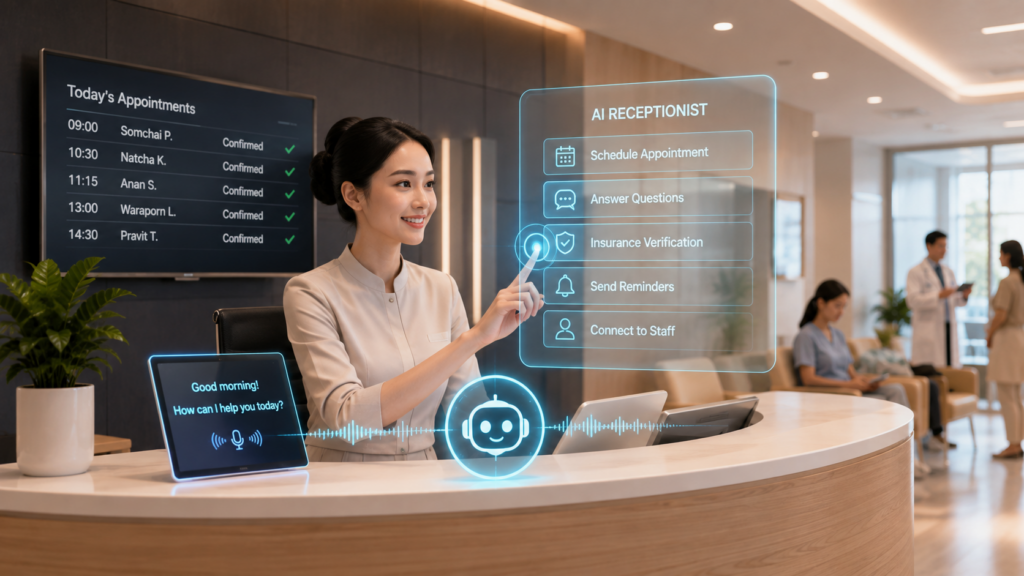
An AI receptionist is a virtual assistant powered by artificial intelligence that answers incoming phone calls, interacts with patients using natural language, and performs routine administrative tasks without human intervention. In healthcare settings, it can book, reschedule, or cancel appointments, answer frequently asked questions, provide clinic information, send appointment reminders, and route urgent calls to the appropriate staff member. Unlike traditional IVR systems that rely on fixed menu options, AI receptionists understand conversational speech, making patient interactions faster and more intuitive.
For hospitals and clinics, an AI receptionist serves as an extension of the front desk rather than a replacement for staff. It helps reduce missed calls, shortens patient wait times, and provides 24/7 availability, allowing reception teams to focus on in-person patient care and complex inquiries. When integrated with scheduling software or electronic health records (EHRs), AI receptionists can streamline appointment management while supporting secure and compliant handling of patient information, making them a valuable administrative tool for modern healthcare practices.
Leading AI Receptionist Companies in Thailand
Healthcare providers in Thailand are increasingly exploring AI receptionists to improve patient communication, reduce administrative workload, and deliver round-the-clock support. Below are some of the leading AI receptionist companies marketed toward Thai healthcare organizations, compared based on their features, healthcare expertise, multilingual capabilities, and publicly documented presence in the region.
1. MantraAssist
Best for: Clinics and hospitals seeking healthcare-focused voice, SMS, and chat automation with EHR integration from a company listing a Bangkok office.
MantraAssist is an AI-powered patient communication platform built specifically for healthcare organizations. The platform automates patient interactions across voice, SMS, and chat, helping clinics manage appointment scheduling, reminders, patient intake, and follow-up communication through a single system. It also lists Bangkok among its office locations, providing a publicly documented connection to Thailand.
One of MantraAssist’s key strengths is its FHIR-based EHR integration. This allows healthcare providers to connect appointment scheduling and patient communication directly with existing healthcare systems instead of managing separate administrative workflows. The platform is designed to streamline front-desk operations while improving patient access.
According to the company, MantraAssist reduces missed appointments through automated reminders, fills cancelled appointment slots more efficiently, prevents double bookings, and automates a significant proportion of routine patient enquiries. It also offers specialty-specific workflows for areas such as dermatology, orthopedics, and OB-GYN, allowing hospitals and clinics to tailor patient communication to their clinical requirements.
While MantraAssist demonstrates strong healthcare expertise and a documented presence in Bangkok, healthcare providers should verify Thai-language conversational accuracy, local implementation support, data hosting arrangements, and PDPA compliance directly with the vendor before deployment. These factors are particularly important for organizations handling sensitive patient information within Thailand’s regulatory framework.
Key Features:
- AI-powered voice, SMS, and chat automation
- Appointment scheduling and reminders
- FHIR-based EHR integration
- Patient intake and follow-up workflows
- Specialty-specific workflows (Dermatology, Orthopedics, OB-GYN)
- Automated patient enquiry handling
- Healthcare-focused platform
- Multilingual patient communication
2. Lyngo AI
Best for: Allied health clinics using Cliniko, Nookal, or PracSuite that want a healthcare-focused AI phone receptionist, despite the lack of a confirmed Thailand presence.
Lyngo AI is a healthcare-focused AI phone receptionist developed in Sydney, Australia. Unlike many AI voice platforms that serve multiple industries, Lyngo AI is built specifically for medical and allied health practices. It helps clinics automate patient communication while integrating directly with practice management software.
The platform integrates with Cliniko, Nookal, and PracSuite, allowing clinics to book, reschedule, and cancel appointments directly within their existing systems. It also answers incoming patient calls, confirms bookings, routes urgent or clinically sensitive enquiries to staff, and reduces missed calls during busy periods. According to the company, Lyngo AI currently supports more than 1,500 clinicians.
Lyngo AI emphasizes healthcare data security and highlights compliance with Australia’s Privacy Act, New Zealand’s Privacy Act, the Health Information Privacy Code, and GDPR for its supported markets. The company also states that its technology is built in-house rather than relying on multiple third-party voice AI services, giving it greater control over performance and the patient experience.
One limitation for healthcare providers in Thailand is the lack of publicly documented Thailand-specific deployments, Thai-language support, or PDPA compliance information. However, clinics already using Cliniko, Nookal, or PracSuite may find its deep software integrations particularly valuable. Before deployment, organizations should verify Thai-language accuracy, local implementation support, data hosting arrangements, and PDPA compliance directly with the vendor.
Key Features:
- AI phone receptionist for healthcare
- Appointment booking, rescheduling, and cancellations
- Integrations with Cliniko, Nookal, and PracSuite
- Intelligent call routing and escalation
- Healthcare-focused voice automation
- Built-in privacy and security controls
- Supports over 1,500 clinicians
- Practice management software integration
3. HuskyVoiceAI
Best for: Multilingual clinics seeking an affordable AI voice receptionist with publicly documented Thailand support.
HuskyVoiceAI is an AI voice automation platform developed by AppEQ Inc. Although it serves multiple industries, healthcare is one of the sectors where it actively promotes appointment booking, patient communication, and automated call handling. The platform is designed to reduce front-desk workloads by managing routine patient interactions while allowing staff to focus on more complex requests.
One of HuskyVoiceAI’s key strengths is its multilingual capability. According to the company, the platform supports more than 30 languages, including Thai, and lists Thailand among its supported markets. This makes it a practical option for clinics serving both residents and international patients. By communicating in multiple languages, the platform can help improve accessibility while reducing communication barriers.
The platform automates common administrative tasks such as answering patient calls, booking and confirming appointments, sending reminders, routing urgent calls, and delivering WhatsApp notifications. Public pricing starts at around $99 per month, making it a relatively accessible option for smaller clinics and healthcare practices exploring AI-powered voice automation.
HuskyVoiceAI also highlights GDPR, SOC 2, and ISO 27001 certifications, demonstrating its focus on data security and privacy. However, healthcare providers in Thailand should verify Thai-language accuracy, PDPA compliance, data hosting arrangements, and local implementation support directly with the vendor before deployment to ensure the platform meets their operational and regulatory requirements.
Key Features:
- AI voice receptionist
- Multilingual support (30+ languages, including Thai)
- Appointment booking and confirmations
- Automated reminders and WhatsApp notifications
- AI call routing
- Voice automation for patient enquiries
- Public pricing starting around $99/month
- GDPR, SOC 2, and ISO 27001 certifications
Comparison Table: AI Receptionist Companies Serving Thailand
| Platform | Best For | Primary Focus | Industry Focus | Deployment |
|---|---|---|---|---|
| MantraAssist | Hospitals and multi-specialty clinics | AI-powered patient communication and healthcare workflow automation | Healthcare | Cloud |
| Lyngo AI | Clinics using Cliniko, Nookal, or PracSuite | AI phone receptionist with practice management integration | Healthcare | Cloud |
| HuskyVoiceAI | Multilingual clinics and healthcare practices | AI voice receptionist and appointment automation | Healthcare | Cloud |
How to Choose the Right Provider for Your Business
Every healthcare provider has different operational needs. Evaluate healthcare integrations, multilingual support, data security, and PDPA compliance before choosing an AI receptionist.
Choose MantraAssist
If you’re looking for a healthcare-focused platform with voice, SMS, and chat automation that integrates with EHR systems. Its publicly listed Bangkok office provides a documented local presence, making it an attractive option for Thai healthcare organizations. Before deployment, confirm Thai-language performance, implementation support, and PDPA-specific documentation directly with the company.
Choose Lyngo AI
If your clinic already relies on platforms such as Cliniko, Nookal, or PracSuite and values deep healthcare software integration. Although its healthcare expertise is well established, the company does not publicly document operations in Thailand, so testing Thai-language capabilities and discussing PDPA compliance should be part of the evaluation process.
Choose HuskyVoiceAI
If multilingual communication and affordability are your top priorities. The platform publicly lists Thailand as a supported market and identifies Thai as one of its supported languages, making it a practical choice for clinics serving both local and international patients. However, healthcare providers should still request PDPA-specific compliance information and verify how patient data is processed and stored.
Conclusion
AI receptionists are becoming valuable administrative tools for healthcare organizations looking to improve patient communication, reduce missed calls, and ease the workload on front-desk staff. However, choosing the right platform requires balancing functionality with regulatory compliance and regional suitability. Features such as appointment scheduling, multilingual support, healthcare integrations, and secure handling of patient information should all be considered alongside pricing.
Among the providers reviewed, MantraAssist and HuskyVoiceAI have the strongest publicly documented connection to Thailand. MantraAssist lists a Bangkok office, while HuskyVoiceAI identifies Thailand as a supported market and includes Thai among its supported languages. Lyngo AI is an established healthcare AI provider with proven capabilities in other regions, but its publicly available information currently focuses on markets such as Australia, New Zealand, Europe, the United States, and Canada rather than Thailand.
Regardless of which platform you choose, compliance should remain a top priority. Since Thailand’s Personal Data Protection Act (PDPA) governs the handling of patient information, healthcare providers should request clear documentation covering data security, storage practices, breach response procedures, and compliance measures before implementation. Taking the time to evaluate both operational capabilities and regulatory readiness will help ensure that your AI receptionist improves patient experience while supporting safe, efficient, and compliant healthcare operations.
Frequently Asked Questions
Many AI receptionist platforms are designed to integrate with appointment scheduling systems, electronic health records (EHRs), and practice management software. The level of integration varies by provider, so healthcare organizations should confirm compatibility with their existing systems before implementation to avoid workflow disruptions.
Healthcare organizations should look for healthcare-specific functionality, multilingual support, seamless integration with EHR or practice management software, reliable appointment scheduling, secure data handling, and compliance with Thailand’s Personal Data Protection Act (PDPA). It’s also advisable to evaluate customer support, implementation assistance, and the vendor’s experience serving healthcare organizations.
Implementation timelines depend on the provider, the complexity of integrations, and the size of the healthcare organization. A basic deployment may take only a few days, while larger hospitals requiring EHR integration, workflow customization, staff training, and compliance reviews may need several weeks before the system is fully operational.
Many AI receptionist platforms are designed to integrate with appointment scheduling systems, electronic health records (EHRs), and practice management software. The level of integration varies by provider, so healthcare organizations should confirm compatibility with their existing systems before implementation to avoid workflow disruptions.
Healthcare organizations should look for healthcare-specific functionality, multilingual support, seamless integration with EHR or practice management software, reliable appointment scheduling, secure data handling, and compliance with Thailand’s Personal Data Protection Act (PDPA). It’s also advisable to evaluate customer support, implementation assistance, and the vendor’s experience serving healthcare organizations.
Implementation timelines depend on the provider, the complexity of integrations, and the size of the healthcare organization. A basic deployment may take only a few days, while larger hospitals requiring EHR integration, workflow customization, staff training, and compliance reviews may need several weeks before the system is fully operational.

