
A clinic in Osaka once answered only 18% of the 20,000 calls it received in a single day before adopting AI phone automation. While this may seem surprising, it highlights a much larger challenge facing healthcare providers across Japan. Rising patient demand, an aging population, and ongoing workforce shortages are making it increasingly difficult for hospitals and clinics to manage front-desk operations efficiently, making AI Receptionist Companies in Japan an increasingly relevant solution.
Moreover, the pressure extends beyond healthcare. Businesses across Japan are looking for smarter ways to manage customer calls, appointment requests, and routine inquiries without increasing administrative costs. As a result, AI receptionist companies in Japan are helping organizations automate customer communication, improve response times, and provide reliable 24/7 support.
Against this backdrop, AI receptionists are transforming how businesses handle customer interactions. They answer inbound calls, understand natural spoken Japanese, automate appointment scheduling, and route inquiries to the right person. In addition, many platforms support multilingual communication and integrate with existing business systems, making them suitable for organizations with diverse customer needs.
The platforms below represent some of the leading companies in Japan. Each has been evaluated based on publicly available product information, documented features, customer deployments, and real-world use cases where available. Use this comparison to identify the AI receptionist platform that best fits your business needs, operational requirements, and budget.
What Is an AI Receptionist?
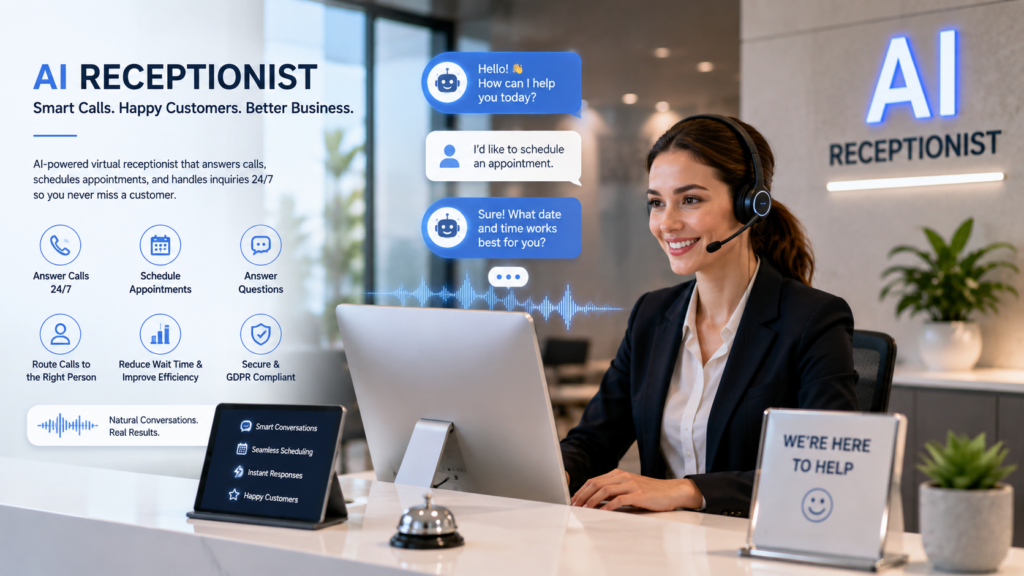
An AI receptionist is a voice-powered virtual assistant that answers inbound calls, understands the caller’s request using natural language processing, and automates routine front-desk tasks. It can schedule or reschedule appointments, answer frequently asked questions, take messages, route calls to the right department, and provide 24/7 customer support without requiring a human receptionist.
Unlike traditional IVR systems that rely on fixed menus, AI receptionists hold natural, human-like conversations. They understand the caller’s intent, handle interruptions, and complete tasks by integrating with scheduling, CRM, or business management systems. In Japan, support for natural spoken Japanese, regional dialects, and culturally appropriate communication is essential. As a result, businesses can improve customer satisfaction, reduce missed calls, and streamline front-desk operations while maintaining a consistent customer experience.
The Future of Front Desk Operations: Top AI Receptionist Companies in Japan
Japan’s growing demand for automation has accelerated the adoption of AI-powered receptionists across healthcare, retail, hospitality, and professional services. Businesses are using conversational AI to answer calls, schedule appointments, respond to customer inquiries, and reduce the administrative workload placed on front-desk teams. As customer expectations continue to evolve, organizations are increasingly looking for AI solutions that can deliver fast, natural, and reliable support in Japanese.
The platforms below represent some of the leading AI receptionist companies in Japan. While some specialize in healthcare automation and patient communication, others focus on conversational AI, customer engagement, or enterprise communication. Each platform has been evaluated based on publicly available product information, documented capabilities, customer use cases, and overall suitability for organizations operating in Japan.
1. MantraAssist
Best for: Healthcare providers, clinics, hospitals, and wellness organizations
MantraAssist is an AI-powered front-desk automation platform built specifically for healthcare organizations. It automates patient communication across voice, SMS, email, and chat, helping providers manage appointment scheduling, reminders, cancellations, patient inquiries, and post-visit follow-ups from a single platform.
A key differentiator is its healthcare-first architecture. MantraAssist integrates with electronic health records using FHIR standards, enabling real-time patient data synchronization without manual entry. According to the company, the platform handles up to 95% of routine patient inquiries 24/7, helping reduce wait times, eliminate voicemail queues, and save front-desk staff 2–3 hours per day.
For healthcare organizations in Japan looking to modernize patient communication, MantraAssist offers one of the most comprehensive AI receptionist solutions. However, providers should confirm local data hosting arrangements and compliance with Japan’s healthcare privacy and data protection requirements before deployment.
Key Features:
- AI-powered patient communication
- Appointment scheduling and reminders
- FHIR-based EHR integration
- Healthcare workflow automation
- Multi-channel communication
- 24/7 patient support
2. Dr. Joy
Best for: Small businesses and service organizations
Dr. Joy provides AI-powered virtual receptionist capabilities that help businesses automate customer communication, reduce missed customer calls, and improve responsiveness. The platform supports inbound call handling, appointment scheduling, FAQ automation, lead qualification, and call routing, allowing organizations to provide customer support around the clock.
Its automation capabilities make it suitable for businesses that receive frequent customer inquiries but want to reduce the workload on reception and customer service teams. By managing routine interactions automatically, businesses can improve response times while ensuring every inquiry receives attention.
Organizations evaluating Dr. Joy should review its available integrations, deployment options, and Japanese-language performance to determine whether it aligns with their operational requirements.
Key Features:
- 24/7 AI call answering
- Appointment management
- FAQ automation
- Lead qualification
- Intelligent call routing
- Customer inquiry management
3. Wellvill
Best for: Organizations exploring emerging conversational AI solutions
Wellvill represents a newer generation of AI-powered customer engagement platforms. Although publicly available information about its AI receptionist capabilities remains limited, the company reflects the broader trend of Japanese businesses adopting conversational AI to improve customer interactions and automate routine communication.
Because product information is limited, organizations should request a live demonstration and verify language support, integrations, deployment options, and AI receptionist functionality before implementation.
For businesses willing to evaluate emerging technologies, Wellvill may provide opportunities to customize conversational AI experiences based on their specific operational requirements.
Key Features:
- Conversational AI
- Customer engagement
- Flexible deployment
- Integration options
- Scalable architecture
- Verify capabilities with vendor
4. Mirai AI
Best for: Enterprises and customer service operations
Mirai AI focuses on conversational AI solutions that help businesses automate customer support and manage high inquiry volumes more efficiently. The platform enables organizations to answer common questions, assist customers with bookings, and improve service consistency without increasing staffing levels.
Its conversational AI technology is designed to create natural customer interactions while reducing repetitive work for support teams. This makes Mirai AI particularly suitable for enterprises, contact centers, and organizations handling large volumes of customer inquiries.
Businesses evaluating Mirai AI should assess available integrations, deployment flexibility, and Japanese-language performance to ensure it meets their customer service objectives.
Key Features:
- Conversational AI
- Customer support automation
- Call center applications
- Japanese-language support
- Cloud deployment
- Scalable customer engagement
5. MediaLink
Best for: Businesses seeking an AI-powered communication and customer engagement platform
MediaLink provides communication technology solutions that help businesses improve customer engagement and operational efficiency. As organizations continue investing in digital transformation, AI-powered communication tools have become an increasingly important part of delivering responsive customer service.
The platform supports voice communication and customer engagement capabilities that can complement broader communication strategies. Organizations should evaluate its AI functionality, integration capabilities, deployment options, and scalability based on their operational requirements.
For businesses looking beyond a traditional AI receptionist and toward a broader communication ecosystem, MediaLink offers a solution worth considering.
Key Features:
- Voice communication
- Customer engagement
- CRM integration
- Scalable deployment
- Security features
- Communication infrastructure
Comparison Table: AI Receptionist Companies in Japan
| Platform | Best For | Primary Focus | Language Support | Deployment |
|---|---|---|---|---|
| MantraAssist | Healthcare providers, clinics, hospitals, and wellness organizations | AI-powered patient communication and healthcare workflow automation | Multilingual | Cloud |
| Dr. Joy | Small businesses and service organizations | AI call answering, appointment scheduling, and customer inquiry management | Japanese | Cloud |
| Wellvill | Organizations evaluating emerging AI customer engagement solutions | Conversational AI and customer engagement | Verify with vendor | Verify with vendor |
| Mirai AI | Enterprises and customer support teams | Conversational AI and customer service automation | Japanese | Cloud |
| MediaLink | Businesses seeking communication technology solutions | Voice communication and AI-powered customer engagement | Verify with vendor | Cloud |
How to Choose the Right AI Receptionist for Your Business
The right AI receptionist depends on your industry, call volume, Japanese-language capabilities, integration requirements, and budget. Choose a platform that aligns with your operational needs while delivering reliable customer communication and automation.
Go with MantraAssist
If you run a healthcare organization and need AI-powered patient communication, appointment scheduling, reminders, and healthcare workflow automation. It is best suited for clinics and hospitals looking to reduce administrative workload while improving patient engagement.
Go with Dr. Joy
If you operate a customer-facing business that needs 24/7 AI call answering, lead qualification, appointment management, and FAQ automation. It is a practical option for organizations that want to improve responsiveness without expanding front-desk staff.
Go with Wellvill
If you’re interested in exploring emerging conversational AI technologies and are comfortable conducting additional product evaluation. Request a live demonstration and verify language support, integrations, and AI receptionist capabilities before deployment.
Go with Mirai AI
If you manage a high-volume customer service operation and need scalable conversational AI. It is well suited for enterprises looking to automate routine inquiries while improving response efficiency.
Go with MediaLink
If you’re looking for broader communication technology solutions with AI-powered customer engagement. Evaluate its AI functionality, integration capabilities, and deployment options to determine whether it fits your business requirements.
Conclusion
Japan’s aging population, workforce shortages, and growing demand for digital customer service are accelerating the adoption of AI receptionists across healthcare and other industries. By automating call handling, appointment scheduling, and routine customer inquiries, these solutions help organizations improve operational efficiency while delivering faster and more consistent customer experiences.
Among the platforms reviewed, MantraAssist stands out for healthcare providers seeking AI-powered patient communication and workflow automation. Mirai AI is well suited for enterprises managing high customer inquiry volumes, while Dr. Joy offers practical call automation for small businesses and service organizations. Organizations considering Wellvill and MediaLink should conduct additional due diligence to verify AI receptionist capabilities, language support, integrations, and deployment options before implementation.
As AI adoption continues to grow across Japan, investing in the right AI receptionist can help businesses reduce administrative workloads, improve customer satisfaction, and stay competitive in an increasingly digital and service-driven economy.
Frequently Asked Questions
Yes, but capabilities vary by provider. Healthcare-focused platforms such as MantraAssist and conversational AI platforms like Mirai AI support natural Japanese-language interactions for many routine inquiries. Businesses should still evaluate language accuracy, industry workflows, and real-world performance before deployment.
Pricing varies significantly depending on the provider, implementation scope, integrations, and monthly usage requirements. MantraAssist, Dr. Joy, and several other AI receptionist providers typically offer custom pricing based on organizational size and communication volume. Some platforms may also include usage-based fees, while others operate on fixed monthly subscriptions. Businesses should request customized quotes and evaluate total ownership costs, including setup, integrations, support, and scaling requirements.
Yes, provided organizations choose vendors that follow appropriate security, privacy, and compliance standards. Businesses should ensure that AI receptionist providers have robust data protection measures, secure infrastructure, and clear privacy policies. Healthcare organizations, in particular, should verify that the platform can securely handle patient information and supports Japan’s relevant data protection and healthcare privacy requirements. Before deployment, it is recommended to review data handling practices, hosting arrangements, and security certifications directly with the vendor.

