
What happens when every patient call matters, but your front desk cannot answer them all? In the Netherlands, where every resident must register with a general practitioner (GP) before accessing most specialist care, the front desk is the foundation of the patient journey. However, rising patient demand, limited administrative capacity, and growing expectations for faster service mean that clinics often struggle to manage appointment requests, prescription renewals, referrals, and routine patient inquiries efficiently. For this reason, AI receptionist companies in Netherlands are becoming an important option for clinics looking to handle patient communication more efficiently.
At the same time, healthcare providers must comply with one of Europe’s strictest regulatory environments. Patient health information is protected under Article 9 of the GDPR and Dutch healthcare legislation, while the EU AI Act requires AI systems to inform callers whenever they are interacting with an automated assistant. As a result, compliance, secure data handling, and accurate Dutch-language communication have become essential requirements for any AI-powered patient communication platform.
Against this backdrop, AI receptionist companies in the Netherlands are helping healthcare providers modernize front-desk operations with 24/7 call answering, intelligent appointment scheduling, multilingual patient support, and workflow automation. Whether serving a small general practice or a large hospital network, these platforms help improve patient access, reduce administrative workloads, and deliver a more responsive healthcare experience.
What Is an AI Receptionist?
An AI receptionist is a voice-based or multichannel system that handles inbound patient or customer calls automatically – understanding the caller’s concern in natural language and taking the appropriate next step: booking or rescheduling an appointment, answering a question about clinic hours or services, processing a repeat prescription request, or routing an urgent call to a human staff member.
Unlike IVR phone trees, modern AI receptionists hold genuine conversations. They handle interruptions, follow the caller’s train of thought, and complete the task – including writing the outcome into a structured log or, where integration is available, directly into the clinic’s scheduling or CRM system. For the Dutch market, native Dutch-language accuracy, GDPR compliance, EU AI Act transparency obligations (disclosure at start of the call that the caller is speaking with an AI), and compatibility with Dutch healthcare administration systems are the baseline requirements for any healthcare deployment.
24/7 Patient Support: AI Receptionist Companies in the Netherlands
Healthcare providers across the Netherlands are increasingly adopting AI receptionists to streamline patient communication, manage appointment requests, and reduce administrative workloads. The leading AI receptionist companies in the Netherlands help clinics and healthcare organizations deliver 24/7 call handling, faster response times, and improved patient access while enhancing operational efficiency.
1. MantraAssist
Best for: Hospitals, multi-specialty clinics, and healthcare providers needing deep EHR integration with 24/7 multilingual patient communication
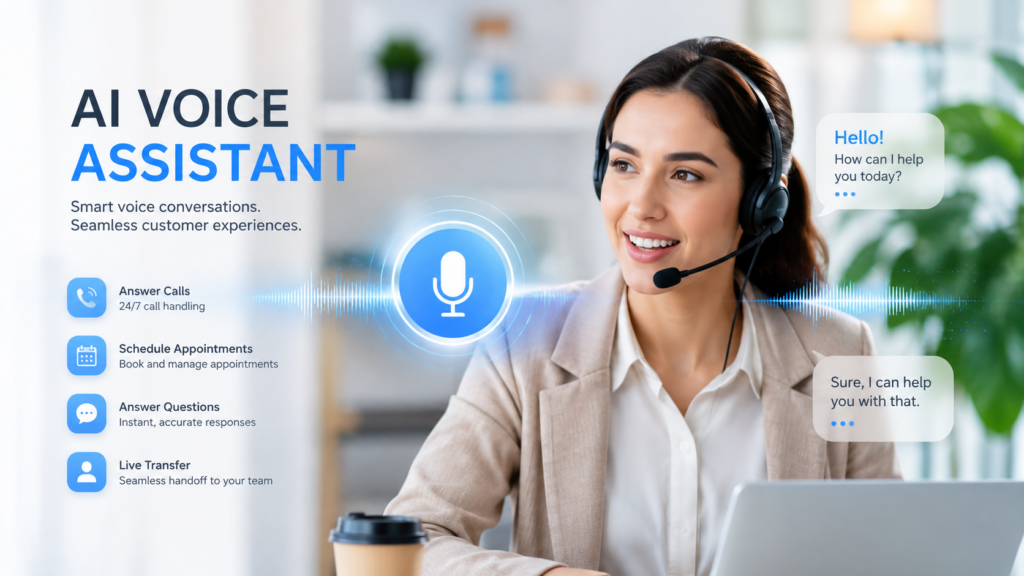
MantraAssist automates calls, intake, and scheduling for clinics using AI voice agents, with 500+ healthcare partners globally.
The platform handles 95% of patient inquiries 24/7, eliminating wait times, voicemails, and IVRs for faster support. It prevents double-bookings, fills last-minute cancellations, sends proactive reminders to reduce no-shows, integrates with EHRs via FHIR standards to automate patient intake and record updates, and is designed to cut administrative workload by 2–3 hours per FTE while reducing burnout and turnover.
Beyond scheduling and communication, the platform automates prior authorizations, prescription checks, and approvals – reducing delays and preventing errors that typically require manual staff time. The platform covers the full patient journey, from first inquiry through post-visit follow-up, across voice, SMS, email, and chat, with specialty-specific workflows spanning OB-GYN, orthopedics, mental health, and urgent care, and multilingual support across 80+ languages on the broader platform.
Key Features:
- 24/7 patient call handling across voice, SMS, and chat
- EHR integration via FHIR standards with real-time read/write capability
- Appointment scheduling, no-show reminders, and cancellation management
- Prior authorization and prescription check automation
- Specialty workflow support across multiple clinical areas
- $15M Series A from Impanix Capital; 500+ global healthcare partners
2. Vocca
Best for: Healthcare clinics – including dental practices, imaging centers, hospitals, and ophthalmology practices – wanting a purpose-built, GDPR and SOC2-compliant AI medical receptionist with specialty-specific clinical vocabulary
Vocca is a healthcare-focused AI receptionist platform that stands out among AI receptionist companies in the Netherlands for its specialization in medical and hospital workflows. The company states that its platform has handled millions of patient calls across hundreds of practices and thousands of healthcare providers. Built to HIPAA, GDPR, and SOC 2 standards, Vocca keeps patient data within the customer’s region, applies strict access controls, and does not use patient data to train its AI models.
What differentiates Vocca is its healthcare-specific AI. The platform understands clinical terminology and adapts to each specialty, applying customized scheduling logic, eligibility rules, and communication workflows for dental clinics, imaging centers, ophthalmology practices, and hospital networks. It also supports 100+ simultaneous calls, integrates with calendars and CRM systems, and communicates through phone, SMS, and WhatsApp. According to the company, Vocca can save up to four hours of receptionist time per day, and a documented deployment at a hospital center in the Paris region increased the call answer rate from 30% to 100%, demonstrating its ability to improve patient access and front-desk efficiency.
Key Features:
- Healthcare-specialist AI receptionist with specialty-specific clinical vocabulary across dental, imaging, ophthalmology, hospitals, and more
- 100+ simultaneous calls; 24/7 inbound and outbound call handling
- Automated appointment reminders to reduce no-shows; up to 4 hours saved per receptionist daily
- HIPAA, GDPR, and SOC2 compliant; data stays in region; never used to train AI models
- Degressive per-call pricing; 50%+ cheaper than outsourcing
- Connects via phone, SMS, and WhatsApp; integrates with calendars, CRMs, and specialty PMS platforms
3. Kore.ai
Best for: Enterprise healthcare organizations and large Dutch hospital networks wanting a Global 2000-validated agentic AI platform for contact center automation
Kore.ai is an enterprise agentic AI platform trusted by nearly 500 Global 2000 companies and recognized as a leader in the Gartner Magic Quadrant for Conversational AI Platforms. The company serves enterprise clients including Coca-Cola, Airbus, Roche, and AT&T, and operates a global network of offices spanning India, the UK, the Middle East, Japan, South Korea, and Europe.
In healthcare, Kore.ai’s AI agents handle scheduling, billing inquiries, and prescription refills, enhancing patient experience and freeing care teams from routine coordination. The platform’s agent architecture supports end-to-end patient interaction workflows – automating routine tasks from appointment scheduling and reminders to lab and pharmacy queries, providing support beyond standard clinic hours, with seamless escalation to human teams for more complex needs. Its no-code/low-code XO Platform allows technical and non-technical teams to design, deploy, and manage AI agents at enterprise scale without extended engineering lead times.
Kore.ai’s model-agnostic architecture gives organizations the flexibility to choose and switch between LLM providers – OpenAI, Azure AI, and others – without vendor lock-in. The platform integrates with AWS Amazon Bedrock, Amazon Connect, Microsoft Azure AI Foundry, Teams, and Copilot.
Key Features:
- Enterprise agentic AI; Gartner Magic Quadrant leader for Conversational AI Platforms
- AI agents for scheduling, billing, prescription refills, and patient intake
- No-code/low-code XO Platform for rapid deployment without engineering overhead
- Model-agnostic: supports multiple LLMs without vendor lock-in
- Integrated with AWS, Microsoft Azure, Amazon Connect, and Microsoft Teams
- Trusted by nearly 500 Global 2000 companies; regional European and Middle East presence
4. PolyAI
Best for: Large Dutch enterprises and hospital groups wanting a fully managed, enterprise-grade voice AI platform with independently validated ROI, Dutch-language support, and deployment handled by the vendor
PolyAI is an enterprise voice AI platform founded by researchers from the University of Cambridge. Recognized by Deloitte as the UK’s fastest-growing AI company in 2025, it is one of the AI receptionist companies in the Netherlands that large hospitals and healthcare organizations can consider for enterprise-scale voice automation. The platform supports 45 languages, including Dutch, and integrates with Epic and Cerner to automate patient intake, appointment scheduling, triage, and other routine patient interactions. It also meets SOC 2 Type II, ISO 27001, HIPAA, and GDPR standards.
PolyAI operates as a fully managed service, handling implementation, integration, and deployment on behalf of customers, with typical go-live timelines of around six weeks. According to the company, its AI agents can automate work equivalent to 1,000+ full-time employees, while independent research by Forrester reported a 391% return on investment for PolyAI customers over three years. This makes the platform a strong option for large healthcare providers seeking enterprise-grade voice AI with minimal internal technical overhead.
Key Features:
- Deloitte UK Technology Fast 50 2025: UK’s fastest-growing AI company; 248% growth over 3 years
- Forrester TEI Study: 391% ROI; $14.2M in value over 3 years for typical customers
- 45 languages, including Dutch; voice-first with barge-in and dialect handling
- Healthcare EHR integrations: Epic and Cerner; SOC 2 Type II, ISO 27001, HIPAA, GDPR
- Fully managed service: PolyAI builds, deploys, and maintains the agent; approximately 6 weeks to live
5. IntelePeer SmartAgent
Best for: Healthcare organisations at scale – dental networks, imaging centers, multi-location practices – wanting an agentic AI platform that covers the full patient journey from call answering through collections
IntelePeer’s SmartAgent AI Receptionist eliminates voicemail, long hold times, and abandoned calls with always-available, intelligent call handling. It reduces front-desk workload by up to 60% and allows staff to focus on complex or high-touch interactions. The platform delivers fast, accurate, and empathetic responses with voice-optimised AI that understands intent, handles errors gracefully, and escalates with full context when human support is needed.
What distinguishes IntelePeer from most platforms on this list is its scope across the complete patient revenue cycle. SmartAgent is an agentic AI platform that automates the entire patient journey – from scheduling and intake to collections and follow-up. It automates scheduling end-to-end and offers real-time availability, confirmations, reminders, and rescheduling. SmartAgent Collections accelerates revenue recovery with automated, compliant outreach, personalised payment reminders, secure payment options, and instant confirmations.
Documented results are substantial. Jefferson Dental’s 70+ locations used SmartAgent to reduce missed appointments and deliver seamless appointment management via voice, text, and digital channels. SimonMed saw data and voice costs fall by approximately $500K while expanding by around 70%. One dental group deployed SmartAgent Collections and captured over $7 million in collections in seven months, including $1.8 million from balances more than 180 days past due.
Key Features:
- 24/7 AI call handling; reduces front-desk workload by up to 60%
- End-to-end appointment management, including waitlist fill, reminders, and rescheduling
- SmartAgent Collections: automated patient financial outreach with 15–30% improved collection rates
- SmartAnalytics: post-visit pattern analysis, call reason tracking, and workflow optimisation
- Multilingual; integrates with existing patient management systems
- HIPAA and HITRUST-aligned; enterprise-grade security and compliance
Comparison Table: AI Receptionist Platforms for the Netherlands
| Platform | Best For | Primary Focus | Industry Focus | Deployment |
|---|---|---|---|---|
| MantraAssist | Hospitals, multi-specialty clinics, and healthcare providers | AI-powered patient communication and clinical workflow automation | Healthcare | Cloud |
| Vocca | Healthcare providers seeking a purpose-built AI medical receptionist | AI voice receptionist with specialty-specific clinical workflows | Healthcare | Cloud |
| Kore.ai | Large hospitals and enterprise healthcare organizations | Enterprise AI agents for scheduling, billing, and patient support | Healthcare & Enterprise | Cloud |
| PolyAI | Enterprise healthcare providers requiring managed voice AI | AI voice agents for patient intake, scheduling, and triage | Healthcare & Enterprise | Managed Cloud |
| IntelePeer SmartAgent | Large healthcare organizations needing end-to-end patient automation | AI-powered patient communication, scheduling, and revenue cycle automation | Healthcare | Cloud |
How to Choose the Right AI Receptionist for the Netherlands
Healthcare providers in the Netherlands have different operational needs, from small GP practices to large hospital networks. Selecting an AI receptionist with the right automation, compliance, and integration capabilities ensures long-term value and better patient experiences.
Choose MantraAssist
If you run a hospital or multi-specialty practice and need deep FHIR-based EHR integration alongside prior authorization automation and multilingual patient communication – and you are prepared to confirm Dutch-language support and GDPR compliance directly with the vendor.
Choose Vocca
If your priority is a healthcare-purpose-built platform with deep specialty clinical vocabulary, GDPR and SOC2 compliance, regional data storage, and documented results in European clinic deployments – particularly for dental, imaging, ophthalmology, or hospital environments.
Choose Kore.ai
If you manage a large Dutch hospital network or enterprise organisation and want a Global 2000-validated agentic AI platform with no-code deployment tools, model-agnostic architecture, and deep integration across AWS and Microsoft Azure. Engage the European regional team to confirm Dutch-language performance and local compliance.
Choose PolyAI
If you run a large enterprise or hospital group and want the highest-fidelity fully managed enterprise voice AI, built by Cambridge researchers, validated by independent Forrester ROI analysis, with Dutch confirmed in its 45-language set and a 99.9% SLA – and you want the vendor to build and operate the system entirely.
Choose IntelePeer SmartAgent
If you operate a large multi-location healthcare group that needs AI across the full patient revenue cycle – from call answering and scheduling through to collections – after confirming Dutch-language support and GDPR compliance requirements directly with the vendor.
Conclusion
The Netherlands’ AI healthcare market is operating under one of the world’s most demanding compliance frameworks – GDPR, the EU AI Act, and the Dutch Autoriteit Persoonsgegevens as an active enforcement authority – while simultaneously facing the same structural administrative bottleneck that drives AI receptionist adoption everywhere: too many calls, too few staff to answer them, and patients who simply stop trying.
The five platforms take different approaches to healthcare communication. Vocca stands out for healthcare specialization and GDPR compliance, and PolyAI delivers proven enterprise-scale performance. Meanwhile, MantraAssist, Kore.ai, and IntelePeer focus on enterprise healthcare workflows, automation, and patient engagement at scale.
None of these platforms eliminates the need for human staff. What they do is ensure that when a patient calls their huisarts at 6 PM on a Thursday – or during peak hours when every line is occupied – the call is answered, the booking is made, and the care journey begins without friction.
Frequently Asked Questions
Yes. Most healthcare-focused AI receptionists can book, reschedule, and cancel appointments automatically. They can also send reminders and confirmations, helping reduce administrative workloads and missed appointments.
No. AI receptionists are designed to handle routine administrative tasks and common inquiries. Human staff remains essential for managing complex requests, sensitive patient interactions, and situations that require judgment or personalized support.
Yes. One of the primary benefits of AI receptionists is 24/7 availability. They can answer calls, collect patient information, schedule appointments, and route urgent requests even when the clinic is closed.

