
Picture the average Monday morning at a mid-sized Indian clinic. The phone rings before the doors even open. By 10 AM, the front desk has fielded forty calls – appointment requests, reschedules, a patient asking whether their lab report is ready, and someone asking if the cardiologist is in today. The receptionist is one person. The calls keep coming. Somewhere in that crush, a patient gives up, hangs up, and calls the clinic down the road instead.
This is not a hypothetical. Many healthcare providers report that AI voice agents can automate a significant share of routine front-desk calls, helping reduce administrative workloads and improve patient access. The gap between patient demand and front-desk capacity is one of the most persistent operational problems in Indian healthcare – and it’s compounded by a doctor-to-patient ratio that already falls below global standards.
AI receptionists are the direct response. They answer every call – in Hindi, English, Hinglish, or a regional language – at 2 AM as readily as 2 PM. They book appointments, send WhatsApp confirmations, recover missed calls, and route emergencies to a human when it actually matters. For a healthcare system stretched this thin, that’s not a convenience. It’s capacity that didn’t exist before.
This article looks at seven AI receptionist platforms serving Indian healthcare providers today – what each one actually does, who it’s built for, and what’s been independently or company-verified about its results.
What Is an AI Receptionist?
An AI receptionist is a voice – or chat-based AI system that handles inbound patient communication automatically – answering calls or messages, understanding what the patient needs, and taking the next step without requiring a human on the line for every interaction.
Unlike old-style IVR menus (“Press 1 for appointments, Press 2 for billing”), today’s AI receptionists hold real conversations. They understand natural, mixed-language speech – including the Hindi-English code-switching common across urban and semi-urban India – ask clarifying questions, and complete the task: booking, rescheduling, sending a report, or escalating an urgent case to staff. The strongest platforms integrate directly with a clinic’s Hospital Management System (HMS) or EHR, support WhatsApp alongside voice, and operate around the clock without adding headcount.
How We Evaluated These AI Receptionist Platforms
To identify the leading AI receptionist companies serving healthcare providers in India, we evaluated each platform based on practical criteria that matter most to hospitals, clinics, and medical practices. Rather than relying solely on vendor claims, we assessed solutions on their ability to support real-world healthcare communication and operational efficiency. Our evaluation considered:
- AI call answering capabilities
- Appointment scheduling and booking automation
- Natural language conversation quality, including multilingual support
- Healthcare-specific features and workflow integration
- HMS, EHR, and third-party integrations
- Scalability for clinics, hospitals, and multi-location healthcare networks
- Patient experience and accessibility
- Overall business value and deployment flexibility
The Future of Front Desk Operations: Top AI Receptionist Companies in India
Healthcare providers across India are increasingly adopting AI receptionists to ensure every patient call is answered, appointments are scheduled efficiently, and routine inquiries are handled without overwhelming front-desk staff. From multilingual voice support and WhatsApp-based communication to HMS integration and automated appointment management, these platforms are helping clinics and hospitals improve patient experience while streamlining daily operations.
Below, we compare seven of the leading AI receptionist companies in India, highlighting their strengths, ideal use cases, and key features to help you choose the right solution for your healthcare organization.
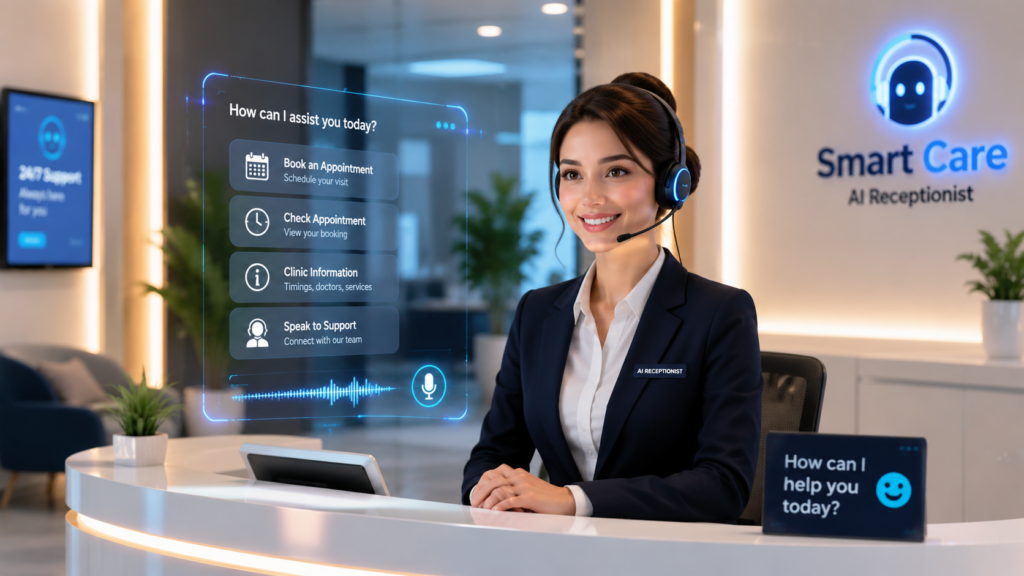
1. MantraAssist
Best for: Hospitals, clinics, and multi-specialty practices needing deep EHR-integrated patient communication
MantraAssist is a healthcare-focused AI automation platform headquartered in New Delhi, built to handle the full patient communication cycle – from first inquiry through post-visit follow-up – without requiring staff to answer every call manually. The company has raised $15 million in Series A funding from Impanix Capital and reports more than 500 healthcare partners globally.
The platform handles 95% of patient inquiries 24/7, eliminating wait times, voicemails, and IVRs for faster support, while preventing double-bookings and sending proactive reminders to reduce no-shows. Its clinical integration runs deep: MantraAssist connects with EHRs via FHIR standards, automating patient intake, record updates, and data accuracy, and also automates prior authorizations and prescription checks to reduce delays. For administrative staff, the platform is designed to cut administrative workload by 2–3 hours per FTE while reducing burnout and turnover – a meaningful claim in an Indian healthcare system already short-staffed.
MantraAssist supports a wide range of specialties, from OB-GYN to orthopedics to mental health, with workflow customization tailored to each. Pricing is not published; the company quotes custom plans based on practice size and integration scope.
Key Features:
- 24/7 patient call handling across voice, SMS, and chat
- EHR integration via FHIR standards
- Appointment scheduling and no-show reminders
- Prior authorization and prescription automation
- $15M Series A funding from Impanix Capital; 500+ global healthcare partners
- Pricing: custom – contact MantraCare for a quote
2. HuskyVoice.AI
Best for: Hospitals and clinics wanting a voice AI built specifically for Hindi, Hinglish, and regional Indian speech patterns
HuskyVoice.AI is positioned explicitly as an India-first voice AI receptionist – not a Western platform adapted for the Indian market. The company’s core pitch is that most voice systems are built for Western markets, and that Indian healthcare needs voice AI that feels local, familiar, and human, handling the mixed Hindi-English conversational style that real patients actually use on the phone.
The platform answers patient calls 24/7, books and reschedules appointments, sends WhatsApp confirmations, and provides India-based customer support rather than offshore ticketing. It’s built around real patient conversations rather than scripted menus – handling phrases like a patient asking about an ENT doctor’s availability or a price inquiry in natural, code-switched Hindi-English, and responding the way a trained human receptionist would. The platform serves hospitals, clinics, diagnostic centers, dental clinics, and specialty practices, and is deployed across multiple Indian cities including Delhi, Chennai, and Hyderabad, with city-specific configurations for local context.
Pricing starts at ₹1,999/month for the AI Receptionist plan, which includes an Indian mobile phone number and 100 AI credits, with a free trial available before committing and custom enterprise pricing for larger deployments.
Key Features:
- Built specifically for Hindi, Hinglish, and regional Indian language conversation
- 24/7 call answering with WhatsApp appointment confirmations
- India-based customer support (not offshore tickets)
- Optional HMS integration; encrypted voice calls and secure cloud infrastructure
- Scales from single-doctor clinics to multi-branch hospital networks
- Pricing: from ₹1,999/month, with a free trial available
3. Praktice.ai
Best for: Hospitals seeking AI-driven care navigation alongside voice-based lead conversion
Praktice.ai is a healthcare AI company founded in 2017, headquartered in Karnataka, India, operating in the healthcare sector with a team of approximately 50 people. The company builds two core products relevant to patient communication: Sarah, an AI-driven care assistant that automates care navigation, eligibility checks, referral management, and consultation and radiology test bookings; and PABX Falcon, a voice AI solution built specifically to convert inbound leads into booked patients.
PABX Falcon integrates directly with a healthcare facility’s existing landline phone system to navigate patient calls and answer queries, then understands the patient’s context to guide them through the relevant operational process – with follow-up activated through SMS via an advanced UI. The broader goal across both products is improving hospital operations so existing staff can treat more patients without proportionally increasing headcount, addressing the structural mismatch between patient demand and available clinical and administrative staff that defines much of Indian healthcare delivery today.
Praktice.ai has been recognized as a featured startup on the Indian government’s IndiaAI platform. Pricing is not publicly listed and is quoted directly to healthcare facilities based on deployment scope.
Key Features:
- Sarah: AI care navigation assistant for eligibility checks, referrals, and bookings
- PABX Falcon: voice AI that integrates directly with existing hospital landlines
- SMS-based follow-up UI for guiding patients through operational processes
- Founded in 2017, headquartered in Karnataka, India; ~50-person team
- Featured startup on IndiaAI (Government of India AI platform)
- Pricing: custom – contact Praktice.ai for a quote
4. AIOnCalls
Best for: Clinics and hospital chains wanting fast deployment and multilingual voice AI at scale
AIOnCalls, operated by Technoveda AI and based in Pune, Maharashtra, is an AI voice agent platform built to automate inbound and outbound calls at scale. The company states it is trusted by clinics and hospitals across India – including Mumbai, Pune, Delhi, and Bangalore – as well as healthcare providers in the UAE, UK, Canada, and Southeast Asia, with deployment typically completed in 24–48 hours.
The platform is explicitly positioned as purpose-built for healthcare rather than a generic AI tool retrofitted for the sector – built with end-to-end encryption, multilingual support, and clinical workflow training from day one. It’s designed to automate every repetitive patient interaction: booking appointments, answering clinical FAQs, and providing the same warm, accurate response whether a patient calls at 9 AM or 3 AM. Company-wide, AIOnCalls reports serving 500+ businesses across 30+ countries, supporting 90+ languages with 1,000+ voice styles, and handling 10,000+ concurrent calls – figures that apply across its full client base, not healthcare alone.
Pricing for the platform’s broader business plans starts at $49/month, though healthcare-specific deployments are typically scoped and quoted individually, given the clinical workflow training involved.
Key Features:
- Healthcare-specific build: end-to-end encryption, clinical workflow training
- Deployment typically completed in 24–48 hours
- Serves clinics and hospitals across India, the UAE, the UK, Canada, and Southeast Asia
- Multilingual support (90+ languages company-wide)
- Handles high call concurrency (10,000+ concurrent calls, platform-wide)
- Pricing: from $49/month for general plans; healthcare deployments quoted individually
5. Curefy
Best for: Independent practices and medical tourism providers needing combined CRM, lead management, and patient communication
Curefy began as a Delhi-based on-demand doctor consultation app, founded by Mayank Agarwal (Founder & CTO) and Raghav Seghal (Founder & CEO), with institutional backing from Catapooolt. It has since evolved into a HIPAA-compliant, AI-powered healthcare CRM and automation platform focused on patient management, communication, and revenue growth for clinicians and practice administrators.
Curefy’s AI receptionist function works inside this broader CRM: it captures patient inquiries from the clinic’s website, marketing campaigns, and inbound calls, then scores and routes them to the appropriate front-desk team member for handling – combining lead generation with patient communication in a single platform rather than requiring separate tools. The platform centralizes patient data, automates follow-up communication, and personalizes messaging across a patient’s full care journey, from first inquiry through treatment and post-visit follow-up.
A distinct strength is Curefy’s medical tourism functionality – the platform supports international patient discovery and connects overseas patients with partner hospitals, combining healthcare CRM, patient management, and marketing tools specifically for cross-border care coordination, including treatment planning and travel logistics from a unified dashboard. This makes it a relevant option for Indian hospitals and clinics that see meaningful inbound medical tourism volume, alongside standalone and small-to-mid-sized domestic practices.
Key Features:
- HIPAA-compliant healthcare CRM with integrated AI receptionist functionality
- Captures and scores leads from website, campaigns, and calls; routes to front desk
- Centralizes patient data and automates follow-up across the care journey
- Dedicated medical tourism workspace for cross-border patient coordination
- Founded in Delhi by Mayank Agarwal and Raghav Seghal, backed by Catapooolt
- Pricing: custom – contact Curefy for a quote
6. Tatkal Doctor
Best for: Multi-clinic networks wanting combined WhatsApp and Voice AI appointment automation with documented performance metrics
Tatkal Doctor, headquartered in Delhi, is a combined WhatsApp and AI Voice appointment system built specifically for Indian clinics and hospitals. The platform connects to WhatsApp via the official Meta Cloud API, letting patients book, reschedule, or cancel appointments, receive reports and prescriptions, and get automated reminders directly through WhatsApp rather than a separate app. More than 400 clinics use the platform to automate bookings on WhatsApp daily.
The Voice AI Agent side handles inbound calls in Hindi and English, with documented metrics from live clinic deployments: the AI handles 95% of routine calls autonomously, recognizes urgency in a patient’s tone and routes emergency calls to a live human agent, and routes calls automatically across 100+ clinics and departments without phone-menu navigation. Reported performance figures across the platform include a 31% reduction in no-shows, 63% of missed calls recovered through automatic WhatsApp re-engagement, and a 2.4x increase in follow-up bookings driven by sharing lab reports and recovery instructions over WhatsApp after visits.
Setup for large clinic networks typically takes one to two weeks, including configuration, testing, and staff training, and the system integrates with a clinic’s existing phone line without requiring hardware changes. Tatkal Doctor states it is HIPAA compliant and uses enterprise-grade encryption for patient data.
Key Features:
- WhatsApp appointment booking via official Meta Cloud API; 400+ clinics live
- Voice AI Agent handles 95% of routine calls autonomously in Hindi and English
- Documented results: 31% fewer no-shows, 63% of missed calls recovered, 2.4x more follow-up bookings
- Emergency-tone detection with automatic escalation to human staff
- Routes calls across 100+ clinics and departments with zero menu navigation
- HIPAA compliant; no-code dashboard for updating call flows
7. Voiceoc
Best for: Hospitals and multi-specialty clinics wanting an omnichannel AI receptionist across voice, chat, WhatsApp, and SMS
Voiceoc is a healthcare-focused conversational AI platform founded in 2019, built specifically for hospitals and clinics rather than adapted from a generic customer-service tool. It has been ranked among the “Top 30 startups” by Inc42, one of India’s leading startup media outlets. The platform’s defining feature is omnichannel reach: it engages patients across phone calls, website chat, WhatsApp, and SMS from a single backend, so patients can interact through whichever channel they already use.
Voiceoc integrates with a hospital’s HMS or EHR to book, reschedule, or cancel appointments without human intervention, and supports multilingual conversations spanning English, Spanish, and regional Indian languages. The platform leverages advanced language models, including GPT-4, to generate accurate, context-aware responses while maintaining clinical guardrails around verified medical information rather than open-ended generation. Company-reported results include reducing missed calls by up to 77% for some clients, and the voice product can intelligently shift a call to SMS mid-conversation when that channel better suits the patient’s need – useful for scheduling or report-related follow-ups that don’t require a live voice exchange.
Voiceoc is positioned for accessibility and patient convenience first, with strong omnichannel and multilingual depth; healthcare organizations needing heavier workflow automation or analytics on top of communication may want to evaluate this alongside platforms with deeper EHR-side automation.
Key Features:
- Omnichannel patient engagement: voice, website chat, WhatsApp, and SMS
- HMS/EHR integration for end-to-end appointment management
- Multilingual support, including English, Spanish, and regional Indian languages
- Built on advanced LLMs (including GPT-4) with clinical guardrails
- Company-reported results: up to 77% reduction in missed calls for some clients
- Recognized among Inc42’s “Top 30 startups”
Comparison Table: Leading AI Receptionist Companies in India
| Platform | Best For | Primary Focus | Industry Focus | Deployment |
|---|---|---|---|---|
| MantraAssist | Hospitals & multi-specialty clinics | Patient communication, appointment scheduling & EHR automation | Healthcare | Cloud |
| HuskyVoice.AI | Clinics & hospitals | Multilingual AI call answering & appointment booking | Healthcare | Cloud |
| Praktice.ai | Hospitals | Care navigation & AI voice lead conversion | Healthcare | Cloud |
| AIOnCalls | Clinics & hospital chains | AI voice automation & patient communication | Healthcare | Cloud |
| Curefy | Independent practices & medical tourism | Healthcare CRM with AI receptionist | Healthcare | Cloud |
| Tatkal Doctor | Multi-clinic networks | WhatsApp & Voice AI appointment automation | Healthcare | Cloud |
| Voiceoc | Hospitals & multi-specialty clinics | Omnichannel AI patient communication | Healthcare | Cloud |
How to Choose the Right AI Receptionist
The right platform depends on your facility’s size, patient language mix, existing phone infrastructure, and how deeply you want the AI to integrate with clinical systems.
Go with MantraAssist
If you run a hospital or multi-specialty practice and need deep EHR/FHIR integration alongside patient communication – particularly if prior authorization and prescription automation matter to your workflow.
Go with HuskyVoice.AI
If natural Hindi-Hinglish conversation quality is your top priority, and you want India-based support rather than an offshore-managed platform retrofitted for the Indian market.
Go with Praktice.ai
If your facility already has a landline-based phone system you want to keep, and you’re looking for combined care navigation (eligibility, referrals, bookings) alongside voice-based lead conversion.
Go with AIOnCalls
If speed of deployment matters most – the platform’s 24–48-hour setup window is faster than most alternatives – and you want a provider with an established multi-country healthcare footprint.
Go with Curefy
If you run an independent practice or a hospital with meaningful medical tourism volume and want a single platform combining CRM, lead scoring, and patient communication rather than separate tools.
Go with Tatkal Doctor
If WhatsApp is your patients’ primary channel and you want documented, clinic-level performance metrics on no-show reduction and missed-call recovery before committing.
Go with Voiceoc
If omnichannel reach is essential – patients moving fluidly between phone, WhatsApp, website chat, and SMS – and you want a platform with an established multilingual track record across English, Spanish, and Indian regional languages.
Conclusion
The question this article opened with isn’t rhetorical. Every missed call at an Indian clinic is a patient who either gave up or went elsewhere – and at scale, across a healthcare system already operating below capacity relative to patient demand, that adds up to real harm, not just lost revenue.
The seven platforms above represent genuinely different approaches to the same underlying problem: MantraAssist and Voiceoc lean into deep clinical-system integration and omnichannel reach; HuskyVoice.AI and Tatkal Doctor lean into India-specific language handling and WhatsApp-first patient behavior; Praktice.ai and AIOnCalls focus on fast, infrastructure-light deployment; Curefy folds the receptionist function into a broader CRM built around patient relationships and, distinctively, medical tourism.
None of them eliminates the need for human staff. What they do is make sure that when a patient calls – at 9 AM or 3 AM, in Hindi or English or somewhere in between – someone, or something, picks up.
Frequently Asked Questions
Pricing varies widely. HuskyVoice.AI starts at ₹1,999/month, including 100 AI credits and an Indian phone number. AIOnCalls’ general business plans start at $49/month, though healthcare-specific deployments are typically quoted separately. MantraAssist, Praktice.ai, Curefy, Tatkal Doctor, and Voiceoc all use custom, quote-based pricing tied to facility size, call volume, and integration scope.
Yes, to varying degrees. HuskyVoice.AI and Tatkal Doctor are both built specifically around natural Hindi-English conversation, including code-switching. Voiceoc supports English, Spanish, and regional Indian languages across its omnichannel platform. MantraAssist and AIOnCalls offer multilingual support as part of their broader global platforms. Always confirm specific regional language and dialect coverage with the vendor for your patient base.
MantraAssist integrates via FHIR standards. Voiceoc integrates with hospital HMS/EHR systems to manage appointments end-to-end. Praktice.ai’s PABX Falcon integrates directly with a facility’s existing landline infrastructure rather than requiring system replacement. Tatkal Doctor and AIOnCalls integrate with existing phone systems without requiring hardware changes. Confirm specific HMS/EHR compatibility with each vendor before committing.

